


“Right after I graduated, I interned with the Arms Control Association. It was terrific.”
Scientists Find Plutonium Pits Are ‘Aging Slowly’
September 2026
By Xiaodon Liang
The plutonium pits at the core of U.S. nuclear weapons are “aging slowly” and observable changes “do not call into question present weapons performance,” a panel of independent technical experts concluded.
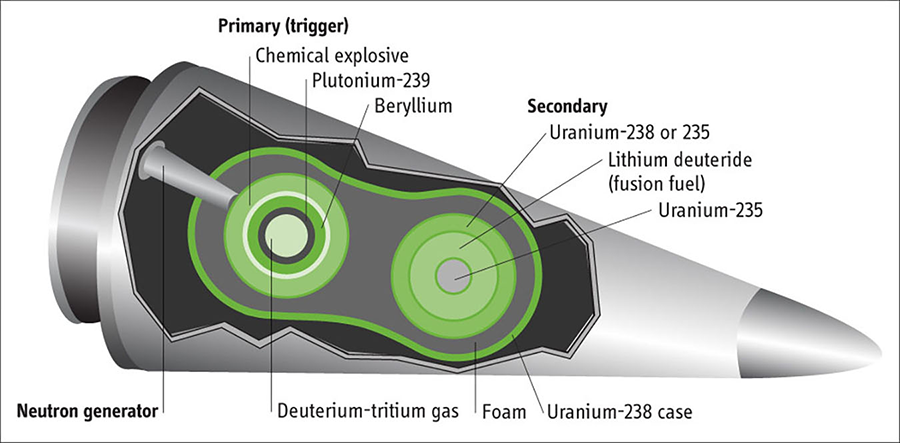
The JASON group of scientists, which has long served as independent advisers to the U.S. government, encourages the National Nuclear Security Administration (NNSA), however, to continue “establishing pit production capabilities that may be needed to provide options to mitigate any future aging-related issues.”
That recommendation was one of several in the executive summary of a JASON study completed in March. The group also called on NNSA to accelerate construction of the Scorpius machine, a linear accelerator that will create radiographic images of subcritical plutonium experiments.
By fiscal year 2030, the NNSA will be on track to better understand plutonium pit performance degradation as it continues executing a decade-long research plan into pit aging begun in 2021, the study predicted.
The NNSA released the unclassified executive summary Aug. 7 but has withheld the full report, which Congress commissioned in the fiscal year 2024 energy and water appropriations act.
The conclusions of the new JASON report may complicate the NNSA’s rationale for prioritizing resumption of large-scale plutonium pit production.
During the Cold War, the United States produced plutonium pits at scale at the Rocky Flats Plant in Colorado. After Rocky Flats closed in 1989, Los Alamos National Laboratories produced 31 pits for the W88 warhead program between 2007 and 2011.
The agency is currently executing a plan adopted in 2018 to produce 30 pits per year at Los Alamos and 50 per year at the future Savannah River Plutonium Processing Facility. Congress mandated in 2019 that the NNSA be able to produce 80 pits annually.
The JASON group last conducted a full study of plutonium aging in 2006, at which point it concluded that “most primary types have credible minimum lifetimes in excess of 100 years,” referring to the first stage of a nuclear weapon within which pits are a key component.
The executive summary to the new study notes that NNSA began observing “some aging effects” in 2010. The NNSA’s current plans for pit production were in part justified by a 2019 two-page abbreviated assessment by the JASON group of the state of research into plutonium aging, which called for pit production to be re-established “expeditiously.”
Although Trump administration officials expressed confidence earlier this year that plutonium pit production at Los Alamos could be accelerated to produce 100 pits by 2028, construction at Savannah River remains at an early stage. (See ACT, April 2026.)
In its fiscal 2027 budget request, the NNSA described a $25 billion working cost estimate for the Savannah River facility as a “budgetary placeholder.” (See ACT, June 2026).
The agency anticipates completion of the facility by between late 2031 and mid-2035. In February, the Government Accountability Office (GAO) reported that NNSA employees were skeptical of the timeline.
The GAO also said that contractor performance at Savannah River has been unsatisfactory, with delays and inadequacies in the delivery of designs. In February, NNSA decided to open for tender the next management and operating contract for the Savannah River Site, in a sign of frustration with the current consortium led by Fluor Corp. (See ACT, June 2026.)
The agency nonetheless exercised
an option Aug. 10 to extend the current contract for one year, through September 2027.
The NNSA said the move would “ensure continuity and stability of the contractor workforce” as it assesses bids.
U.S. Deputy Secretary of Energy James Danly also raised questions about the NNSA’s plutonium pit production plans in August 2025, tasking the Energy Department’s Office of Enterprise Assessments to conduct an internal review.
Danly set a Dec. 9 deadline for the process and Congress later instructed the NNSA in its fiscal 2026 energy and water appropriations act to provide a copy of the review report.
In July, the nonprofit organization Nukewatch New Mexico filed a Freedom of Information Act lawsuit in a bid to obtain the internal report.