


"I find hope in the work of long-established groups such as the Arms Control Association...[and] I find hope in younger anti-nuclear activists and the movement around the world to formally ban the bomb."
Fighting Mars U.S.-Iranian Pledges to End War, Restart Nuclear Talks
July/August 2026
By Kelsey Davenport
Iran and the United States announced a memorandum of understanding to end their war and begin new talks on a nuclear agreement, but negotiators face significant obstacles to a final deal, including a resurgence in fighting.
Pakistani Prime Minister Shehbaz Sharif announced June 14 on the social media platform X that the United States and Iran reached a peace agreement and that, “Both sides have declared the immediate and permanent termination of military operations on all fronts, including in Lebanon.”
The ceasefire broke down two weeks later when the United States blamed Iran for launching drone attacks on two vessels in the Strait of Hormuz and retaliated. Despite the strikes, the U.S. and Iranian negotiating teams conducted a second round of talks on implementing the memorandum in Doha June 30-July 1.
The United States and Israel initiated the 2026 war when they illegally attacked Iran Feb. 28, prompting retaliatory strikes by Iran that included targets in Gulf states. Several days later, Israel began attacking targets in Lebanon that it claims are tied to the Iranian-supported Hezbollah militia.
Pakistan helped broker an initial ceasefire between the United States and Iran April 8 and mediated talks on the memorandum.
Following Sharif’s announcement, U.S. President Donald Trump confirmed the deal in a June 14 post on Truth Social saying “Congratulations to all!” He announced that the Strait of Hormuz, a critical waterway for shipping oil and other commodities that Iran closed by targeting ships, was now open as a result of the memorandum.
Iranian Supreme Leader Ayatollah Mojtaba Khamenei said in a June 18 message shared with Iranian media that he “issued [his] permission” for Iran to sign the memorandum despite having a “different view” of what should be included. He warned that “in-person negotiations that will take place in the future will not mean acceptance of the enemy's position.”
Trump, in Versailles, and Iranian President Masoud Pezeshkian, in Tehran, signed the memorandum June 17. The next day, Pezeshkian called the memorandum an “historic document.” He wrote on X that “peace will be achieved in the shadow of mutual respect.”
The United States released the text of the 14-paragraph memorandum June 17. It said that the United States, Iran, and their allies “declare the immediate and permanent termination of military operations on all fronts, including in Lebanon, and undertake from now on not to initiate any war or military operation against each other, and to refrain from the threat or use of force against each other.”
Specifically on the nuclear program, the memorandum reaffirmed Iran’s commitment to never “procure or develop nuclear weapons.” It also noted that the United States and Iran “agreed to resolve the disposition of stockpiled, enriched material pursuant … with the minimum methodology to be down-blending on site” under International Atomic Energy Agency (IAEA) supervision. The issue of uranium enrichment and other nuclear issues would be negotiated as part of a final deal, according to the memorandum. In return, the United States committed to “terminate all types of sanctions against Iran,” including at the United Nations. It specified that U.S. primary and secondary sanctions on Iran would be included in the sanctions lifting.
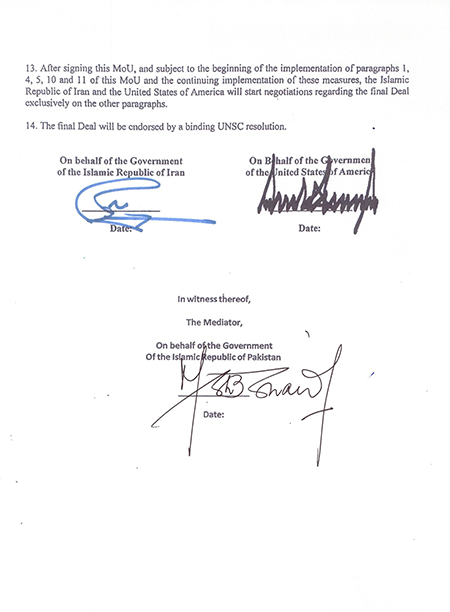
The memorandum committed the United States and Iran to negotiate a final nuclear deal “in maximum 60 days extendable with mutual consent.”
The agreement declared the immediate reopening of the Strait of Hormuz and committed Iran and Oman to “define the future administration and maritime services” through that waterway, in discussion with other regional states. Before the war, the Strait of Hormuz was an open waterway, but Iran now seeks to profit from it.
The memorandum includes a commitment to establish a fund to rebuild Iran and requires that the United States issue waivers for Iranian oil sales. The U.S. Treasury Department quickly issued a license for Iran to sell oil and other petrochemical products through Aug. 21.
Although Vice President JD Vance, who was deeply involved in the memorandum negotiations, repeatedly stated that Iran does not receive any unilateral benefits, the upfront sanctions relief and vague nuclear commitments spurred bipartisan criticism of the memorandum as a win for Iran.
Reaching a final agreement in 60 days will be challenging, as negotiators appear far apart on key issues and will likely face opposition.
Although the memorandum references Iran, the United States, and “their allies,” Israeli Prime Minister Benjamin Netanyahu said his country is not bound by the interim deal. He said June 14 that Israeli troops “will remain in the security zone in southern Lebanon for as long as necessary” to protect against Hezbollah attacks. Netanyahu also continues to reiterate that Iran must give up its entire nuclear program as part of any agreement.
Trump wrote June 18 on Truth Social that he expects a “complete Ceasefire on all fronts” and that all states in the Middle East should “maintain their commitment to allowing our negotiations to beautifully unfold.” He has also threatened to resume attacks on Iran if a deal is not reached, in an apparent violation of the ceasefire.
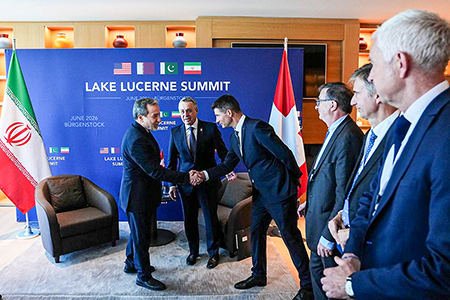
Despite Trump’s threat, U.S. and Iranian negotiating teams met in Lucerne, Switzerland, June 21-22 for the first round of talks after reaching the memorandum.
Pakistan and Qatar mediated the talks and afterwards said that “encouraging progress has been made, including the creation of a mechanism for further technical talks.” A high-level committee will provide political oversight of the process and there will be working groups on nuclear issues, sanctions, monitoring, and dispute resolution, according to a June 22 statement.
After the talks, Iranian Foreign Minister Abbas Araghchi said on X that they “delivered major progress to end Lebanon War.” He described deconfliction in Lebanon as the first “real test” of the process.
The two sides offered different accounts of what transpired on the nuclear issue. In a press conference following the meetings, Vance said that “we made a lot of good progress on other nuclear talks.”
Iranian Foreign Ministry spokesman Esmail Baghaei said that the United States presented its “positions regarding the nuclear issue,” but there was “no discussion of details.” He suggested that nuclear issues also were not a focus of the second round of talks in Doha.
Trump suggested to The New York Times in a June 14 interview that the United States would accept a 15-year suspension on Iran’s uranium enrichment, moving away from his previous demand for a permanent enrichment ban. Iran is open to a suspension but seeks a shorter duration. Although the memorandum suggests that the United States is now open to diluting the highly enriched uranium in Iran, it still appears that Trump wants the blended-down material shipped elsewhere, whereas Iran wants to keep the enriched uranium in the country.
Before the Lucerne talks, Vance suggested that the two sides would discuss a resumption of IAEA inspections. Iran is legally required to implement a safeguards agreement with the IAEA, but it suspended cooperation with the agency and blocked its access to bombed sites after the 12-day U.S.-Israeli war in June 2025. (See ACT, July/August 2025.)
After the meetings ended, Vance said the United States, the IAEA, and Iran will discuss inspections “this week.”
Iranian Deputy Foreign Minister Kazem Gharibabadi suggested the resumption of inspections is not imminent. He said in a June 24 post on X that Iran held “no meeting with [IAEA Director-General Rafael Mariano] Grossi took place in Switzerland, despite his request,” and that there is “no plan for access to the attacked facilities and nuclear materials.” Inspections will be “resolved with the framework of the final agreement,” he said.
Grossi told reporters at a June 24 press conference in Japan that “inspections will indeed take place.” The IAEA and Iran will be “working on the modalities—dates, procedures, places—very soon,” he said.