


"I find hope in the work of long-established groups such as the Arms Control Association...[and] I find hope in younger anti-nuclear activists and the movement around the world to formally ban the bomb."
U.S. Plans Review of Force Posture in Europe
July/August 2026
By Libby Flatoff
U.S. Defense Secretary Pete Hegseth announced that the United States will conduct a six-month review of U.S. basing and force posture in Europe for what he called “NATO 3.0.”
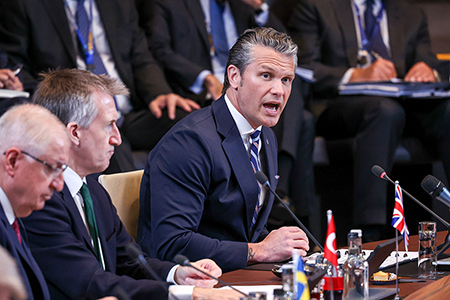
“[W]e’re doubling down on our effort to make NATO what it always was supposed to be, a balanced alliance with Europe in the lead for its own defense,” Hegseth told NATO defense ministers in Brussels June 18.
The announcement came after The Financial Times reported June 1 that the United States was in internal discussions with the alliance about deploying nuclear dual-capable aircraft to additional countries in Europe.
Belgium, Germany, Italy, the Netherlands, and Turkey currently operate their own dual-capable aircraft, purchased from the United States and designed and certified to deliver U.S. nuclear weapons. Turkey remains in a reserve and contingency role.
The newspaper said that two sources briefed on the discussions believe that this signaling was “intended to show the U.S. commitment to providing a nuclear umbrella even as NATO allies were pushed to shoulder more of the conventional defence burden.”
“Europe can and must take primary responsibility for its conventional defense as it pledged at the Hague Summit,” Hegseth told the defense ministers. “Going forward, [U.S.] annual NATO dues will be contingent on other countries meeting their defense spending targets. Where other allies do not spend with urgency, our dues contributions will go down. NATO will be a two-way street.”
On the same day, the Nuclear Planning Group, NATO’s senior body for nuclear deterrence, met and released a statement on nuclear deterrence matters for the first time since 2007. The group, which includes all NATO members except France, agreed to “continue enhancing NATO’s nuclear deterrence mission by modernising NATO’s nuclear capabilities, strengthening its nuclear planning capacity, and adapting to achieve its security interests.”
PBS News reported June 3 that Poland and Lithuania confirmed that they began discussions with the United States on their role within NATO nuclear deterrent efforts. Polish Deputy Defense Minister Pawel Zalewski told Polish Radio, “We are talking, in order to create better conditions for nuclear deterrence and for Poland to play an important role in that.”
Poland has also expressed interest in France’s new “forward deterrence” plans, which were announced by President Emmanuel Macron in March and could allow for the temporary deployment of nuclear strike aircraft outside of France. (See ACT, March 2026.) Belgium, Denmark, Germany, Greece, the Netherlands, Sweden, and the United Kingdom have expressed their intention to discuss nuclear cooperation with France.
Most recently, Norway announced in a May 27 press release that it signed a comprehensive defense agreement with France “to commit to come to each other’s aid should the need arise.” The press release added that, “Together with nine other European countries, Norway will also participate in a process to determine how France’s nuclear weapons can contribute to security and deterrence in Europe.”
Finland, which joined the alliance in 2023, lifted its national ban on nuclear weapons June 17, 2026, after a vote by parliament. Heikki Autto, chair of the parliamentary defense committee, stated in an interview that “nuclear deterrence is, in the end, the guarantor of peace in Europe.… It’s the ultimate deterrence against the Russian aggression.”
Russian spokesman Dmitry Peskov warned June 3 that, “By placing nuclear weapons on its territory, Finland will begin to pose a threat to us. And if Finland threatens us, we will take appropriate measures.”
In a March 5 press release, the Finnish Defense Ministry first announced its intention to amend the state’s Nuclear Energy Act to allow nuclear arms within its territory “to remove legal barriers to enable Finland’s homeland defence as part of the Alliance and the full utilisation of NATO’s deterrence and defence.” (See ACT, April 2026.)
The next NATO summit will be July 7-8 in Ankara.