


By: Mia Clarke, ACA Summer intern '26
Engaging the next generation is among the most repeated calls within the nuclear policy community. The cultural and political contexts in which the arms control and disarmament movement exists have changed dramatically over the past decade, and our methods for connecting with the younger members of the public must keep pace to remain effective. Sadly, there’s no magic formula for navigating these changes perfectly. But selecting the appropriate medium, centering hope within messaging, and building on the intersection of nuclear weapons with many other concerns can all guide efforts to engage younger audiences.
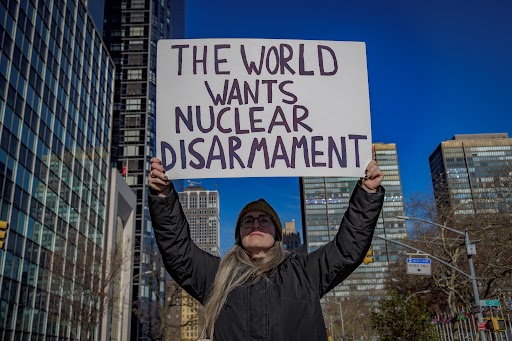
Many of the calls to engage young members of the public make reference to the Nuclear Freeze Movement and its 1982 rally in Central Park. On June 12, 1982, approximately 750,000 people gathered in Central Park in New York City to voice public support for disarmament amid the United Nations Second Special Session on Disarmament. A New York Times article published the next day reported that “the vast parade… brought together pacifists and anarchists, children and Buddhist monks, Roman Catholic bishops and Communist Party leaders, university students and union members.” The event is commonly remembered as a shining example of the potential bipartisan popularity of nuclear arms control.
Public support may be nearing similar levels once again. In 1983, polls found that approximately 72% of respondents supported the freeze and only 20% opposed it. In a mirror image, a January 2026 poll found that 72% of respondents believed removing limits on U.S. and Russian nuclear arsenals would make the United States less secure.
The Medium Shapes the Message
The first consideration is to weigh the medium of communication and the best mechanisms for maintaining trust within those media. The most effective way to engage younger generations is to be in the venues they have chosen, which are different from those of their elders. According to a Reuters Institute study, as of 2026, social media and video networks are now the most widely used sources of news globally. Social media and chatbots built on artificial intelligence are the main source of news for 52% of 18–24-year-olds and 44% of 25–34-year-olds. 39% of people under 35 believed social media and video networks are the best way to follow news about the war in Iran (more than any other news source).
However, the shift in preferred medium has been accompanied by a reduction in trust. The same study notes that respondents typically trust social media and video networks less than traditional media. With an increased reliance on these “less trustworthy” media, trust in news overall has generally decreased as well.
While digital, particularly video forward, platforms have higher likelihoods of reaching younger individuals, they necessitate an increased emphasis on transparency. Experts must maintain clarity about the uncertainty of conclusions and statements in rapidly evolving situations in order to build long-term trust. In an environment where news consumers are increasingly exposed to misinformation, there is increased value to objectivity and steadfast commitment to truth-telling. While virality and outlandish claims may travel further and faster, maintaining credibility in an increasingly untrustworthy environment is critical for long-term success.
Hope as the Alternative to Fear
Secondly, hope must take a central role in efforts to connect with younger generations. From the Cuban Missile Crisis to “Duck and Cover” drills, fear of a nuclear attack colored perceptions of international events in the decades leading up to the Nuclear Freeze Movement. While the prevalence of this fear in the public consciousness has thankfully subsided since the end of the Cold War, there is a temptation to wish for another crisis to scare the next generation into action. However, with the proliferation of competing existential threats and the growing sense of a permanent crisis, hope is a more productive motivator than fear.
Recent research comparing the impact of fear- and hope-based appeals to address climate change found that hope-based appeals for action resulted in higher feelings of personal and individual efficacy. While fear-based messages tended to result in feelings of anxiety or helplessness, hope-based messaging reframed the issue around individual actions and an individual’s ability to enact change. While this study focused on reactions to climate change messages, nuclear weapons pose a similarly complex, existential threat.
When nuclear weapons are presented as one more impossible problem to solve, it’s difficult to overcome paralysis and motivate engagement and action. By breaking down the complex, national-level issues in the nuclear policy debate into smaller, locally specific issues, action becomes more accessible. Individuals and communities can make meaningful progress in educating their peers on nuclear risk, supporting local resolutions, and engaging political candidates on reducing nuclear-weapons risks. Particularly for communities near critical test, design, or production facilities, grassroots organizing has extraordinary potential for enacting change on issues of both national and local importance.
Intersection as a Multiplier
Finally, the multiplying number of contemporary threats, issues, and crises can be used to the movement’s advantage. Capitalizing on nuclear weapons’ intersections with an individual’s pre-existing passions or commitments can help overcome the bottleneck of time, resources, and attention that civically minded citizens must manage. Addressing the nuclear threat can thereby become a new facet of existing engagement, not something new that must be prioritized separately.
Nuclear weapons interact with issues and movements across the political spectrum. Opportunities range from highlighting the impact of nuclear weapons on the national debt and deficit, to addressing the environmental impacts of the nuclear weapons complex, to emphasizing adherence to pro-life principles.
This method of using opposition to nuclear weapons as a unifying, not dividing, force has visible parallels in the Nuclear Freeze movement itself. Journalists who attended the march described signs reading “Choose life,” “Bread Not Bombs,” and “A Feminist World Is a Nuclear-Free Zone.” An emphasis on intersection renews an element of this movement’s past and capitalizes on the incredible work of many activists already engaged to make nuclear risk a part of the broader conversation.
A Modern Example
One example of a modern movement incorporating these considerations successfully is the opposition to data center construction. This movement has worked to create large impacts across the country by prioritizing digital and local organizing efforts centered on actionable goals within the communities most impacted.
The movement to oppose the construction of large-scale data centers blocked or delayed 75 data center projects and $130 billion in construction projects in the first three months of 2026 while relying largely on community level and digital organizing. Data Center Watch, a research firm tracking this opposition, reported that local communities have led the movement by targeting data center projects that impact them most and leveraging social media to gather support.
According to a University of Virginia study this opposition has united young people across party lines. Over 50% of individuals in both parties would oppose the construction of a new data center in their local area, and that sentiment is most concentrated among people between 18 and 30 years old (75% of those surveyed opposed data center construction). These advocates have been able to navigate a multifaceted issue which touches on quality of life, ethical, environmental, and economic concerns, with 98% of opponents indicating that more than one factor played into their opinion. Many of those factors even overlap with concerns raised by nuclear weapons, offering an opportunity to capitalize on intersections.
These considerations are just a few of the endless possible lenses that could influence efforts to engage younger communities. While these endeavors must meet the current moment and culture, they are not entirely distinct from efforts 40 years ago, and there’s little benefit to re-inventing the wheel. It is both possible and necessary to balance the lessons learned in the past with the changes demanded by the modern political and cultural landscape.