


*The Japanese language version of this essay will be published in the Peace Depot's journal "Voice for Peace"(See: http://www.peacedepot.org/dp_report_cat/info/)
by Daryl G. Kimball, Executive Director
 Since the nuclear Nonproliferation Treaty (NPT) entered into force in 1970, the United States and Russia have negotiated agreements that have set verifiable limits on their deadly long-range nuclear arsenals and intermediate-range systems to mitigate the dangers of nuclear arms racing and nuclear war. The process has reduced nuclear dangers, reduced the size of their deadly arsenals and partially fulfilled their obligations under Article VI of the NPT to engage in good faith negotiations on the cessation of the nuclear arms race and on disarmament.
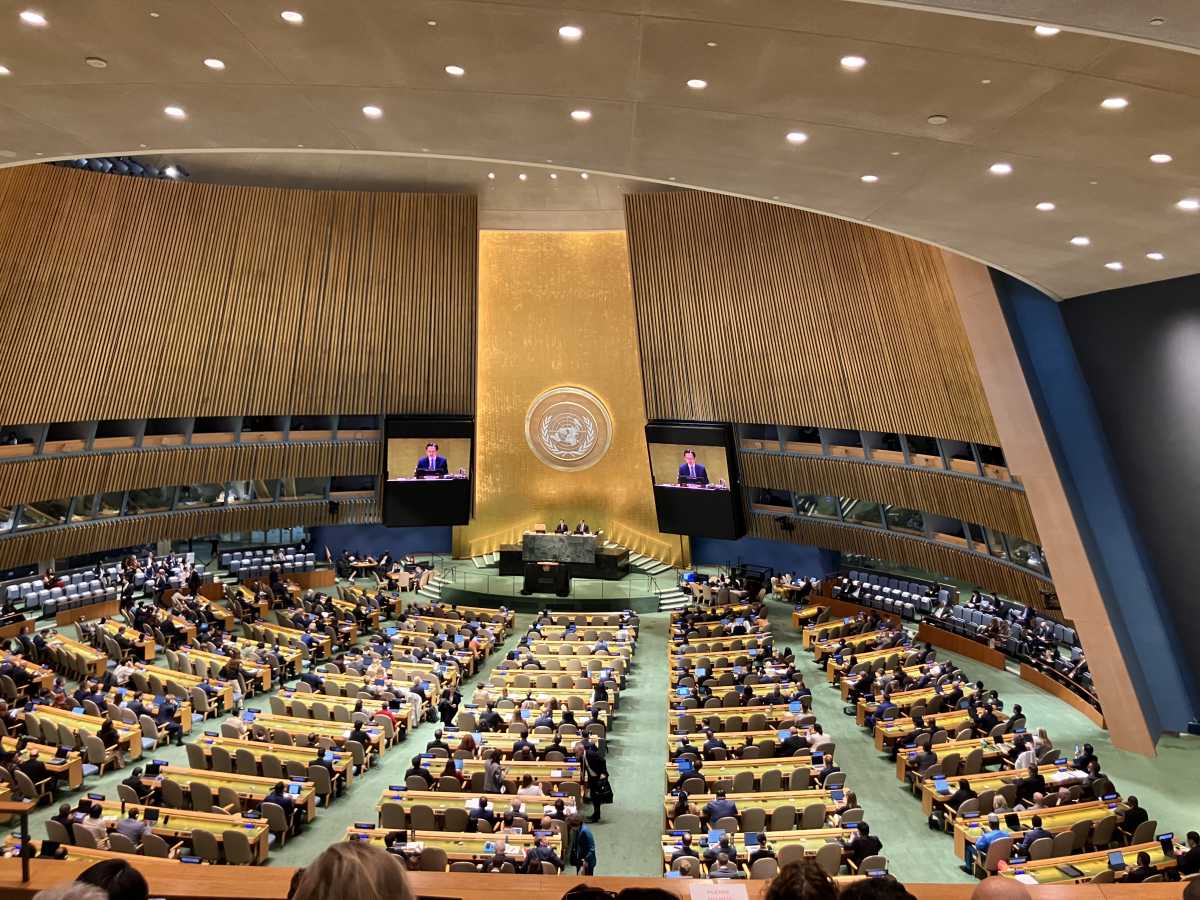
Today, as the 11th Review Conference for the NPT opens in New York, this essential pillar of international peace and security is at severe risk. On Feb. 5, the New Strategic Arms Reduction Treaty (New START), the last U.S.-Russian treaty limiting their nuclear arsenals expired without any agreement designed to constrain their deadly arsenals, and no U.S.-Russian nuclear arms reduction talks are underway or are planned.
New START, the latest in a long line of U.S.-Russian nuclear arms control agreements, was a modest but vital instrument that verifiably restricted each side to no more than 1,550 deployed warheads on no more than 700 deployed long-range missiles and bombers.
Instead of pursuing a new agreement with Russia to supersede New START, U.S. President Donald Trump declared he would pursue a “new era of arms control” involving an as-yet undefined multilateral approach that he says must include China, which is in the midst of a significant buildup of its nuclear arsenal. Trump also declined to take up a proposal from Russian president Vladimir Putin to continue to respect the central limits of the New Strategic Arms Reduction Treaty for one year to provide time to negotiate a new bilateral arms control agreement.
In the absence of legally-binding limits on their arsenals, the United States and Russia may soon begin to increase the number of deployed strategic nuclear weapons for the first time in more than 35 years. Many members of the U.S. nuclear-weapons establishment are lobbying for such a buildup beginning with a decision to upload additional warheads on existing ground-based intercontinental ballistic missiles and by adding sea-based nuclear-armed missiles on strategic submarines. Independent experts estimate that the United States, as well as Russia, could potentially add hundreds of warheads to their deployed strategic arsenals.
More nuclear weapons will not make anyone, anywhere, safer. In 2013, the Pentagon’s Report of Nuclear Weapons Employment Strategy determined that the United States could reduce its deployed strategic nuclear weapons by up to one-third below New START levels and still deter potential nuclear attacks from any adversary. That basic conclusion still holds today, despite the expansion of China’s arsenal which began around 2019.
Today, the United States already has a massive, devastating, and largely invulnerable nuclear force that is more than sufficient to deter nuclear attack by China, Russia, and any other nuclear-armed state. Contrary to hype, deploying additional U.S. nuclear weapons or additional nuclear weapons platforms would not change Chinese President Xi Jinping’s or Putin’s fundamental deterrence calculus in a future war. Increases in U.S., Russian, or Chinese strategic and/or non-strategic nuclear forces would further destabilize the mutual balance of nuclear terror, add to the trillions of dollars that are already being spent on nuclear weapons operations and modernization, and lead to an unconstrained, dangerous, and unwinnable arms race.
There are other severe challenges to other essential norms that reduce the risk of arms racing and proliferation, namely, the 1996 Comprehensive Nuclear Test Ban Treaty (CTBT). In February, U.S. officials alleged that China conducted a secret nuclear test explosion, in the 10 ton (TNT equivalent) range, on June 22, 2020 in violation of the 1996 Comprehensive Test Ban Treaty, and in October of 2025, Trump threatened to resume U.S. nuclear explosive testing "on an equal basis."
However, the seismic signals from the June 2020 event that were detected by the Comprehensive Test Ban Treaty Organization's (CTBTO) International Monitoring Network do not confirm, nor do they rule out a potential nuclear test explosion. That ambiguous assessment has also been confirmed by other independent seismic experts. The CTBTO reported that it detected two seismic events that day, 12 seconds apart, and at locations more than 100 km from Lop Nur facility, where China conducted most of its 45 nuclear test detonations from 1964-1996.
U.S. Assistant Secretary of State Christopher Yeaw said on Feb. 23, that he hoped the U.S. allegations would “spur a discussion on how we all approach responsible nuclear testing behavior going forward.”
The only "responsible" nuclear testing behavior is not to do it. Even if one believes that China conducted a clandestine test, two nuclear wrongs don't make a right. The U.S. nuclear weapons laboratories confirm there is no technical or military reason for the U.S. to resume testing.
Any resumption of U.S. nuclear explosive testing, for any reason, would violate the 1996 Comprehensive Test Ban Treaty, set off a chain reaction of nuclear testing by other states, including Russia, North Korea, India, and others, and blow apart the global nuclear nonproliferation regime.
How Did We Get Here?
Seven U.S. presidents from Nixon to Obama concluded or substantively advanced major nuclear arms control and nonproliferation agreements with Russia. Bill Clinton and Boris Yeltsin provided critical leadership that led to the end of U.S. and Russian nuclear testing and the negotiation of the CTBT. Though the United States was the first to sign the CTBT, the Senate's brief and highly partisan debate and rejection of its ratification in October 1999 has denied the United States and the world, the full benefits of the treaty, including the option for short-notice, on-site inspections to detect and deter clandestine cheating.
But since New New START entered into force, progress on disarmament has stalled. In 2013, U.S. President Barack Obama proposed to President Putin that their two countries follow-up New START with negotiations aimed at achieving a further one-third cut in their strategic nuclear arsenals. Sadly, Putin said "nyet," and relations between the two countries have only worsened since then.
Following Russia's February 2022 full-scale invasion of Ukraine, the United States suspended further U.S.-Russian "strategic stability talks," but in June 2023 at the Arms Control Association Annual Meeting the Biden administration shifted course and proposed that the U.S. and Russia resume their talks designed to work out a new nuclear arms control framework agreement to supersede New START. Unfortunately, the Kremlin declined citing the United States' ongoing support for Ukraine's defense.
After six years in the White House, however, President Donald Trump failed to make any progress despite talking often about his desire for “denuclearization” with Russia and China, complaining about the high costs of nuclear weapons, and noting the devastating effects of nuclear conflict.
In 2019, near the end of his first term, Trump's team failed to resolve an ongoing dispute with Russia over its compliance with the 1987 Intermediate-Range Nuclear Forces (INF) Treaty. They refused to agree with Russia to extend New START by five years. Instead, his envoy for arms control Marshall Billingslea sought to reach an agreement on transparency measures on sub-strategic nuclear weapons and they publicly challenged China, which has a smaller and differently structured nuclear arsenal, into a three-way arms control negotiation. Both efforts failed and it took an agreement between President Biden and President Putin in early 2021 to extend New START by five years before it would have expired on Feb. 5, 2021.
In his second term, Trump has raised tensions further by issuing nuclear threats, expanding costly plans to modernize and upgrade the U.S. arsenal, threatening to resume nuclear explosive testing for the first time since 1992, and pursuing an ambitious, unworkable national missile defense scheme to defeat not just limited missile attacks to the U.S. homeland but missile attacks from Russia and China. The concept, dubbed "Golden Dome," calls for deploying thousands of space-based interceptors into earth orbit. Though it is expensive and would take years to develop, it will encourage adversaries to build up their offensive nuclear systems to ensure they can overwhelm any new U.S. missile defense capabilities.
Nevertheless, in August 2025 after his summit with Russian President Vladimir Putin in Alaska, Trump claimed that “we would like to denuclearize. It’s too much power, and we talked about that.” Questioned about the expiration of New START, Trump said in July, “We are starting to work on that … That is a big problem for the world, when you take off nuclear restrictions.”
On Sept. 22, Putin offered a modest way forward, announcing that “Russia is ready to continue to adhere to the central quantitative restrictions under the [New] START Treaty for one year after February 5, 2026” if the United States reciprocates. When asked Oct. 5 about Putin’s proposal, Trump said, “Sounds like a good idea to me.”
Yet, the White House ignored the Kremlin offer and allowed New START to expire without any new understanding restricting U.S. and Russian nuclear arsenals, and without any talks on nuclear arms control with either Russia or China.
Pathways for Progress
Trump’s comments that he wants to pursue "multilateral" arms control talks are welcome, and his past statements suggest he grasps some of the basic realities—nuclear weapons are too plentiful, too expensive, and too dangerous to use. But he needs to translate the words into meaningful action. So far, he doesn’t yet have a coherent strategy.
This situation creates risk, but also opportunities. Rather than revive his failed plan from 2020 for "trilateral" talks, Trump officials say they are flexible about how to involve China in a "multilateral" nuclear arms control process. They often cite the utility of the so-called "P5 Process," a dialogue involving mid-level officials from NPT's five nuclear armed states that has been held since 2007. These meetings, however, have been relegated to lower, "expert-level" discussions and are not a forum for negotiations.
The U.S. call for multilateral nuclear talks involving the other NPT nuclear-armed states may sound appealing. Indeed, all five NPT nuclear-armed states have Article VI obligations.
But without a serious strategy for success, this could be a formula for further inaction, especially given the complexities of a five-sided negotiation involving states with different force sizes, force structures, nuclear postures, and strategic cultures.
Even if the P5 Process can be revived and become a forum where actual proposal on arms control and disarmament can be exchanged and negotiated, that doesn't preclude more parallel bilateral talks on nuclear risk and arms reduction proposals that might produce more tangible results.
Specifically, Presidents Trump and Xi could agree to assign senior arms control officials to meet regularly for bilateral risk reduction and arms control talks. Senior Chinese officials publicly and privately claim China may be willing to engage in a bilateral (but not trilateral) dialogue on strategic risk reduction. (In November 2023, both countries held one round of bilateral talks.)
In addition, Trump could easily also seek to engage Russia bilaterally in talks on a successor to New START, an option that the Kremlin has expressed serious interest in pursuing. Making progress on an “improved” nuclear arms control deal with Russia will take time, preparation, and tough negotiations.
To improve the chances of success now that New START has ended, Trump and Putin should continue to respect the treaty’s central limits. They should also refrain from talking about—let alone taking actions—that would increase the size of their respective deployed arsenals and immediately launch serious and sustained nuclear bilateral negotiations on a new framework deal.
If Trump and Putin can agree to maintain mutual restraints on their strategic nuclear arsenals and resume bilateral nuclear talks, they would be in a stronger position to call upon China, France, and the United Kingdom to respond by freezing their strategic launchers at their current number.
As of now, Russia and the United States each have fewer than 800 total strategic launchers; China has an estimated 550, including unfilled strategic missile silos; and France and the United Kingdom have a combined total of about 96. A freeze on strategic nuclear launchers at these levels would not adversely affect any one country’s ability to deter nuclear attack, and it could be verified through remote, national means of intelligence.
These joint restraint measures would create a more positive environment for US-Russian and US-Chinese talks on strategic nuclear reductions, new restrictions on intermediate-range missiles and tactical nuclear weapons, limits on strategic missile defenses, and other nuclear risk reduction measures, including joint steps to mitigate the risks of AI integration in nuclear command and control.
However, a resumption of US nuclear testing would blow a hole in any such efforts. If the Trump administration, which has failed to support the 1996 Comprehensive Nuclear Test Ban Treaty, has credible evidence that Russia or China is conducting clandestine nuclear test explosions, it should take up the issue at the treaty’s governing body, the CTBTO.
In addition, friends of the CTBT states should press the United States, Russia, and China, and possibly also France and the UK, to engage in technical talks on new, mutual, voluntary confidence building measures that can be implemented prior to CTBT entry into force to ensure that there are no activities at the former test sites that violate the prohibition on nuclear testing established by the CTBT. Such an approach was proposed in June 2023 by then-administrator for the National Nuclear Security Administration, Jill Hruby.
The NPT and the Role of Middle Powers
The continued failure of Beijing, Moscow, and Washington to engage in good-faith arms control and disarmament negotiations also violates their obligations under Article VI of the nuclear Nonproliferation Treaty (NPT) and undermines its long-term viability.
The non-nuclear weapon state majority need to recognize that the upcoming review conference of the Nuclear Non-Proliferation Treaty from April 27 to May 22 is not just another multilateral discussion forum. The viability of the NPT and the common security it provides is at stake.
It is in the interest of all states that value the NPT to work cross-regionally and to band together to demand—loudly—that the United States, Russia, China, France and the United Kingdom all reinforce their commitment to the global nuclear test moratorium and act now on their Article VI commitments to “pursue negotiations in good faith on effective measures relating to cessation of the nuclear arms race at an early date and to nuclear disarmament.”
Doing so will require that "middle power" countries, including Japan, must, as they have in the past, band together to push the nuclear-armed great powers to agree to concrete action steps to:
- advance progress toward CTBT ratification and to strengthen measures to verify compliance ahead of its entry into force
- immediately engage in negotiations to cap and significantly reduce their nuclear arsenals
- refrain from threatening or using nuclear weapons, including by ratifying the protocols to key nuclear weapons free zone treaties that will formalize negative nuclear assurances to states in those zones
- and reaffirm their unequivocal undertaking, as pledged by the NPT's nuclear five in the year 2000, to achieve the total elimination of nuclear weapons.
Some states and civil society organizations will continue to express their support for the Treaty on the Prohibition of Nuclear Weapons, and they should. But they should also recognize the TPNW, which only has the formal support of nonnuclear weapon states, cannot address the deficit in actual nuclear disarmament diplomacy between and among the nuclear weapon states, the severe threats to the 1996 CTBT, and the near-term risk of an unconstrained, global nuclear arms race.
In the longer term, non-nuclear middle powers will also need to help build new processes to overcome the inequities and sclerosis of the current nuclear order. For example, a group of the willing could advance a new initiative to convene a series of high-level nuclear disarmament summits involving a group of 20 to 30 leaders from nuclear- and non-nuclear-weapon states. If designed properly, such an approach could help guard against the further erosion of essential guardrails against nuclear anarchy, foster new proposals and voluntary actions to reduce nuclear risks, and renew progress toward the elimination of nuclear weapons.
In this time of rising nuclear danger, Civil society and responsible government leaders can and must step forward to jumpstart concrete action to address the most immediate existential security threat facing the world and bolster the beleaguered international nuclear nonproliferation and disarmament system.