


“For 50 years, the Arms Control Association has educated citizens around the world to help create broad support for U.S.-led arms control and nonproliferation achievements.”
North Korea and South Korea Launch Missiles Amid Tensions
November 2026
By Kelsey Davenport
North Korea and South Korea tested missile systems as tensions persist over Seoul’s allegations that Pyongyang placed landmines on the south side of the demarcation line separating the two countries.
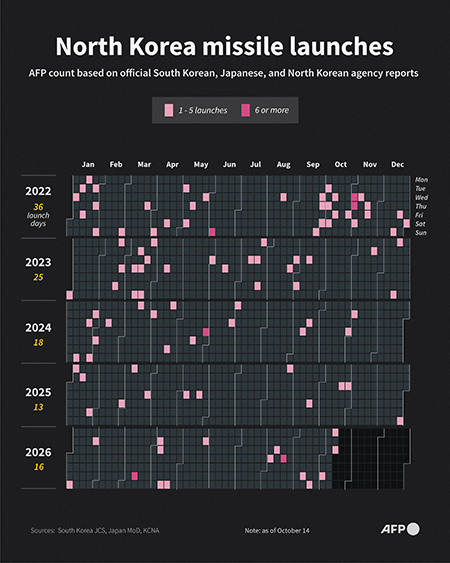
North Korea and South Korea announced that they tested hypersonic missile systems in October. North Korea’s test of a hypersonic ballistic missile is similar to systems that it has tested in the past and does not appear to represent new capabilities, but South Korea’s launch marked the first test of its indigenously developed hypersonic glide vehicle.
Whereas a hypersonic missile performs more like traditional ballistic missiles but is more maneuverable, a hypersonic glide vehicle is boosted by a missile into the atmosphere before separating from the system and reentering the atmosphere on a maneuverable trajectory at speeds in excess of Mach 5, or five times the speed of sound. The high speeds of both weapons make them more challenging to track and intercept using air defenses.
The state-run Korean Central News Agency (KCNA) said in an Oct. 4 statement that North Korea launched an intermediate-range strategic missile the previous day. The statement described the missile as hypersonic and said it traveled about 1,000 kilometers before splashing down in the Sea of Japan.
The launch was part of an effort to “train the missile soldiers operating the hypersonic strategic weapon system,” the statement said. North Korean leader Kim Jong Un observed the launch and described the drill as a demonstration of the soldiers’ ability to operate a “major offensive system.” North Korea must continue to “make the enemy recognize the reliability and fatality of our strategic offensive means,” Kim said.
The South Korean Defense Ministry issued a statement Oct. 4 saying it monitored the test’s “preparation stage” and detected and tracked the missiles immediately after launch, and precisely identified the launch point.”
Japan also issued a statement confirming that it tracked the missile but had a slightly different assessment of the flight range.
Although the missile type North Korea tested is more challenging to track and intercept because of the maneuverability of the reentry vehicle, the Defense Ministry statement said that South Korea and the United States assess “that the missile North Korea recently launched is fully detectable and interceptable by the defense assets held by both countries.”
Five days after the launch, South Korea tested a domestically developed missile tipped with a hypersonic glide vehicle. South Korean President Lee Jae Myung observed the Oct. 8 test and later described it in a statement as “successful.” Hypersonic glide vehicles are an “advanced weapon system that will change the landscape of future battlefields,” he said.
Lee emphasized that South Korea designed the missile indigenously and that its success demonstrates the country’s “determination to defend our nation with our own technology and our own strength.” The launch was designed to test the heat resistance of the hypersonic glide vehicle, its guidance systems, and ability to maneuver, according to a separate statement from Lee’s office.
North Korea accused South Korea of lying about the hypersonic test. Jang Chan Ha, general director of North Korea’s Missile Administration, said in an Oct. 14 interview with KCNA that it was “hard to believe” that the glide vehicle “underwent hypersonic flight.” He said photos released by South Korea depicting the test “arouse suspicions” about the validity of the claim. Jang said it is “hard to believe that [the glide vehicle] underwent hypersonic flight circumstances characterized by extremely high temperatures as its outside appearance is so clean with its coating paint remaining intact, not stained with any soot.”
The South Korean Ministry of National Defense responded to the allegation, saying in an Oct. 15 statement that the “heat-resistant materials” used for the hypersonic glide vehicle protected against soot.
In addition to the hypersonic intermediate-range ballistic missile launch, North Korea tested in October what state media described as submarine-launched cruise missiles (SLCMs) and a short-range ballistic missile designed to carry a tactical nuclear warhead.
On Oct. 12, North Korea tested a “tactical ballistic missile,” according to a Missile Administration statement in KCNA issued Oct. 13. The statement described the test as part of the Missile Administration’s “regular activities” to upgrade its missiles and improve the “performance and sophistication of all offense weapons systems.”
In an Oct. 15 statement in KCNA, North Korea’s Missile Administration said it fired two types of SLCMs. The Oct. 14 launches were intended to “examine the current mobilized posture of the underwater combat systems” and help North Korea’s navy perform “its strategic missions,” the statement said.
Photos released by KCNA suggest the SLCMs were launched from a Soviet diesel-powered submarine that North Korea describes as a tactical nuclear attack submarine. The tests appear to be part of Kim Jong Un’s focus on expanding North Korea’s naval nuclear deterrence.
The uptick in North Korean missile launches comes amid tensions between Seoul and Pyongyang after two South Korean soldiers were injured by a land mine in the demilitarized zone between the two countries. Another unexploded mine was found Sept. 29.
U.N. Command and South Korea’s military conducted a joint investigation of the Sept. 21 incident and determined that the landmines were deliberately buried on the south side of the military demarcation line established by the Korean War Armistice Agreement. The mines were buried within the last 12 months and the design components are consistent with North Korean landmines, the assessment concluded.
South Korea’s vice chairman of the Joint Chiefs of Staff, Lt. Gen. Kwon Dae-won, said in a Sept. 28 press briefing that North Korea must apologize for the incident and remove the mines south of the demarcation line. Otherwise, the South Korean military will “continue mine-clearing operations there to ensure peace in the [demilitarized zone] and the safety of our troops.”
In an Oct. 2 statement in KCNA, Kim Yo Jong, sister of Kim Jong Un and department director of the Central Committee of the Workers’ Party of Korea, accused South Korea of making a “groundless conclusion” that North Korea deliberately laid the mines. South Korea’s accusations “clearly revealed its sinister intention to plunge the situation in the Korean peninsula again into a critical state for its selfish purpose,” she said. Kim Yo Jong reiterated that North Korea is not interested in talks with South Korea and said Seoul “should no longer play cheap tricks” designed to “tarnish the image of our state.”