


“The Arms Control Association and all of the staff I've worked with over the years … have this ability to speak truth to power in a wide variety of venues.”
Public-Private Partnerships Expand U.S. Nuclear Fusion Research
October 2026
By Shaghayegh Chris Rostampour
The U.S. nuclear weapons enterprise is expanding its engagement with private fusion companies, with the National Nuclear Security Administration (NNSA) exploring how such capabilities could complement those of the national laboratories.
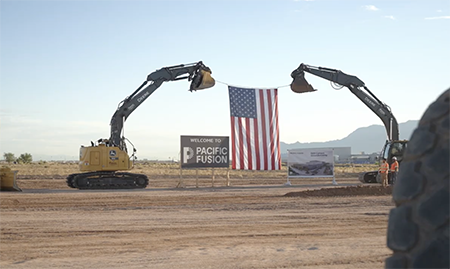
The NNSA signed an Aug. 25 memorandum of understanding with Pacific Fusion, a private company that is building a high-yield fusion research facility in Albuquerque, New Mexico, backed by $1 billion in private investment.
The agreement establishes a framework for Pacific Fusion and the NNSA to collaborate and “advance shared interests in the development, integration, and demonstration of a high-yield fusion system,” according to the Energy Department’s announcement. It does not, however, commit the NNSA to establish or fund specific projects. Any such arrangements would be decided via separate agreements, the department said.
Although fusion research is also pursued as a potential energy source, the NNSA uses high-yield fusion in experiments that can recreate some of the extreme temperatures, pressures, and radiation conditions associated with nuclear weapons physics in a laboratory.
The experiments are part of the U.S. stockpile stewardship and management program, which seeks to “maintain the safety, security, and reliability of the stockpile” without conducting full-scale nuclear explosive tests, as well as “modernizing the stockpile and our infrastructure simultaneously,” according to the Energy Department.
NNSA Administrator Brandon Williams, who signed the agreement on behalf of the agency, said in the department’s statement that the partnership with Pacific Fusion would “expand capabilities that support the nuclear deterrent.”
Other private fusion companies are also developing relationships with the U.S. nuclear security enterprise. Fuse Energy announced in August a five-year cooperative research and development agreement with the Nevada National Security Sites, adding to its previous collaboration with Los Alamos and Sandia national laboratories.
Private-sector involvement in nuclear security builds on decades of fusion research at U.S. national laboratories, including the NNSA’s inertial confinement fusion (ICF) program, which uses lasers or electrical pulses to create extreme conditions that generate data relevant to nuclear weapons research. The National Ignition Facility at Lawrence Livermore National Laboratory, whose 2022 fusion-ignition breakthrough was described by then-NNSA Administrator Jill Hruby as a “new chapter in NNSA’s stockpile stewardship program,” is one of three major U.S. ICF facilities, alongside the Z pulsed power facility or “Z machine” at Sandia National Laboratories and the Omega Laser Facility at the University of Rochester.
The Pacific Fusion agreement is part of a broader effort to explore private-sector capabilities. At an April 2026 U.S. Senate hearing, NNSA Deputy Administrator David Beck said the agency was working with multiple fusion companies, including on potential upgrades to Sandia National Laboratory’s Z machine.
Meanwhile, the House and Senate fiscal year 2027 defense bills include provisions encouraging the NNSA to work with private companies on nuclear-weapons-related activities for “nuclear deterrence … strategic systems survivability; and … weapons component qualification testing.”
The growing U.S. interest in private fusion research comes amid competition with China. At the April hearing, Sen. Martin Heinrich (D-N.M.) said China was “racing ahead” in the field and asked the NNSA how public-private partnerships could accelerate U.S. high-yield fusion capabilities. “The competition with China is crucial to our ability to maintain our deterrent,” Beck replied. Keith LeChien, the cofounder of Pacific Fusion, later referenced arms racing with China in his company’s Aug. 25 announcement of the NNSA agreement, saying that “America can still build the hard things, and build them faster than any other country, including China.”
Meanwhile, the NNSA is expanding and modernizing other elements of the U.S. nuclear weapons enterprise while maintaining the existing stockpile, including through increased funding for nuclear weapons activities and new efforts to accelerate the development of nuclear capabilities. (See ACT, May 2026.) The NNSA is also preparing for challenges associated with aging plutonium pits. (See ACT, September 2026.)
These expansion and modernization efforts come as the Congressional Budget Office estimates that U.S. nuclear forces will cost $946 billion in 2025-2034, with an additional $129 billion in potential costs if programs experience historical rates of growth.
The estimate is based on Defense Department and Energy Department budget plans and does not account for Pacific Fusion’s $1 billion investment or other private sector contracts.