


“We continue to count on the valuable contributions of the Arms Control Association.”
IAEA Closes Syria Nuclear Investigation
October 2026
By Kelsey Davenport
The International Atomic Energy Agency Board of Governors voted to close the investigation into Syria’s nuclear program after the agency reported that the new Syrian government provided the necessary cooperation to resolve long-standing questions about the illicit nuclear activities of the deposed Assad regime.
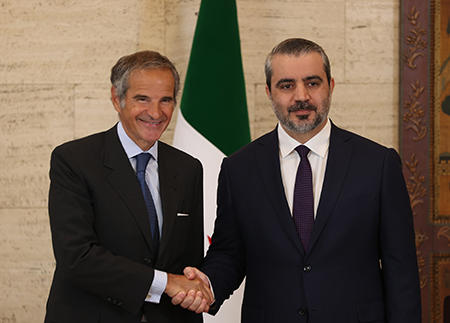
The Sept. 9 resolution, which passed unanimously, welcomed Syria’s cooperation. It noted that Syria has “taken the measures required to remedy the non-compliance found by the Board” in 2011 and closed the investigation.
IAEA Director-General Rafael Mariano Grossi hailed Syria’s cooperation with the agency as a “breakthrough” in a Sept. 7 statement to the board. The government’s transparency and cooperation facilitate “resolution of the outstanding safeguards issues related to Syria’s past nuclear activities,” he said.
In a Sept. 14 video statement to the IAEA General Conference, Syrian Foreign Minister Asaad al-Shibani expressed gratitude to the IAEA and board for closing the noncompliance case “inherited from the previous regime.” He reaffirmed Syria’s commitment to transparency and IAEA safeguards going forward.
Shibani said that Syria offers a “model” for resolving nonproliferation threats in the region and called on all nuclear facilities “without any exception, to be placed under safeguards.”
The IAEA was able to resolve its concerns about Syria’s past nuclear activities after the new Syrian government negotiated an access agreement with the IAEA July 29. Before that agreement, Syria notified the agency in a July 17 letter about the discovery of a cache of undeclared nuclear materials dating from when President Bashar al-Assad ruled the country. He was ousted in 2024 by opposition forces.
As a result of the information and access provided under the July 29 agreement, the IAEA assessed in a Sept. 1 report that it was able to “establish that the former Syrian authorities had failed to report nuclear material, facilities and activities as required” under the nuclear Nonproliferation Treaty (NPT) safeguards agreement.
The report affirmed previous IAEA assessments, which led the Board of Governors to pass a resolution in 2011 that declared Syria in violation of its NPT-required safeguards agreement for constructing a nuclear reactor at Deir el-Zour without informing the agency. The IAEA requested access to the site after Israel bombed it in 2007, but the Assad regime refused to cooperate with the agency, leading to the board’s decision to declare Syria in noncompliance.
The Sept. 1 report concluded that Syria took “measures to remedy the situation by providing to the Agency the required nuclear material accounting reports and design information for the above-mentioned facilities in accordance with its NPT Safeguards Agreement.”
The IAEA noted 73 tons of natural uranium metal, 55 tons of which are in the form of fuel rods and 18 of which are uranium waste and scrap, when it inspected the newly discovered site.
Syria declared the nuclear material to the agency and provided an accountancy report Aug. 27, according to the IAEA report. That material is now under IAEA safeguards in Syria.
The agency’s excavations at the Deir el-Zour site confirmed previous assessments that Syria was building an undeclared nuclear reactor at the site. According to the report, the IAEA uncovered “cooling infrastructure” that is “consistent with that of a nuclear reactor.”
The Sept. 1 report also noted that agency inspectors visited three locations connected to Deir el-Zour, including a facility intended for fabricating fuel for the reactor. The IAEA visited those sites in 2024 to take environmental samples, which tested positive for uranium.
Despite the closure of the investigation, the Sept. 9 resolution requested that the IAEA director-general provide an update about the agency’s ongoing activities in Syria “upon their completion.”
In a Sept. 10 speech, the U.S. ambassador to the IAEA, Wells Griffith III, called the adoption of the resolution a “historic milestone” but noted that the “work of Syria and the IAEA is not yet complete.” He said that “many questions related to Assad’s program remain unanswered” and requested a “detailed assessment of Syria’s previously undeclared nuclear program” from Grossi.
Griffith called on Syria to sign an additional protocol—giving the IAEA expanded access to sites and more tools to verify that a state’s nuclear program is entirely peaceful—to its safeguards agreement “as early as possible.” Adopting an additional protocol “would be an important demonstration of the Syrian government’s enduring commitment to transparency and to fostering international trust,” he said.—