


"The Arms Control Association’s work is an important resource to legislators and policymakers when contemplating a new policy direction or decision."
Trump, Xi, Putin Failing to Tackle the Nuclear Threat
October 2026
By Daryl G. Kimball
In previous decades, the leaders of the largest nuclear superpowers often engaged in serious negotiations about nuclear arms control and disarmament. Presidential summits—such as the Oct. 11-12, 1986, encounter in Reykjavik, which was held amid enormous geopolitical tension and public demand for disarmament—catalyzed high-level negotiations that produced treaties mandating massive cuts in strategic arsenals and the elimination of intermediate-range missiles.
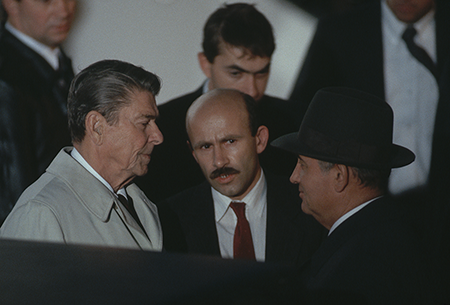
Forty years later, the nuclear sword of Damocles still hangs over all of us. The threat has become more complex, and in the absence of new arms control breakthroughs, we are headed for an unprecedented three-way buildup of Chinese, Russian, and U.S. nuclear forces.
Nevertheless, there are currently no high-level discussions among the major nuclear powers on reducing the nuclear threat, let alone on achieving nuclear zero, as U.S. President Ronald Reagan and Soviet leader Mikhail Gorbachev considered.
To his credit, U.S. President Donald Trump has, from time to time, talked of his concern about the nuclear threat and his desire for fewer nuclear weapons. But saying something and doing it are not the same.
By all indications, Trump’s Sept. 24 summit with Chinese President Xi Jinping was another missed opportunity. The White House said the U.S. leader “advocated for trilateral arms control negotiations between the U.S., Russia, and China,” but there was no corresponding mention in the Chinese readout of the meeting. Beijing has repeatedly rejected a trilateral approach since Trump first proposed it in 2019. Instead, Beijing has proposed that nuclear-armed states negotiate a no-first-use agreement among them to reduce the risk of nuclear war.
Trump’s summit with Russian President Vladimir Putin in August 2025 was another blown opportunity. With the last bilateral nuclear arms control treaty about to expire, the two were scheduled to discuss arms control but the meeting was cut short before they reached that agenda item. Weeks later, Putin proposed that the two sides continue respecting the central limits of the New Strategic Arms Reduction Treaty after it expired to provide time for talks on a follow-on deal. Trump failed to respond to the Russian offer.
Instead, when the treaty expired in February 2026, Trump’s national security team called for a new era of “multilateral” risk reduction talks that also involves China, which is increasing its strategic arsenal to ensure it retains its nuclear retaliatory potential.
Complicating the equation, China, Russia, and the United States are pursuing new nuclear capabilities for potential use in a regional war. The Pentagon is developing new strategic missile interceptors that would make reductions in offensive weapons more difficult. U.S. officials also allege that China conducted a prohibited nuclear test in 2020. In response, Trump has threatened to resume nuclear testing “on an equal basis.” None of these developments breed trust, but they do necessitate more, not less dialogue.
U.S. State Department officials say they have been quietly holding mid-level talks on Chinese nuclear force levels and nuclear testing, aimed at nuclear risk reduction and transparency, on the sidelines of the P5 process dialogue on nuclear matters. The next meeting is set for this month in New York.
Such discussions can be very useful if they are approached as opportunities to bridge differences, not to score points. Undoubtedly, China and Russia should do more to advance global nuclear disarmament negotiations. All five nuclear-armed members of the nuclear Nonproliferation Treaty (NPT) are obligated to “pursue negotiations in good faith on effective measures relating to cessation of the nuclear arms race at an early date and to nuclear disarmament.”
But, as the Reykjavik summit reminds us, without a bolder, more balanced, clearer U.S. strategy, progress on nuclear risk reduction and disarmament will be incremental at best.
One win-win goal for the nuclear five should be to reaffirm their commitment to the Comprehensive Test Ban Treaty and agree on new voluntary technical measures to ensure no state is conducting clandestine low-yield nuclear explosions. They could also begin negotiations on a binding declaration on maintaining effective human control over nuclear use and operational best practices to mitigate the risks of AI integration in nuclear and military systems.
To jump-start serious disarmament diplomacy, even more ambitious concepts should be pursued. For instance, all five NPT nuclear-armed states could agree to indefinitely freeze deployment of additional strategic launchers. As of now, Russia and the United States each have fewer than 800 total strategic launchers; China has an estimated 550; and France and the United Kingdom have a combined total of about 96.
A freeze at these levels would not affect any country’s ability to deter nuclear attack (and inflict catastrophic harm), could be confidently verified through national means of intelligence, would reduce tensions, and would create a better environment for arms reduction talks.
Reykjavik shows that significant disarmament progress is achievable with the right preparation, sustained presidential leadership, and bold ideas that can produce significant results. In the face of today’s nuclear dangers, ordinary people and government leaders the world over need to demand more from the men who lead the world’s nuclear-armed states.