


"I find hope in the work of long-established groups such as the Arms Control Association...[and] I find hope in younger anti-nuclear activists and the movement around the world to formally ban the bomb."
China Tests Submarine-Launched Missile in Pacific
September 2026
By Xiaodon Liang
The Chinese military successfully tested a submarine-launched ballistic missile (SLBM) July 6, delivering a dummy warhead to a target location in the Pacific Ocean, according to state media.
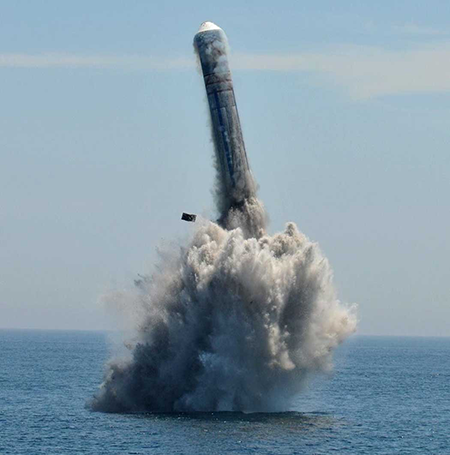
The People’s Liberation Army (PLA) Navy fired the missile approximately 7,000 kilometers from the South China Sea to open waters in the South Pacific, between Kiribati and Tuvalu. Warning notifications issued by Chinese authorities before the test indicate that a second launch from the Bohai Sea, off northern China, was canceled.
The PLA Navy characterized the test as “a routine arrangement … [that] complies with international law and international practice, and is not directed at any specific country or target,” according to a Xinhua report.
The U.S. military also routinely conducts land- and submarine-launched missile tests in the Pacific.
The launch was the second Pacific-facing long-distance Chinese missile test in recent years, following an intercontinental ballistic missile test in late 2024. (See ACT, November 2024.)
Since a pair of Pacific-facing tests in 1980, all of China’s long-distance missile tests have been conducted in the opposite direction, toward targets in western China. These include prior successful tests of land- and sea-based intercontinental missiles, which often occur without notice unless disclosed by other countries.
The missile tested July 6 may have been either a Julang-2 (JL-2), which the Chinese Navy has deployed for a decade, or the newer JL-3, deployed in 2022. The trajectory would have exhausted the range of the JL-2. The JL-3 likely has an extended range of 10,000 kilometers, allowing PLA Navy ballistic missile submarines to range most of the continental United States from littoral waters.
Open-source analysts warn that the JL-2 and JL-3 missiles are difficult to distinguish based on external observation. In July 8 parliamentary testimony, however, a senior Taiwanese intelligence official said the tested missile was a JL-2.
The test was conducted off the coast of Guangdong province from a surfaced vessel in the South China Sea, according to the official, Hsieh Jih-sheng, the deputy chief of intelligence of the general staff of Taiwan’s Ministry of National Defense.
Regional states protested the July 6 test despite receiving prior notification of the event from Beijing.
Japan “strongly urged” China not to conduct the test or endanger Japanese airspace, a government statement said. Although the test trajectory from the South China Sea could not have infringed on Japanese sovereignty, the scrapped prospective test from the Bohai site might have.
“Australia has been clear with China that we regard this as destabilizing to the region,” Foreign Minister Penny Wong told press July 6. She added that the “rapid military buildup by China … [lacks] the transparency and reassurance as to intent that the region expects.”
Matthew Wale, the prime minister of the Solomon Islands, said July 7 that his country does not “want to see any more countries—China, America, anybody—testing in the Pacific Islands region, that’s the bottom line,” according to Australia’s ABC News.
New Zealand Foreign Minister Winston Peters said that “This missile was fired into the South Pacific Nuclear Free Zone established by the Treaty of Rarotonga. China’s action goes against the object and intent of that Treaty,” according to a July 7 report by Radio New Zealand.
He also noted that a pre-launch notification was received only “hours” before the test.
On Aug. 11, the United States and 40 other countries, in a joint statement issued at the Conference on Disarmament in Geneva, called on “all relevant countries” to commit to providing “sufficient advance notice” of at least 24 hours before ballistic missile tests.
The statement, which cites “Recent missile testing activity in the Pacific area,” noted that 145 countries already participate in the Hague Code of Conduct Against Ballistic Missile Proliferation, a political agreement that includes a prelaunch notification obligation.
Although the Hague agreement does not include a 24-hour standard for advance notice of launches, the 1988 U.S.-USSR and 2009 China-Russia launch notification agreements do.
Code adherence have privately discussed and recommended a 24-hour standard, however.
The Aug. 11 statement also called on states to provide in launch notifications “the generic class of the ballistic missile or [space-launch vehicle], the planned launch notification window, the launch area, and the planned direction.” In response to a question regarding criticism of the SLBM test, a Chinese Foreign Ministry spokeswoman said July 7 at a press conference that “there is no need for any country to overinterpret the test launch.”