


“Over the past 50 years, ACA has contributed to bridging diversity, equity, inclusion and that's by ensuring that women of color are elevated in this space.”
UN Members Discuss AI in the Military Domain
July/August 2026
By Michael T. Klare
UN member states and nongovernmental organizations met in June to discuss artificial intelligence in the military domain and its implications for international peace and security, the first such gathering under UN auspices.
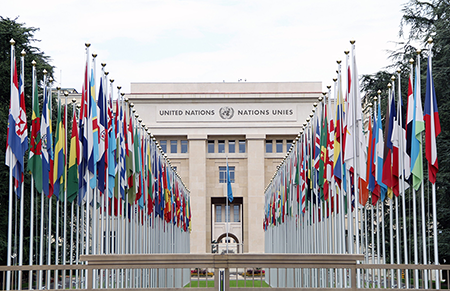
The June 15-17 “informal exchange” in Geneva was organized by the UN Office of Disarmament Affairs in accordance with General Assembly Resolution 80/58 of Dec. 5, 2025, which proposed the consultation to address the risks and opportunities posed by the accelerating application of AI to military targeting and decision-making tools.
Participants were encouraged to reflect on a report on this topic released by the UN secretary-general in June 2025 and to consider possible next steps that the General Assembly could take at its fall 2026 meeting. The United States was among the countries that did not attend.
At the three-day meeting, participants heard from a number of governmental and academic experts on the ways in which AI is being applied to military operations and the resulting implications for international peace and stability. The applications include automatic targeting systems, such as the Maven Smart System used by U.S. forces to help identify targets in Iran for attack during U.S.-Israeli airstrikes in February-April 2026, and AI-enabled decision-support systems, used by some militaries to provide combat commanders with recommended courses of action. (See ACT, May 2026.)
Many governmental and civil society participants noted that the military use of these technologies increases the risk of unintended escalation in a military conflict and unnecessary civilian casualties by accelerating the pace of combat decision-making—leaving less time for informed human judgment—and by maximizing the potential for AI errors and malfunctions. Participants also expressed concern that the use of these technologies could undermine compliance with international humanitarian law.
Although most of the discussion in Geneva focused on the use of AI in conventional military operations, some participants warned of escalatory dangers arising from the integration of AI in nuclear weapons command and control. Numerous participants stressed that decisions involving the use of nuclear weapons must be made by humans, not machines.
In a session on possible responses to these challenges, participants considered various measures, ranging from a legally binding ban on the use of AI in targeting systems to a variety of nonbinding measures, such as information exchanges and a voluntary pledge to exclude AI from decisions involved in killing humans. No consensus was reached on this matter—Russia’s representative, for example, was adamantly opposed to any binding measures—but participants largely agreed that further consultations on the topic would be useful.
South Korean Ambassador Song Si-Jin proposed that states use the coming months to consider possible follow-up steps for the General Assembly to discuss at its meeting this fall.