

“Over the past 50 years, ACA has contributed to bridging diversity, equity, inclusion and that's by ensuring that women of color are elevated in this space.”
South Korea Announces Plans for Nuclear-Powered Submarines
July/August 2026
By Kelsey Davenport
South Korea’s nuclear-powered attack submarines will run on low-enriched fuel produced domestically, according to a government document outlining Seoul’s plans for the submarine program.
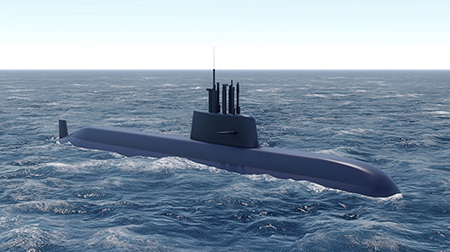
The Ministry of National Defense released the Basic Plan for the Development of the Republic of Korea Nuclear-Powered Submarine May 26. Defense Minister Ahn Gyu-back told press during the plan’s unveiling that South Korea aims to launch its first submarine in the mid-2030s.
The “nuclear-powered submarines can monitor and track North Korean submarine forces more covertly and swiftly than conventional diesel submarines,” Ahn said, thus significantly contributing to South Korea’s “underwater kill chain capability.” The underwater kill chain refers to South Korea’s plans to track and target North Korea’s nuclear-armed submarines before Pyongyang can attack.
The plan was published six months after President Donald Trump pledged U.S. support for South Korea’s decision to build nuclear-powered attack submarines and its ambition to enrich uranium and separate plutonium, capabilities Washington previously sought to prevent Seoul from acquiring. (See ACT, December 2025.)
The plan states that, “to secure autonomy and stability in force acquisition, sustainment, and maintenance, the nuclear-powered submarine will be developed and built within the Republic of Korea.”
The plan did not specify the uranium enrichment level for the planned submarine reactor fuel, but the document’s reference to “low-enriched” suggested that the fuel would be less than 20 percent enriched uranium-235. Uranium enriched to less than 20 percent poses less of a proliferation risk because it cannot immediately be used for nuclear weapons. But as a practical matter, if South Korea is producing the enriched uranium to fuel the reactors, it could use the same technology to produce weapons-grade uranium, which is enriched to above 90 percent U-235.
The submarine plan committed South Korea to “establish a safeguards system applicable to nuclear-powered submarines in cooperation” with the International Atomic Energy Agency (IAEA). Seoul also pledged to “faithfully fulfill its nuclear non-proliferation obligations throughout the entire process of securing and managing low-enriched uranium, the nuclear fuel required for the propulsion system of nuclear-powered submarines, in close communication with the United States.”
In a June 8 statement, IAEA Director-General Rafael Mariano Grossi said the agency noted South Korea’s commitment to “fulfilling its non-proliferation obligations” and welcomed its “intention to work with the Agency on safety, security and safeguards measures applicable to nuclear-powered submarines.”
After publication of the plan, South Korea and the United States met to discuss the nuclear cooperation provisions that Trump and Lee agreed to in November.
First Vice Foreign Minister Park Yoon-joo led the South Korean negotiating team. After the June 2-3 meeting with U.S. Undersecretary of State for Political Affairs Allison Hooker, Park said that a “separate agreement” with the United States on the reactor fuel will be necessary, because “nuclear-powered submarines are related to the military use of nuclear energy.” South Korea has a nuclear cooperation agreement with the United States, but it is restricted to civil nuclear cooperation.
Hooker described the discussions as a “success” in a June 3 post on the social media site X and said the talks “set the stage for continued technical conversations.”
Talks between Park and Hooker also covered enrichment and reprocessing under the existing 2015 civil nuclear cooperation agreement, which allows a high-level bilateral commission tasked with identifying “appropriate options” for South Korean domestic uranium enrichment up to 20 percent U-235. South Korea claims it needs enrichment and reprocessing to support its civil nuclear industry.