


“Over the past 50 years, ACA has contributed to bridging diversity, equity, inclusion and that's by ensuring that women of color are elevated in this space.”
New Chemical Weapons Cache Uncovered in Syria
July/August 2026
By Libby Flatoff
Inspectors from the Organisation for the Prohibition on Chemical Weapons (OPCW) uncovered a significant cache of undeclared chemical weapons and documentation in Syria after the new government of Syrian President Ahmad al-Sharaa pledged to help the agency resolve outstanding issues relating to the arsenal amassed by deposed leader Bashar al-Assad.
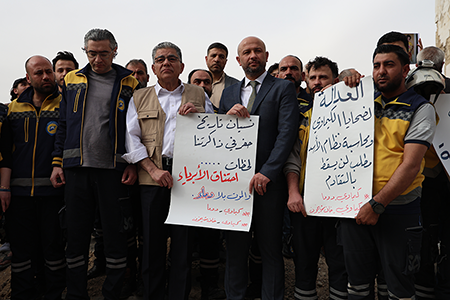
In a briefing June 4, Undersecretary-General and High Representative for Disarmament Affairs Izumi Nakamitsu told the UN Security Council that the cache included rockets of the same type used in the 2013 sarin gas attack in Ghouta that killed an estimated 1,400 people. “These findings are a momentous discovery, not just for Syria, but for international security and the global disarmament regime,” she said.
According to a UN press release, Syria’s UN ambassador, Ibrahim Olabi, described the discoveries as a “decisive turning point” and a “major leap forward in delivering accountability.” He said that his government had facilitated 32 visits by OPCW inspectors and handed over more than 60,000 pages of documents.
The OPCW has been unable to confirm Syria’s chemical weapon declaration since it was submitted in 2014 by Assad’s government, which was ousted in 2024 after a civil war.
In 2017, Damascus used sarin to attack civilians in Khan Shaykhun. In April 2018, chlorine gas was used in Douma. The United States responded with airstrikes both times.
Mohamad Katoub, Syria’s ambassador to the OPCW, told Arms Control Today in May that it was important to confirm and take accountability for these stockpiles because, “Accountability is a measure of nonrecurrence.” (See ACT, May 2026.) “The Syrian people suffered from those chemical weapons, and part of justice is the destruction of the remnants of chemical weapons,” he said. “Without holding perpetrators accountable and bringing justice for the victims, the peace in Syria will keep being fragile.” However, Katoub acknowledged that he doesn’t “believe that we’ll be able to have a 100-percent accurate declaration.” He said that ferreting out remnants of the CW arsenal had been complicated partly by “the Israeli airstrikes [and] what’s happening now in the region.” He noted that the OPCW Technical Secretariat team had to be evacuated from Syria March 17 over security concerns after the U.S.-Israeli war against Iran began Feb. 28.
After the 2024 collapse of the Assad regime, Israel undertook several airstrikes against known Syrian chemical weapon stockpiles.
According to Israeli Foreign Minister Gideon Saar, “We attacked strategic weapons, the residual chemical weapons capabilities, [and] long-range missiles and rockets, so they won’t fall into the hands of radicals.”
In December 2024, the OPCW affirmed its “commitment to clarifying gaps, discrepancies, and inconsistencies in Syrian chemical weapons declaration amidst political transition.”
The UN Security Council press release said that Nakamitsu “stressed that the newly discovered weapons must now be formally declared and destroyed under OPCW verification, and that further inspections of additional sites are needed.”
During the Security Council briefing, France cautioned that this was “only just beginning to reveal the extent of the programme hidden from the international community.”
In the interview with ACT, Katoub said Syria is working to safeguard the new sites until the proper steps toward destruction can be done.