


“Over the past 50 years, ACA has contributed to bridging diversity, equity, inclusion and that's by ensuring that women of color are elevated in this space.”
The Pope’s Historic Encyclical: Disarming AI and Building a Just Peace
July/August 2026
By Maryann Cusimano Love
Pope Leo XIV calls for disarming artificial intelligence in his recent encyclical, Magnifica Humanitas. Although the U.S. government has largely abdicated a role in establishing AI safeguards, Leo issues a rallying cry. Civil society, citizens, AI builders, governments, and multilateral organizations should not leave pivotal decisions to the tech elites alone, he argues. Instead, he calls for everyone to play a role in building peace, protecting the vulnerable, and safeguarding the treasures of human relations from digital slavery.
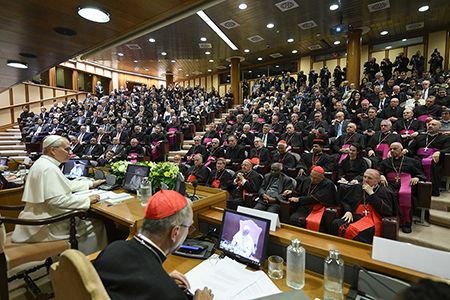
The encyclical is an historic first: the first encyclical of Leo’s papacy, the first written by an American, the first by a mathematician, the first written in English, and the first focused extensively on AI. An encyclical is one of the highest forms of teaching in the Roman Catholic Church. It was addressed not only to the 1.4 billion Catholics who comprise the largest branch of Christianity, the world’s largest religion, but to everyone with the aim of advancing discussion and dialogue about urgent moral issues.
A New Long-Term Project
The Catholic Church is well-practiced in undertaking long-term building projects. The Milan Cathedral took nearly six centuries to complete. Leo just blessed the Sagrada Familia Basilica in Barcelona, after nearly a century and a half of construction, interrupted by the Spanish Civil War, World War II, and the COVID-19 pandemic. Hence, it is natural that Leo opens the encyclical with two contrasting building images that he returns to throughout the text: the negative example of building the Tower of Babel, a hubristic technological ascent, versus the positive example of the decentralized rebuilding of Jerusalem, a slower community construction project. He urges his readers to avoid “the Babel syndrome,” meaning an “idolatry of profit that sacrifices the weak,” and the dehumanization of reducing persons into data, performance, and targets to exploit. Instead, he advocates that people build together for the common good and assures that even if construction moves at a slower pace, a better result awaits.1
In an unprecedented move, Leo spoke publicly about the encyclical when it was unveiled May 25, saying, “artificial intelligence needs to be disarmed. The word is strong, I know, but deliberately chosen.… The church has long been working for nuclear disarmament, aware that every great technical power can affect people’s lives and so must be accompanied by adequate moral discernment and public control. Nuclear disarmament remains a service to peace and the dignity of the human family.”2
He continued, “In a similar sense, artificial intelligence now demands to be ‘disarmed,’ freed from logics that turn it into an instrument of domination, exclusion and death. Like nuclear energy, it must be at the service of all and of the common good. Decisions about technology must never be separated from conscience and responsibility.… vigilance is necessary today. Peace, not merely the absence of war, is justice at work. But when technology weakens our critical sense, peace itself is at risk. Disarming, however, is not enough. We must build.… a future, not for a privileged few, but for the entire human family.”3
The encyclical is a broad and deep analysis of what it means to be human in a digital age, warning about advancing technology without a moral compass and the concentration of power in the hands of a select few tech elites. Leo underscores that “technology is never neutral, because it takes on the characteristics of those who devise, finance, regulate and use it.”4 He notes the good that AI and emerging technologies can do in fields such as medicine, for example, but he also warns of the risks of technology being used to dominate, dehumanize, and exploit in pursuit of power and profit rather than the common good.
The encyclical peels back deeper layers beyond the usual policy questions over AI regulation and governance. Who are we and who do we want to be? What do we want to build to serve humanity? How can we build ethically, caring for one another and our common home? Leo contests the vision and building plans of some AI elites, such as Elon Musk, that view humans as merely the small bit of code and “biological boot loader” used to create superior machine intelligence.5 He covers the impact of AI on the environment, education, families, employment, human trafficking, truth and democracy, and of war and peace.
Why Listen to the Church?
Some tech powers in Silicon Valley welcomed Leo’s decision to open the conversation on the ethical concerns surrounding AI, which has become integral to war-fighting and national security decision-making. Christopher Olah, a co-founder of Anthropic, regularly consults Catholic thinkers on the ethics (or as he refers to it, the “soul”) of Claude and other Anthropic products; he participated in the release of the encyclical at the Vatican. Anthropic’s CEO, Dario Amadei, agrees with Leo that AI leaders such as himself should not be deciding the future of these technologies on their own.6
Others in Silicon Valley are pushing back, arguing that the pope should stay in his lane, and that the Catholic Church is not competent to discuss AI.7 Leo is a mathematician who leads the world’s largest nongovernmental educational network, including over 1,400 universities, 230,000 schools and educational institutions, academic institutes and think tanks on artificial intelligence and emerging technologies in almost all countries. They include The Catholic University of America’s Leonine Institute for Emerging Technologies and the University of Notre Dame’s DELTA network. Catholic professors, such as I, have degrees in AI and teach AI courses and programs. Catholics build and use AI programs, and Holy See diplomats negotiate on AI law and policy. Many Catholic priests, who are also scientists and engineers, serve as AI advisers to governments and international bodies, including the United Nations and European Union, and to the tech industry.
The Holy See led the Rome Call for AI Ethics, a pledge pioneering the development and application of common principles for AI ethics and regulation, including accountability, inclusiveness, impartiality, and privacy. Major tech companies such as Microsoft, IBM, Cisco, and Salesforce are signatories. The Pontifical Academy of Sciences traces its lineage from one of the oldest scientific forums in history, the Accademia dei Lincei (1603-1651), which counted Galileo Galilei among its members. Many Nobel laureates are members, and AI has been a dialogue theme between religious and scientific leaders for many years now.
Nobel laureates and Catholic experts met July 14-16, 2025, in Rome for a discussion of AI and nuclear weapons. For more than a decade, long before the advent of ChatGPT and today’s large language models, the Catholic Church has been convening the Minerva Dialogues between AI industry leaders and religious leaders, urging that AI respect human dignity and serve the common good. Two Church offices, called dicasteries, released Antiqua et Nova: Note on the Relationship Between Artificial Intelligence and Human Intelligence last year. Leo’s Magnifica Humanitas encyclical is not a one-off; it is the fruit of this long engagement and discernment on these issues.
Realist thinkers argue that religious actors and factors have no role in international relations or should have no role,8 but this assertion rather proves the point that the pope is making about the need to overcome a culture of exclusion. It is not merely a matter of creating more moral machines. “A more moral AI is not enough if that morality is determined by a few,” Leo wrote.9
Unlike the frontier AI companies, the Catholic Church is not selling AI, so it can speak frankly. The tech titans have a conflict of interest in promoting their lucrative interests while claiming there are no serious downsides to their products, tech companies can be trusted to self-regulate, yet resisting attempts to strengthen requirements for transparency, accountability, safety regulations, and guardrails. Palantir co-founder Peter Thiel—a self-identified libertarian, conservative Christian, MAGA contrarian—seems to be trolling Pope Leo. In a series of lectures held in Rome near the Vatican, Thiel claimed that those who propose AI regulations are the Antichrist.
Disarming AI
Leo goes beyond calls for AI regulation and safety. He urges deeper relationships for deeper disarmament and says that any technological advancements detached from ethics and human responsibilities exacerbate, accelerate, and dehumanize conflict, cyberattacks, and hybrid war, rather than building just peace. “Disarming AI means freeing it from the mentality of ‘armed’ competition, which today is not limited simply to the military context, but is also an economic and cognitive phenomenon. This entails a race for ever more powerful algorithms and larger datasets, driven by the desire to secure geopolitical or commercial dominance,” he writes.10
Leo continues: “To disarm means discrediting the assumption that technical power automatically confers the right to govern. To disarm does not mean rejecting technology but preventing it from dominating humanity. It means freeing technology from monopolistic control and opening it to discussion and debate, therefore making it human-friendly and restoring it to the plurality of human cultures and ways of life.… For this reason, merely regulating it is insufficient; it must be disarmed, welcoming and accessible.”11
In this context, the pope says that disarming AI means confronting realpolitik, the culture of power that normalizes war under a false realist school of international relations theory that incorrectly claims conflict is inevitable, so therefore arm up. By erasing truth and the historical memory of the harms and horrors of war, algorithms and communications networks reward conflict and stoke disinformation and fear while sanitizing and gamifying violence.
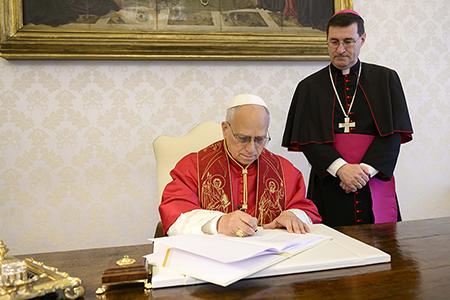
In the encyclical, Leo expands upon previous Catholic calls against lethal autonomous weapons systems and in favor of nuclear disarmament and arms control. He notes that “No algorithm can make war morally acceptable,”12 and sets out three non-negotiable requirements for the use of AI in military systems. First, the buck must stop with a person; accountability and blame cannot be “collapsed into ‘the machine,’” but must be traceable to human decision-making processes. Second, the use of force must “remain under effective, self-aware and responsible human control.” And third, at the communal level, the world must develop a shared international framework to curb the AI and technological arms race.13
Leo further makes the point that words are powerful and must be chosen wisely to favor more peaceful, less aggressive language over confrontational language that divides humanity into in-groups and out-groups.” He urges people to disarm hearts, words and relationships, in order to build a just peace and move away from the normalization of war, the arms race, the false logic of deterrence, and the just war tradition.
Just Peace Over Just War
In repudiating the normalization of war, Leo criticizes just war theory as outdated. Some media outlets jumped on this quote and reported that the pope had overturned just war tradition. Not exactly.
The just peace tradition is the majority position within the church and holds that the objective at all times is to prevent conflict, end conflict, and build peace. The just war tradition is the minority position.14 Popes have emphasized the just peace tradition for decades, while de-emphasizing the just war tradition. Leo clears up several common errors. First, he says that Jesus worked to build a just peace without violence. The just war tradition was never the foundational Catholic teaching on war and peace. It emerged centuries later to limit violence, not to justify or expand war, as it is commonly misunderstood today.
Second, Leo notes that St. Augustine has been stripped of his original emphasis on building a just peace and turned into a caricature as a proponent of war. An example is when Vance tried to invoke Augustine to justify the U.S. attacks on Iran—Leo is not having this. Throughout the encyclical, he writes that the Catholic tradition seeks to build a just peace, while lamenting the false manipulation of the just war tradition to justify any kind of violence. Unjust wars are being fought for profit, and arms makers and the military-industrial complex fuel conflicts to reap these profits.
Leo reiterates that “preventive” attacks are not just, and do not meet the strict conditions of self-defense, nor do unjust wars fought to divert public attention from domestic problems. As the former head of the Augustinian order (Catholic religious orders are often named after the saints that founded or inspired them) and a scholar of St. Augustine, Leo reminds his readers that the saint put the drive for a just peace first and foremost among his priorities. “In an increasingly interdependent world, peace is not just one issue among others, but a prerequisite for the universal common good and a test of the moral maturity of peoples, especially of those who bear responsibility for governing,” he writes.15
Third, Leo notes that humanity has far more effective tools to resolve conflict, such as dialogue, diplomacy, and forgiveness, than its leaders have sought to exercise. He recommends applying all the just peace principles and practices—expanding participation in restoring communities, building right relationships, truth-telling, and reconciliation—to build a more sustainable peace with one another and with our common home. These tools are practical and have a successful record, which Leo documents: restoring and rebuilding Europe after World War II and building multilateral and international laws and institutions, such as the UN, the Universal Declaration of Human Rights, the Refugee Convention, the Treaty on the Prohibition of Nuclear Weapons, the U.S. civil rights movement, the anti-apartheid movement in South Africa, and Wangari Maathai’s Green Belt movement. With more effective tools available to build just peace, the just war doctrine is outdated.
Finally, given the immense destructive potential of modern war, Leo writes that the “evils” of war outweigh the harms that force seeks to eliminate. He does not mention the U.S.-Israeli war on Iran specifically but notes that, “It is much easier to start a war than to stop it.”16
All popes since World War II have called for a greater emphasis on building a just peace, noting that almost all conflicts do not meet the criteria for a just war. Catholic peace groups such as Pax Christi USA and Dorothy Day’s Catholic Worker call for going farther by totally eliminating the just war tradition, in the same way that the Catholic Church changed its position from supporting to opposing the death penalty. It is more likely that Leo the Augustinian will restore St. Augustine’s emphasis on just peace, rather than jettison the just war tradition entirely. He mentions “peace” 67 times in Magnifica Humanitas, and “just war” only once. He retains the narrow strict exception for self-defense, as in the case of Ukraine’s self-defense against Russian attacks, and calls for increased protections of civilians, consistent with the just war tradition’s in bello criteria.
Leo disputes that peace is utopian.17 Empirically, it is not. Most of the world is at peace, most of the time. We work to build peace in our families, workplaces, and communities. Leo is calling humanity to the construction site and telling us to bake bricks and bring them along. Building peace is a moral and religious obligation and a practical action plan.
Criticisms of Nuclear Deterrence
Some proponents of nuclear deterrence hoped Leo would overturn his predecessor’s encyclical, Fratelli Tutti, which holds that the possession of nuclear weapons and adherence to nuclear deterrence are immoral. They will be disappointed. There is no daylight between Leo’s critiques of nuclear deterrence and those of his predecessor, Pope Francis. The new encyclical calls out “the widespread yet erroneous belief that nuclear deterrence is an indispensable prerequisite for security.”18 From a just peace perspective, deterrence displays “a relational poverty that always has disastrous consequences for civilian populations,” Leo writes.19
None of the nuclear armed states are engaged in disarmament negotiations, and the Trump administration argues that this is not the time for such negotiations, that diplomacy must wait until conditions are ripe. Instead the administration prefers multilateral consultations on risk reduction and nuclear testing. Leo disputes this narrative and any assertion that there are parties with whom it is illegitimate to engage. In his view, the time is always right for disarmament negotiations, diplomacy, and dialogue. Leo invokes Fratelli Tutti, which also notes that it is immoral to possess nuclear weapons.20 Dialogue is not transactional but transformative, Leo writes. Diplomacy is a vocation, requiring abundant perseverance, humility, patience, and openness to the other.
For those who hope the Catholic Church will bless the bombs that undergird nuclear deterrence as the Russian Orthodox Church does, that is not going to happen. Not all remarks made by the pope are authoritative, binding, high-level teaching of the Catholic Church. If Leo roots for the White Sox and orders a hot dog at the game, Catholics are not bound to do the same. At the top level of Catholic teaching are apostolic constitutions (such as Vatican II), followed by encyclicals. At the end of the line are pastoral letters by just one bishops’ conference and remarks. The calls for abolishing nuclear weapons, nuclear disarmament, and the critiques of deterrence are in the constitutions and papal encyclicals of higher levels of Catholic teaching. The 1983 pastoral letter of the U.S. Catholic bishops, which in one section offered limited strictly conditional acceptance of nuclear deterrence as long as it was on the path to deeper disarmament,21 was lower-level Catholic teaching, now outdated.
Leo proposes several ways forward: disarming words by speaking the truth; building peace in justice; adopting the perspective of victims; and rejecting realpolitik and seeking practical paths of peace through deeds, diplomacy, dialogue, and multilateral cooperation. Even in the darkest nights, peacemakers build and persevere with astonishing creativity in doing good, protecting the vulnerable, and opening pathways to reconciliation. We are invited to the construction site to build a more fully human future in the digital age, and not to give up just because big tech owns the brick company.
ENDNOTES
1. Pope Leo XIV, Magnifica Humanitas, May 25, 2026, paragraph 10. All following quotes from Magnifica Humanitas include just the paragraph number in brackets.
2. Pope Leo, Remarks at the public event releasing Magnifica Humanitas, May 25, 2026, Vatican City.
4. Magnifica Humanitas, paragraph 9.
5. Elon Musk, “Hope we’re not just the biological boot loader for digital superintelligence. Unfortunately, that is increasingly probable,” Twitter, August 3, 2014.
6. Elias Wachtel, “Why Silicon Valley is Turning to the Catholic Church,” The Atlantic, April 25, 2026.
7. Cade Metz, “At the Epicenter of A.I., Pope Leo’s Warnings Are Dismissed,” The New York Times, May 26, 2026.
8. Maryann Cusimano Love, Global Issues Beyond Sovereignty, Chapter Five, “Religious Actors and Factors in International Politics” (Rowman & Littlefield: Lanham, MD, 2020).
9. Magnifica Humanitas, paragraph 107.
10. Magnifica Humanitas, paragraph 110.
11. Magnifica Humanitas, paragraph 110.
12. Magnifica Humanitas, paragraph 198.
13. Magnifica Humanitas, paragraph 200.
14. Maryann Cusimano Love, “Just Peace and Just War,” Expositions, Vol. 12, No. 1 (2018), pp. 60-71.
15. Magnifica Humanitas, paragraph 182.
16. Magnifica Humanitas, paragraph 195.
17. Magnifica Humanitas, paragraph 205.
18. Magnifica Humanitas, paragraph 194.
19. Magnifica Humanitas, paragraph 192.
20. Maryann Cusimano Love in Chris Seiple and Dennis R. Hoover (eds.), Routledge Handbook of Religious Literacy, Pluralism, and Global Engagement, Chapter Four, “Fratelli Tutti: Lessons Learned from Interreligious Action and the Catholic Church” (Taylor & Francis, 2021).
21. U.S. Conference of Catholic Bishops, “The Challenge of Peace: God’s Promise and Our Response” pastoral letter, May 3, 1983.