

“Right after I graduated, I interned with the Arms Control Association. It was terrific.”
A New Arms Control Tool
September 2026
By Magnus Öberg and Siri Jansson
Since 1817, world leaders have negotiated at least 129 arms control agreements regulating all weapons categories, including weapons of mass destruction and conventional weapons. These agreements all exist on paper and online but not in a form that is easily accessible or usable by scholars, policymakers, or anyone else who wants to examine the details in a broad context—until now.
The Alva Myrdal Centre (AMC) for Arms Control at Uppsala University in Sweden recently completed construction of the AMC Data platform, a new online database that aims to provide a comprehensive and user-friendly reference source for research and education on the complicated topic of arms control agreements.1 The platform is built on an underlying database covering 129 arms control agreements between 1817 and 2025.
The data platform provides structured and easily accessible information about each agreement, presented in text, images, and through interactive visualization tools. Clear and comparable summaries cover basic information on each treaty catalogued, such as key dates of signature and entry into force, details on which states have signed and ratified each agreement, as well as information on which weapons or facilities are affected by the agreement and which stages of the weapons life cycle are regulated.
AMC Data also provides information on verification processes and the organizations responsible for implementing each agreement. The platform offers access to the full texts of all agreements, along with tools for visualizing and comparing states-parties and agreement contents in graphs and tables. Finally, the platform provides a series of data sets for statistical analysis.
The platform is organized around a series of typologies and conceptualizations that make agreements readily comparable with respect to various dimensions, including bans and restrictions over the life cycle of weapons systems from development to disposal, their consultation and compliance mechanisms, and relevant agreement associations. The hope is that systematizing information about the agreements and making it easily accessible will spur increased interest in comparing agreements and their evolution over time, inviting people to ask questions about what different agreements regulate—when they entered into force, how they regulate compliance—and to investigate differences over time and across nuclear and non-nuclear agreements.
The platform should be useful as a go-to reference for quick facts about the agreements, as it is to the authors’ knowledge,—the most comprehensive and systematic overview of arms control agreements available anywhere. It should serve the needs of researchers, students, and practitioners alike, and, with its companion database and data sets, provide answers and inspire new questions.
Compared to existing resources, AMC Data provides a wider range of information on a larger scope of arms control agreements than anything previously available, and it does so in a way that makes all 129 agreements over a 200-plus-year period systematically comparable at a glance. In contrast to key sources such as the UN Office for Disarmament Affairs (UNODA) Treaty Collection, the UNODA Treaty Database, the Nuclear Threat Initiative Education Center, and Arms Control Association treaty “at a glance” backgrounders, AMC Data covers a larger number of agreements and benefits from an integrated comparative framework based on its underlying data sets.
The underlying database and downloadable data sets also contribute as a resource for research in and of themselves. Previous data sets on arms control agreement parties and content are limited in scope and detail and, importantly, are not always freely available.
Contents and Structure
AMC Data is organized around four main components. First, the “AMC agreement profiles” section provides concise, systematic summaries of every arms control agreement included in the database. Written in a standardized format, each profile presents key information on agreement obligations, verification design, agreement associations, and state participation, alongside essential facts and links to the full agreement text.
Second, the platform includes three interactive data visualizers. The “agreement parties visualizer” generates timelines illustrating state actions to sign, ratify, accede to, or withdraw from arms control agreements over time. The “weapon-specific obligations visualizer” enables users to explore and compare the weapons and related objects that are prohibited or restricted by different agreements across the various stages of the weapons life cycle. Finally, the “control system catalogue” provides a searchable overview of the consultation, demonstrated compliance, and verified compliance mechanisms established by each agreement, allowing users to compare implementation and verification across agreements.
Finally, the platform includes the “AMC data portal,” which provides free access to AMC data sets and their accompanying codebooks for research and statistical analysis. Users can also download the digital version of the AMC Encyclopedia of Arms Control,2 which compiles all agreement profiles into a single volume with additional visual features, including a historical timeline, to provide a more engaging reading experience.
The AMC Agreement Data Sets
The platform is built on seven interconnected data sets that systematically capture the content of arms control agreements and states’ participation in them. The “agreement dataset” records core information for each agreement, including key dates, participating states, and weapons regulated. The “weapon-specific obligations dataset” shifts the unit of analysis from agreements to individual obligations, enabling comparisons of how approximately 300 weapons or related materials are regulated across different stages of the weapons life cycle, from development and production to use and destruction. Three additional data sets focus on agreement design by documenting consultation mechanisms, demonstrated compliance mechanisms (such as reporting requirements), and verified compliance mechanisms, including how verification procedures are initiated and what forms of inspection or access they authorize. The “agreement associations dataset” records organizations responsible for treaty implementation, while the “agreement parties dataset” tracks state actions to sign, ratify, or withdraw from agreements over time.
The data sets were compiled by coding official agreement texts using a standardized codebook and by drawing on major international treaty collections. Although considerable effort was made to compile a comprehensive list of agreements, some limitations remain. Coverage is strongest for 20th-century multilateral agreements, while historical agreements, unilateral declarations, and less prominent regional or bilateral arrangements are more likely to be incomplete due to limited historical documentation and challenges in identifying all eligible agreements.
The Data and Its Uses
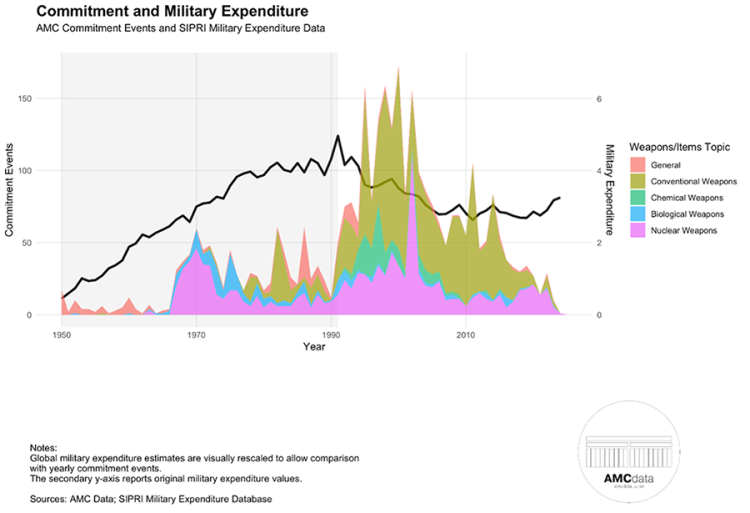
One important use of the AMC data is mapping trends and analyzing patterns in arms control agreements. The data can be used to analyze how any set of country characteristics, geopolitical alignments, or other attributes relates to state commitments or any other aspect of arms control agreements such as verification mechanisms or agreement associations. The possibilities are almost endless. Figure 1 shows trends in states’ commitments to arms control agreements across time and plots it against a geopolitical shift and global arms expenditures, thus illustrating how these shifts and trends relate to each other. State commitment encompasses all actions by which a country expresses its consent to be bound by an agreement, including ratification, accession, approval, acceptance, succession, consent to be bound, and participation. The dynamics changed with the end of the Cold War (a period indicated by the shaded section of the graph) and, as military spending went down, commitments to arms control agreements expanded dramatically across categories. The 1990s stand out as the decade with the highest number of agreements adopted and also as the decade with the greatest number of actions to commit to an agreement, especially in the area of conventional weapons, with important agreements such as the Treaty on Conventional Armed Forces in Europe.
A second purpose of the data portal is to provide structured, accessible, and comparable information at a user’s fingertips. It allows for easy exploration and comparisons of structure and details across a very large number of arms control agreements. For example, users interested in what a specific agreement regulates, or which agreements regulate a specific weapons type, have all the information readily available in the “weapon-specific obligations visualizer”—for any arms control agreement since 1817. By means of the visualizer, a user can easily find out what weapon or related material is regulated, how it is regulated, and what paragraph in the original agreement lays this out. The data portal also provides the original agreement. The same visualizer allows a user to obtain parallel charts for all the seven agreements regulating fissile materials for easy comparison, or all agreements regulating any one of the 300 types of weapons and related materials regulated in any agreement. This is just one example how researchers can access, compare, and visualize information about arms control agreements.
In sum, the data platform provides detailed and systematic information on 129 arms control agreements, many of them historical and less well known. Whether a user is just browsing the agreements, comparing and studying them in detail, or analyzing them statistically, the data can contribute to new insights and ideas for future arms control efforts. The data could be used to analyze how different verification mechanisms affect the likelihood of a treaty being adopted, which in turn might provide useful for thinking about how to design new agreements. It can also be used to understand what drives the type of inspections used in arms control agreements,3 or to analyze verification issues beyond traditional arms control, such as verification regimes for artificial intelligence governance.4 Finally, the online data platform is an ongoing project that will expand over time. In the near future, data on nuclear arms control negotiations will be added. This action will make the tool useful for analyzing the negotiating process and what conditions facilitate successful or failed negotiations.
ENDNOTES
1. See https://amcdata.uu.se/en.
2. Siri Jansson, Tereza Heiligová, Robertas Skipitis, and Magnus Öberg, The AMC Encyclopedia of Arms Control Agreements, Alva Myrdal Centre for Nuclear Disarmament, Uppsala University, 2026.
3. Philip Chennery, Yerdaulet Rakhmatulla, Joel Christoph and Joon Baek, “Who Watches? Inspector Models in Arms Control and Lessons for AI Oversight,” Alva Myrdal Centre for Nuclear Disarmament, Uppsala University, April 2026.
4. Andrew Ayobami, “Nuclear Governance Architecture and Its Limits for AI Verification,” SSRN, May 16, 2026.
Magnus Öberg is a senior lecturer/associate professor in the Department of Peace and Conflict Research at Uppsala University, where he leads the working group on data at the university’s Alva Myrdal Centre for Nuclear Disarmament and directs the Uppsala Conflict Data Program. Siri Jansson is a research assistant with the working group on data at the Alva Myrdal Centre.