


“For 50 years, the Arms Control Association has educated citizens around the world to help create broad support for U.S.-led arms control and nonproliferation achievements.”
'The Brink of War': What It Takes to Prevent Nuclear War
September 2026
By David E. Hoffman
(Editor’s note: Readers should be aware that some details of the film’s conclusion are revealed in this review.)
During the Cold War, arms control negotiations were awfully boring. The jousting and talking was exhausting and took years to achieve results. An exception was the summit between U.S. President Ronald Reagan and Soviet leader Mikhail Gorbachev in Reykjavik, Iceland, over the weekend of Oct. 11-12, 1986. This was the most dramatic and consequential discussion of nuclear danger since the 1962 Cuban missile crisis. Isolated at the Hofdi House on the barren North Atlantic coast, Reagan and Gorbachev came very close to an agreement to eliminate all nuclear weapons. The two leaders failed to do so in the end because of Reagan’s insistence on pursuing his dream of missile defense, the Strategic Defense Initiative (SDI). But they set the stage for real progress in the years that followed when the nuclear stockpiles were sharply reduced, making the world safer.
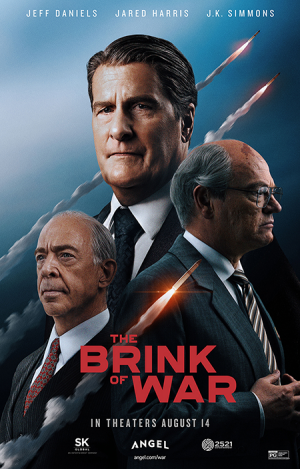
To make a movie about Reykjavik would seem to require nothing more than embracing the history as it unfolded. The transcripts and documents have been declassified, showing that Reykjavik was a summit of high political stakes, yet was also very personal. Director Michael Russell Gunn’s new film about Reykjavik, “The Brink of War,” nicely frames the mood in the first moments with a lonely Reagan, played by Jeff Daniels, staring out at a roiling sea and distant lightning.
This film goes right to the heart of why Reykjavik was a seminal event. Reagan and Gorbachev, from radically different political systems and for quite different reasons, reached the same conclusion. Over and over again during the Cold War, technology ramped up the danger. It took people who recoiled from the balance of terror to curtail the arms race. Reagan and Gorbachev found the political willpower and courage to do so—or at least to try on a fateful Sunday afternoon.
“Nuclear. Zero,” insists a stern Gorbachev (Jared Harris).
“You want to destroy every single nuclear weapon on Earth?” asks an incredulous Reagan. “Gone. Taken out of the silo, off the sub, out of the bomber, dismantled, junked, warheads spun down. In just ten years?”
“Well, then let’s do it!” responds Secretary of State George P. Shultz (J.K. Simmons), in a pivotal moment that is true to the record.
Much retelling of the Cold War is colored by knee-jerk American triumphalism—that Reagan pushed the Soviet Union into the dustbin of history. But at Reykjavik, Gunn shows that it was Gorbachev, not Reagan, who first broached radical arms reductions. Reagan could not believe what he was hearing, and he was not short of enthusiasm. “I’m saying why don’t we get rid of all of them?” he tells Gorbachev.
When the two leaders later get stuck in disagreement over missile defense, Reagan makes a guileless offer to share SDI with the Soviet Union. In what is perhaps the strongest performance of the film, Gorbachev responds with a fiery and humiliating tirade, pointing out that the United States would not share ordinary dairy equipment with the Soviet Union, so how could he take the offer seriously?
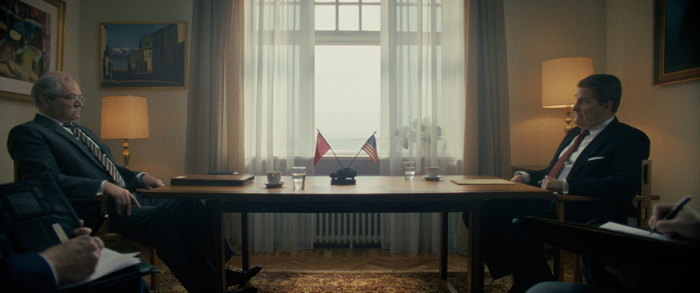
Harris deftly portrays a Gorbachev burdened by over-militarization at home, eager to get on with his political and economic openings of glasnost and perestroika, and accompanied by an enchanting Raisa Gorbacheva (Branka Katic). Reagan comes across as eager to leverage his military buildup into a legacy-defining deal; Nancy Reagan (Hope Davis) remained in Washington. Regrettably, the film does not explore the fascinating backstory of Reagan’s nuclear abolitionism, which had been largely hidden from public view until Reykjavik.
Gunn has cleverly centered the entire film on the actual Hofdi House location and eschewed the submarines and missiles that are seen in many Cold War movies. He has painlessly fiddled with the sequence of the summit events. When he hews to the history, he has a gripping tale. He did not need to weigh it down with so many cliches. “Trust, but verify,” the favorite Reagan saying, is repeated often. “Tear down this wall” pops up—although Reagan did not actually say it until the next year—and the Soviets are reminded numerous times that they have bread lines. Reagan gives a series of anti-communist mini sermons that seem discordant, even for him.
Gunn also attempts to crank up the tension from the very beginning with the idea that the superpowers were on the “brink of war.” Shultz warns the president, “You said you didn’t want to be seen as a warmonger. If we fail here, there’s going to be a war; after this war there’ll be nothing left on God’s green Earth but smoldering, irradiated, lifeless rock. Is that what you want?” This was hardly the case; tensions were much higher in the war scare of 1983, and both Reagan and Gorbachev had jointly concluded their 1985 Geneva summit with a pledge that “nuclear war cannot be won and must never be fought.” The brink-of-war idea is hype, out of character for Shultz. Nor was Gorbachev going to start a war. Months before, he had just been through the shattering and sobering experience of the Chernobyl nuclear disaster.
The summit ended without agreement on nuclear weapons. To those who witnessed the event, Reagan looked dour as he climbed into his limo. Failure was written on Shultz’s face as he addressed the world’s press, and U.S. negotiator Max Kampelman was near tears. In the movie, the ending is a happy handshake over Gorbachev’s agreement to allow the sister of cellist and conductor Mstislav Rostropovich to visit the United States. It was not that way. The Washington Post carried a two-line, front-page banner headline the next morning, proclaiming: “Reagan-Gorbachev Summit Talks Collapse as Deadlock on SDI Wipes Out Other Gains.”
Today, the nuclear arms control treaties that followed Reykjavik have expired or been abandoned. The world is on the cusp of a new arms race, far more complex and just as threatening as the last. We should learn a lesson anew from this film, that the weapons will not go away on their own. It takes people with vision and political willpower—courage and guts—like Reagan and Gorbachev.