


"[Arms Control Today] has become indispensable! I think it is the combination of the critical period we are in and the quality of the product. I found myself reading the May issue from cover to cover."
Reducing Nuclear Dangers Through Diplomacy: Jack Mendelsohn (1934-2026)
September 2026
By Matthew Bunn and Jon Wolfsthal
Jack Mendelsohn, a far-seeing diplomat, family man, teacher, and friend who spent decades working to reduce nuclear dangers, died August 13, five days short of his 92nd birthday. The world is a safer place because of his tireless commitment to common sense and because of the countless people he helped train in national security, nuclear deterrence, and diplomacy who will carry on his legacy.
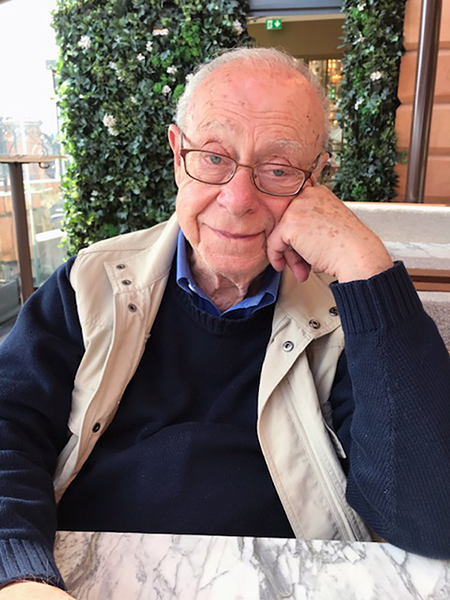
Jack served as a U.S. Foreign Service officer with the U.S. Department of State and the U.S. Arms Control and Disarmament Agency (ACDA). He was a member of the second Strategic Arms Limitation Talks (SALT II) and Strategic Arms Reduction Treaty (START) negotiating teams. He later held appointments as deputy director of the Arms Control Association and vice president of the Lawyers Alliance for World Security (LAWS), and taught at three universities.
Early in his Foreign Service career, Jack served in overseas posts ranging from Haiti to Poland. He then joined ACDA in 1972, as the SALT I negotiations concluded and the SALT II talks began. Jack soon rose to become the right-hand man to the SALT II delegation’s chief negotiator, U. Alexis Johnson, and proved indispensable, helping navigate a group with differing agency viewpoints, Washington officials unaware of on-scene dynamics, and the gulf between the U.S. and Soviet positions.
Later, Jack told historians that during the negotiations he had “an overriding sense” that continuing an “unfettered” nuclear competition was “costly” and “dangerous,” making negotiated arms control a vital tool for U.S. and world security.1 This realization, an example of Jack’s innate common sense, led him and Johnson to consistently work to make negotiating progress, including the occasional use of UNODIR cables—an acronym for “‘unless otherwise directed,’ we intend to take this approach”—to hurry decisions along. Within the delegation, Jack was considered a straight shooter, and the Soviets appreciated his focused, nonpolemical approach.
After SALT II, Jack served at NATO headquarters in the late-1970s, supporting talks on conventional arms control in Europe and advising on how to respond to Soviet SS-20 missile deployments. He backed the initial U.S. view that no new nuclear forces were needed, given the thousands of nonstrategic nuclear weapons that the United States had in Europe, but that view shifted after he left, leading to deployment of the Pershing II ballistic missiles and ground-launched cruise missiles in Europe.
After a stint at the State Department focused on science cooperation, Jack returned to arms control as ACDA’s START representative in the early years of President Ronald Reagan’s tenure. Little progress was made in 1981-1983 because the Reagan administration was more focused on nuclear buildup and confrontation with the “evil empire,” while the Soviet delegation had little room to maneuver as an ailing Soviet leader Leonid Brezhnev gave way to short-lived successors until Mikhail Gorbachev assumed power in 1985.
The U.S. delegation to the START negotiations was led at the time by Ed Rowny, a hawkish retired U.S. Army general who had clashed with Jack on the SALT II delegation. Jack thought little of Rowny’s “absolutely non-negotiable” proposals and tensions ran high.2
Jack was planning to leave that assignment when Rowny sent a famous memo to Washington targeting many members of his delegation; he described Jack (and others) as favoring “progress at any cost.”3 Jack departed the assignment before the Soviet walkout in late 1983, well before arms control revived once Gorbachev came to power.
After START, Jack became dean of the Foreign Service Institute’s School of Language Studies, where one of his proudest accomplishments was converting many instructors from poorly paid adjuncts to full-time employees with benefits.4
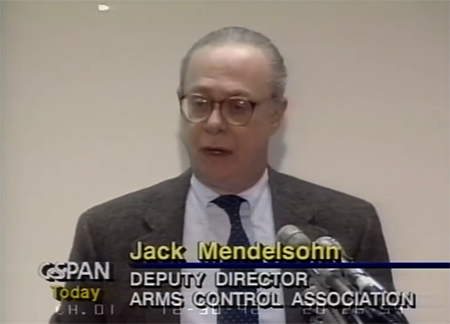
On leaving government in 1985, Jack joined the Arms Control Association (ACA) as deputy director under its new president, Spurgeon Keeny. Over the next 13 years, Jack helped manage the organization’s work, wrote frequently, and appeared on television and radio. His diplomatic skills and close and warm personal relations with officials, reporters, academics, and experts all over Washington served him well in this challenging role. Together, Jack and Spurgeon created a formidable team with unmatched expertise on arms control topics. With Jack’s deft input, the association became one of the most influential and important national security organizations in the 1980s and 1990s.
For younger staffers like we were, Jack’s common sense, negotiating skill, and calm amid the constant controversies of those days were essential guideposts for our careers. He was always eager to take the time to hear the views of staff, holding court on a daily basis. Many of us considered the time at ACA as a type of (very) low-paid, never-ending graduate seminar on nuclear policy and Washington politics. Jack genuinely cared about mentoring the next generation of arms control professionals and invested in that effort again and again. Those who worked under him (and Keeny) have served as ambassadors; White House, State, Defense, and Energy department senior officials; Foreign Service and intelligence officers; and teachers.
Jack left the association in 1998 and spent a year as the John M. Olin distinguished professor of national security affairs at the U.S. Naval Academy, then served as vice president of LAWS, producing white papers on national missile defense (2000), the Comprehensive Nuclear Test Ban Treaty (2001), and a Chronology of Arms Control (2002). He also taught as an adjunct professor at George Washington University’s Elliott School of International Affairs, and later at American University. He was a dedicated teacher and mentor on arms control and broader issues of international security.
Broadly educated and ever curious, Jack would sometimes take a course on Shakespeare or philosophy, or spend an evening seeing a new play or hearing a science lecture. He was a devoted husband, father, and grandfather who at times lamented that arms control work sometimes kept him from his family. His daughter Kasia is now a senior official at the U.S. National Nuclear Security Administration.
Jack’s focused approach, instinct for finding compromises, and broad view of arms control as one tool of U.S. national security policy are qualities much in demand and need today. His humanity and warmth, sense of humor (with a seeming endless supply of comical nicknames and old jokes), and his ready smile and love will be deeply missed.
ENDNOTES
1. Jack Mendelsohn, oral history interview by Charles Stewart Kennedy, Association for Diplomatic Studies and Training, February 12, 1997.
3. After the memo was leaked, the Senate Foreign Relations Committee made it public (with the names redacted) in the course of the hearings on Kenneth Adelman’s confirmation as ACDA director. For one of many press accounts, see Michael Getler, “Target of Controversial Memo: Admiral on START Team Retiring,” Washington Post, April 22, 1983.
Matthew Bunn, is a professor of practice at the Harvard Kennedy School and faculty lead for the school’s “Managing the Atom” project. He was the editor of Arms Control Today in the early 1990s. Jon Wolfsthal, a U.S. nuclear policy fellow at Pax Sapiens and former senior director at the U.S. National Security Council, was the first senior research analyst for nonproliferation at the Arms Control Association from 1991 to 1995.