


"[Arms Control Today] has become indispensable! I think it is the combination of the critical period we are in and the quality of the product. I found myself reading the May issue from cover to cover."
September 2026 Books of Note
September 2026
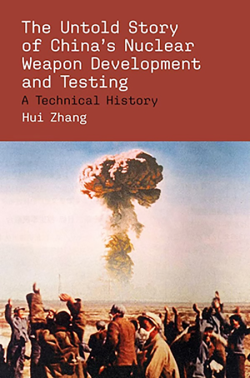 The Untold Story of China’s Nuclear Weapon Development and Testing
By Hui Zhang
MIT Press, 2025
In this new history of China’s nuclear weapons program through the 1996 testing moratorium, Hui Zhang draws on the publications of Chinese nuclear weapons scientists and engineers over the last three decades to revise and expand on standard accounts. Beginning in the 1990s, former employees of the Chinese nuclear program took to local print publishers and the internet to share personal narratives of their experiences in the development, production, and testing programs. Zhang’s volume incorporates these sources to revisit the early days of China’s nuclear program as well as the campaign, beginning in the late 1970s, to develop and produce a second generation of designs.
This second generation of weapons—prioritizing “miniaturization, mobility, penetrability, safety, and reliability,” according to the goals set by the Chinese government—was more successful than previously believed, Zhang argues. Connecting each nuclear test at the Lop Nur site to a specific purpose in the weapons program, the author finds that Chinese advances in warhead miniaturization had born fruit by 1996. By the time China ended testing at Lop Nur, it had warheads with yields and size efficiency roughly comparable to U.S. designs, he claims. Zhang concludes that modern Chinese missiles may be able to deliver at least twice the warheads typically assumed by open-source estimates. He also predicts that China has little left to gain from a resumption of nuclear testing—an assessment with renewed importance following U.S. allegations in February 2026 that China has conducted a secret, low-yield nuclear test explosion in June 2020.—XIAODON LIANG
The Most Awful Responsibility: Truman and the Secret Struggle for Control of the Atomic Age
By Alex Wellerstein
HarperCollins, 2025
Alex Wellerstein seeks to change the narrative around U.S. President Harry Truman’s decision to drop the atomic bomb on Hiroshima and Nagasaki in his book, The Most Awful Responsibility, by claiming that Truman was not fully aware of the consequences of his actions until after the bombs had been deployed in 1945.
Through a narrative-like analysis, the author uses historical sources to document that Truman actually did not have complete understanding of the Manhattan Project or the scope and scale of the atomic bomb during his presidency. Although Truman remained a defender of his use of the atomic bombs after World War II ended, Wellerstein states that “one gets the sense that his defense of the use of the bombs was less about trying to cleanse his [Truman’s] conscience than it was about cleansing the American conscience,” which Truman felt was his duty as president (emphasis as received).
Wellerstein argues that Truman was deeply opposed to nuclear weapons but was still willing to bear the burden of the decision to drop the first and only atomic bombs. The author emphasizes that after the bombing of Nagasaki, Truman did not move to halt all bombings on Japan but placed “the limitation … that there would be no further dropping of the atomic bombs.” Wellerstein also argues that this occurred when Truman’s work to centralize the responsibility for nuclear weapons in one person—the president—began. The author concludes that this change was not an effort to gain power but rather “to make sure [atomic bombs] were not used again.”—LIBBY FLATOFF