


“For 50 years, the Arms Control Association has educated citizens around the world to help create broad support for U.S.-led arms control and nonproliferation achievements.”
Nuclear Weapons: An International History
September 2026
By Douglas B. Shaw
A Towering Achievement of a Narrow Type
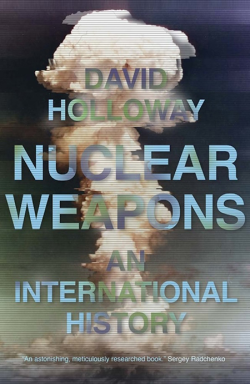
Nuclear Weapons: An International History
By David Holloway
Yale University Press, 2026
David Holloway’s Nuclear Weapons: An International History is a commanding, single-volume update to the political history of nuclear weapons. It brings novel international perspectives into a unified narrative. But the book’s focus on the perspectives of leaders of nuclear armed states comes at a cost: It pays less attention to the facts that those leaders often failed to grasp and exaggerates their already wild overestimation of their control over the prospect of nuclear war.
Holloway’s most important achievement is adding international dimension to the standard understanding of nuclear weapons history. He presents novel facts in rich context, beginning with the Soviet nuclear weapons program and building through later chapters that weave together narratives I had previously encountered only anecdotally by listening to people in India and China talk about their perspective on nuclear weapons. By Chapter 14, “Sino-Soviet Nuclear Relations, 1950-67,” and Chapter 15, “The Crisis of 1969,” I encountered astounding facts and perspectives that were entirely new to me.
From Billiard Ball to Breakable Egg
Holloway’s conclusion draws insightfully on Hedley Bull’s understanding that sovereignty is malleable, not fixed, and must change to accommodate weapons that deny “even the most powerful states” the ability to “guarantee their own survival without some form of cooperation or understanding.”1 The author understands nuclear weapons more deeply than most of the historical figures he describes: not merely as a tool of state power, but as a human invention that changed the Westphalian state’s viability as an instrument of human security.
Daniel Deudney’s work sharpens this vision. Deudney describes how nuclear weapons transformed states from materially robust “billiard balls” into existentially fragile “eggs” that must be protected by new types of institutions or shatter.2 Daniel Ellsberg brings the point into still clearer focus: Nuclear weapons form a single “doomsday machine,” to which multiple leaders hold triggers but which no one can independently render safe.3 Harry Truman put it starkly in his final State of the Union address: “War has changed its shape, and its dimension. It cannot now be a ‘stage’ in the development of anything save ruin for your regime and your homeland.”4
Rather than dwelling on failed proposals for world government or strict international control of nuclear weapons, Holloway traces the pressure the bomb exerted in shaping international politics. He notes that “the innate characteristics of the bomb made it an effective boundary marker,” suggesting that using nuclear weapons might take states beyond the map of international relations altogether into a future of uncertain governance.5 Holloway is rightly skeptical of brinkmanship and of the confidence some leaders placed in their own ability to know when to step back. He returns instead to the inescapable logic of Thomas Schelling’s “threat that leaves something to chance” under conditions of mutual vulnerability. As Holloway puts it, “the danger is not that the deterring power will decide on war, the danger is that war will occur independently of the wishes of either side.”6 Out of this, he traces the emergence of an internationally shared understanding of mutual vulnerability.
This keen insight into how nuclear weapons reshape sovereignty and the state never quite finds its footing within Holloway’s larger narrative, which centers on how world leaders sought influence and security by building and threatening to use nuclear weapons. Holloway identifies the immediate failures and persistent shortcomings of nuclear security, but he does not draw out their policy implications the way Alex Wellerstein does in Restricted Data: The History of Nuclear Secrecy in the United States. The gap between the assumption of state rationality that stable deterrence requires and the actual behavior of states shows up repeatedly in shibboleths that Holloway awkwardly seems to accept as settled wisdom: nuclear secrecy, brinkmanship, and strategic ambiguity.
Great Men, Miniscule Mafias
Holloway’s international history casts world leaders as main characters thwarted time and again by bureaucrats. He depicts these leaders as of two minds about the bomb: aware of the devastating implications of its use, yet unable to resist its presumed coercive power. British Prime Minister Winston Churchill characterized the hydrogen bomb as “a badge to the Royal Enclosure”; Mao Zedong put it more starkly: “In today’s world, if we don’t want to be bullied, we have to have this thing.”7
Holloway portrays history’s great men as gifted in judging how close they could bring a conflict to the brink of war without going further, yet routinely undone by their own governments’ quiet noncompliance with clear directions on managing nuclear weapons. Holloway introduced former British Defense Minister Denis Healey’s phrase “miniscule mafia,” describing the cabal of “civil servants and staff officers, to whom governments abdicated their responsibility for NATO strategy … because politicians did not have the time or energy to master the issues.”8 The author returns to this pattern repeatedly: political leaders of great powers issuing clear direction on nuclear policy, only to have bureaucrats, unaccountable to public scrutiny and dismissive of fundamental truths about nuclear war, overturn it.
The most common form of miniscule mafia behavior is an insistence on elaborate preparations for nuclear war-fighting across varied, improbable, nearly hopeless scenarios, at the expense of restraint intended to lower the risk of nuclear war. Holloway observes that “the leaders of the nuclear powers had come to share the view that, in some ill-specified but profoundly important way, nuclear war was unacceptable.”9 Yet he repeatedly documents officials responsible for military preparations rejecting that view in favor of insisting that victory was possible because otherwise the specific tasks assigned to them could not be completed. Examples include:
- The U.S. Strategic Air Command’s rejection of the RAND Corporation’s “no cities” strategy under which initial U.S. nuclear attacks would focus on Soviet nuclear forces, forgoing early strikes on Soviet cities so that the Soviets would have strong incentives to end the war to protect their cities, and Chief of Naval Operations Arleigh Burke’s “finite deterrence,” which together led Defense Secretary Robert McNamara to abandon his effort to give the president wider nuclear war-fighting options. McNamara argued instead for an “assured destruction” criterion that never translated into doctrine or posture.10
- The Soviet “quarrel of the century” over whether intercontinental ballistic missile (ICBM) silos should be hardened to guarantee retaliation, or left vulnerable on the assumption that Soviet missiles would already be launched before U.S. warheads arrived. One senior Soviet official wrote to Soviet Premier Leonid Brezhnev that “some leading military chiefs were interpreting defense doctrine willfully and inconsistently.”11
- Soviet leader Mikhail Gorbachev’s observation that the Politburo did not control the acquisition and sustainment of Soviet nuclear forces: “if a Politburo member questioned the functioning of a defense industry plant, [Defense Minister Dmitry] Ustinov pounced on the ‘immature faultfinder.’”12
Holloway makes little reference to the human and environmental costs of nuclear weapons. Questions such as how many lives are lost just building, maintaining, and managing nuclear arsenals globally, or how many people would perish in the most planned-for nuclear exchanges, remain frustratingly out of his scope.
A Narrow Focus
Holloway favors political leaders and bureaucrats to the exclusion of dreamers. His omission of Leo Szilard undermines a crucial perspective on how nuclear weapons and their role in human affairs were first imagined.
The lineage runs backward from Szilard. In 1913, physicist Frederick Soddy—building on his 1909 book The Interpretation of Radium, which explained the scale of energy released by radioactive decay—wrote in The New York Times that harnessing the energy of radioactive transmutation would “revolutionize all existence.” H.G. Wells drew on Soddy’s work for his 1914 novel The World Set Free, which coined the term “atomic bomb.” Szilard, in turn, credited Wells’s novel with shaping his own thinking. In 1933, crossing a London street, Szilard suddenly realized that a chain reaction—as imagined by Wells—was the key to building an atomic bomb. That insight led him, in 1939, to draft the letter that Albert Einstein sent to U.S. President Franklin Roosevelt warning that a bomb of unprecedented power could be built.
This omission is striking. Without these facts, the reader gets no sense of how nuclear weapons and their social implications were imagined before they were pursued, and may struggle to see how any of it could have turned out differently.
Holloway’s history ends in December 1988, with Gorbachev’s address to the United Nations—just short of the Soviet collapse that followed, and disappointingly short of how interesting the story of nuclear weapons becomes immediately thereafter. Scholarly work by John Steinbruner, Ashton Carter, Steven E. Miller, and others on managing nuclear escalation gave U.S. Senators Sam Nunn and Richard Lugar the conceptual basis for a transformational vision: reversing the Cold War nuclear arms race through Cooperative Threat Reduction. That program went on to deactivate more than 7,600 strategic nuclear warheads and destroy hundreds of ICBMs and submarine-launched ballistic missiles, along with dozens of ballistic missile submarines.13
Omission of this period is frustrating for two reasons: It eclipses the essential question of what happens to nuclear weapons that are never used, and it feeds a common habit in nuclear policy discourse of dismissing the Cooperative Threat Reduction program’s extraordinary success as irrelevant to humanity’s nuclear future. As a new nuclear arms race accelerates, it is worth remembering that eventually every nuclear weapon produced will either be used in anger; abandoned as the authority responsible for it grows less capable, creating intolerable uncertainty; or verifiably eliminated. The international “miniscule mafia” would prefer to treat cooperative threat reduction as an irrelevant anachronism, rather than as a first, encouraging proof that avoiding nuclear war is technically possible.
The omission of the post-Cold War experience is also disappointing from a scholarly perspective because it fails to recognize important nuclear histories of states without nuclear weapons. Togzhan Kassenova’s 2022 book, Atomic Steppe: How Kazakhstan Gave Up the Bomb, describes in painful detail the human costs of nuclear weapons programs largely absent from Holloway’s account. Mariana Budjeryn’s 2022 book, Inheriting the Bomb: The Collapse of the USSR and the Nuclear Disarmament of Ukraine, sheds astonishing light on how nuclear weapons foster imperial control and undermine the emergence of civic identity. Malfrid Braut-Hegghammer’s 2016 book, Unclear Physics: Why Iraq and Libya Failed to Build Nuclear Weapons, unpacks confounding complexity about what makes nuclear weapons programs more or less successful.
A further missing chapter in the international history of nuclear weapons is the resurgence, and later collapse, of serious political efforts in the last generation to seek the peace and security of a world without these weapons. A series of Wall Street Journal op-eds by U.S. Cold War veterans—secretaries of state George Shultz and Henry Kissinger, Defense Secretary William Perry, and Senator Sam Nunn—broadened the political salience of nuclear danger, beginning with their January 2007 call, “A World Without Nuclear Weapons.”14 That public call to action was matched by careful technical work on how to achieve it—for example, the Hoover Institution’s Reykjavik Revisited conference, also convened in 2007, in which Holloway himself participated, and later the International Partnership for Nuclear Disarmament Verification.
In December 2008, building on decades of work highlighting the danger of accidental nuclear war, nuclear expert Bruce Blair partnered with more than 100 international political, civic, and military leaders to found Global Zero, dedicated to the elimination of nuclear weapons. In April 2009, President Barack Obama gave a landmark speech in Prague recommitting the United States to “seek the peace and security of a world without nuclear weapons.”15 The following year, Obama built on this “Prague Agenda” by convening the largest gathering of heads of state since the signing of the UN Charter: a nuclear security summit in Washington that turned global political attention into tangible commitments from dozens of governments to reduce nuclear risks. The summit reconvened in Seoul in 2012, The Hague in 2014, and Washington again in 2016. Unlike the first efforts immediately following World War II, these efforts cannot reasonably be mistaken for a world government, but are instead just the sort of “egg cartons” Deudney imagines to protect states against their new form of nuclear fragility.
In sum, Holloway’s book is a towering achievement of a narrow type.
ENDNOTES
1. David Holloway, Nuclear Weapons: An International History (Yale University Press, 2026), p. 575.
2. Daniel Deudney, “Nuclear Weapons and the Waning of the Real-State,” Daedalus, Vol. 124, No. 2 (Spring 1995), pp. 209-231.
3. Daniel Ellsberg, The Doomsday Machine: Confessions of a Nuclear War Planner (New York: Bloomsbury, 2017).
13. Cooperative Threat Reduction Program figures per the Defense Threat Reduction Agency’s official program history and Nunn-Lugar 20th-anniversary reporting.
14. George P. Shultz, William J. Perry, Henry A. Kissinger, and Sam Nunn, “A World Without Nuclear Weapons,” The Wall Street Journal, January 4, 2007.
15. “Remarks by President Barack Obama In Prague as Delivered,” U.S. National Archives, April 5, 2009.