


“Right after I graduated, I interned with the Arms Control Association. It was terrific.”
Trump Scales Back U.S.-South Korean Military Exercises
September 2026
By Kelsey Davenport
President Donald Trump announced that the United States would scale back a joint military exercise with ally South Korea because of the message it sends to North Korea.
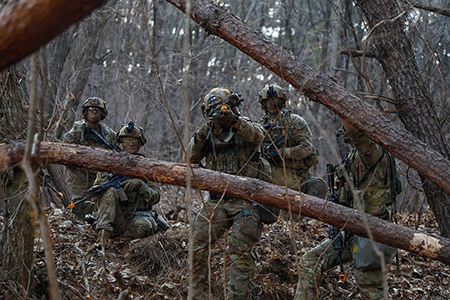
Trump has offered conflicting rationales about why he ordered a shortening of the annual drill, but it appears that he is trying to signal interest in diplomacy with North Korea. He told reporters Aug. 19 that he expects to meet with North Korean leader Kim Jong Un by the end of the year.
In an Aug. 16 post on Truth Social announcing the decision, Trump wrote that he was “not happy” with U.S. participation in the joint military exercises because of his “very good relationship with Kim Jong Un.”
The drills “send a signal that is totally inappropriate and hostile” to North Korea, which has been “unthreatening and respectful” to the United States during his presidency, Trump said. But he also criticized the drills as expensive, saying most costs are “paid for by the United States of America (as usual!),” and complained that South Korea is not doing enough to support U.S. efforts against Iran. Trump implied he would have canceled the exercises outright, but it was “too late” to do so.
The drills, which began Aug. 17 and were set to run through Aug. 28, ended Aug. 21. The Defense Department said in an Aug. 18 statement that “there will be no degradation to U.S. training objectives” due to the shortened schedule.
South Korean President Lee Jae-Myung did not respond to Trump’s post directly, but he raised the issue during an Aug. 18 cabinet meeting. According to a report on the meeting issued by his office, “Lee emphasized that while creating peace without the need for conflict is of the utmost importance, preparation for the worst-case scenario is also necessary.” The readout stated that the August military exercises are defensive in nature and that South Korea has no intention of attacking North Korea or escalating tensions on the peninsula through it.
North Korea’s state-run Korean Central News Agency (KCNA) denounced the drill, despite the reduced duration and South Korea’s description of it as defensive. In an Aug. 19 commentary, KCNA accused the United States and South Korea of “hiding the aggressive and provocative nature of the largest-ever exercises.” The statement said the exercise “is pushing again the tensions on the Korean peninsula to the threshold of a war.”
The day after Trump announced a curtailment in the exercises, he told reporters that he has been in contact with Kim and that Kim responded to his request for a meeting.
Yet, Kim Yo Jong, the sister of North Korea’s leader, denied any contact with Trump. In an Aug. 19 statement on KCNA, she said the relationship between Trump and Kim “is still excellent,” but her brother is “not aware” of any communication. The “U.S. hostile policy toward [North Korea] has remained unchanged,” she said.
Kim Yo Jong also said the U.S. decision to shorten joint exercises with South Korea is “unworthy of comment” and suggested that the curtailment will not alter North Korea’s view of engagement with the United States. If the United States “calculates that it can propagate its recent measure as the one of so-called good faith, they will not get desired answer,” she said.
The last time the United States adjusted its military exercises with South Korea on short notice was in 2018, after Trump’s historic meeting with Kim in Singapore. (See ACT, July/August 2018.) During that meeting, Trump and Kim signed a declaration committing their two countries to denuclearization of the Korean peninsula. Trump and Kim met twice after that during the following year, but the negotiations achieved few tangible results before breaking down.
Since then, North Korea has taken steps to expand its nuclear weapons program, solidify the role nuclear weapons play in its defense, and strengthen its relationship with Russia. Pyongyang now says that North Korea will not negotiate with the United States unless Washington drops its demand for denuclearization.
When previously asked about Trump’s willingness to negotiate with Kim during his second term, the White House stated that dialogue should take place based on the Singapore summit declaration. It is unclear if Trump will move from that demand in order to meet with Kim.
The Lee administration has already deemphasized denuclearization. South Korea’s new strategy toward North Korea drops denuclearization as Seoul’s priority and emphasizes the need to pursue peaceful coexistence before the elimination of nuclear weapons, according to South Korean Unification Minister Chung Dong-young.
Chung outlined the new approach to negotiations with North Korea in a July 23 press briefing. He said that “the ultimate goal of denuclearization has not been abandoned, but denuclearization first has.” Chung said that the Lee administration’s decision to “reset the goals of its North Korea policy” to emphasize “peace first” is a more pragmatic approach that acknowledges the reality of the situation on the Korean peninsula.
He also said that if South Korea emphasizes denuclearization “at the entrance to dialogue, the reality is that dialogue cannot begin.” Instead of insisting on denuclearization early in the process, South Korea’s strategy will call for North Korea to halt nuclear weapons development and later roll it back.
North Korea’s state-run media did not respond directly to Chung’s remarks, but the Foreign Ministry said in a statement July 24 in KCNA that the United States, Japan, and South Korea cannot “bring up for discussion again the issue of ‘denuclearization,’ which was irreversibly and finally concluded.”
Lee’s willingness to deemphasize denuclearization, however, may make it easier for the Trump administration to move away from the Singapore declaration as a starting point for any new talks with North Korea.