


“Right after I graduated, I interned with the Arms Control Association. It was terrific.”
Trump Adds Conditions to U.S.-Saudi Nuclear Cooperation Deal
September 2026
By Kelsey Davenport
The United States signed a nuclear cooperation agreement with Saudi Arabia, but President Donald Trump’s announcement that the deal is contingent upon the kingdom’s recognition of Israel throws the deal’s future into doubt.
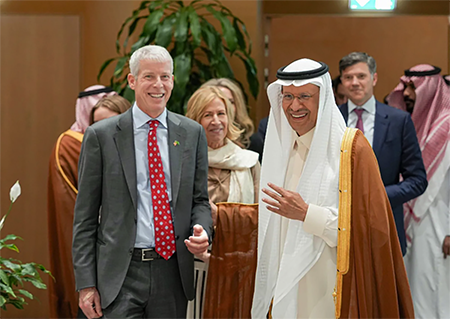
U.S. Energy Secretary Chris Wright and Saudi Energy Minister Prince Abdulaziz bin Salman signed the nuclear cooperation agreement, commonly known as a “123 agreement,” July 20 and July 22, respectively.
The agreement, which is necessary before U.S. companies can sell certain nuclear materials and related technologies, was expected after the White House announced a framework for nuclear cooperation with Saudi Arabia in November 2025. (See ACT, December 2025.)
In a statement issued after the signing, Wright said that the agreement upholds “the highest standards of nuclear safety and nonproliferation.” The deal, however, supports Saudi Arabia’s plan to acquire uranium enrichment technologies necessary to produce nuclear fuel, without insisting on more intrusive International Atomic Energy Agency (IAEA) monitoring. That same technology can be used to produce fissile material for nuclear weapons.
Saudi Arabia does not have a nuclear weapons program and pledged as a member of the nuclear Nonproliferation Treaty (NPT) not to acquire such weapons, but officials, including Crown Prince Mohammed bin Salman, have threatened to build nuclear weapons if Iran does. (See ACT, June 2018.) According to documents obtained by Arms Control Today, Trump formally signed the required presidential determination that the agreement does not “constitute an unreasonable risk to common defense and security” July 16, despite those threats.
The day after Wright signed the deal, Trump posted on Truth Social that the nuclear cooperation agreement “will be approved, but is totally subject to Saudi Arabia joining the very respected and successful Abraham Accords.”
Saudi Arabia has not responded to Trump’s demand regarding the Abraham Accords, a diplomatic framework that led several countries, including the United Arab Emirates and Bahrain, to recognize Israel, but Israeli Prime Minister Benjamin Netanyahu praised the decision. In a July 23 statement, Netanyahu said that Saudi Arabia joining the accords would be a “historic leap forward for peace in the Middle East.”
The Trump administration submitted the nuclear cooperation agreement and the required nonproliferation assessment to Congress for a 90-day review, as required by the Atomic Energy Act on Aug. 24.
The deal is expected to receive pushback from Republican and Democratic legislators, but it is unclear if there will be enough opposition to pass a joint resolution of disapproval, which would block the deal from going forward.
Several members of Congress have already expressed concerns about the agreement because it abandons longstanding conditions for U.S. nuclear cooperation that have bipartisan support. Sen. John Kennedy (R-La.) told the CBS show, “Face the Nation,” July 26 that he was not comfortable with the nuclear cooperation agreement as presented but said, “I don’t think it’s going to happen, anyway.”
All U.S. nuclear cooperation agreements must meet certain nonproliferation criteria enumerated in Section 123 of the Atomic Energy Act, such as the requirement that all nuclear material transferred under an agreement be under IAEA safeguards. Congress, however, has generally supported requiring states to adhere to even more intrusive IAEA monitoring and pushed them to forgo the option to enrich uranium and reprocess plutonium, an approach to nuclear cooperation agreements known as the “gold standard.”
The Trump administration already acknowledged in a November 2025 report to Congress that the nuclear cooperation agreement with Saudi Arabia will not meet the gold standard. The text of the deal confirms that the United States will support Saudi Arabia’s decision to develop uranium enrichment and will not require it to negotiate a more intrusive IAEA safeguards agreement, known as the additional protocol. (See ACT, April 2026.)
The additional protocol, which was finalized in 1997 after illicit nuclear programs in Iraq and North Korea exposed gaps in the NPT-required safeguards, gives the IAEA expanded access to a country’s nuclear sites and additional information about the program. The United States has long supported the universalization of the additional protocol and pushed for its inclusion in nuclear cooperation agreements.
In the November 2025 report to Congress, the Trump administration said that the United States would implement a bilateral safeguards agreement with Saudi Arabia in lieu of the additional protocol. A document outlining the safeguards arrangements submitted to Congress Aug. 24 includes additional details on the information and access that Saudi Arabia will provide the IAEA.
The documents confirm that cooperative U.S.-Saudi nuclear activities could include uranium enrichment, a capability that Riyadh says it wants to develop in order to produce nuclear reactor fuel. (See ACT, March 2023.)
The nuclear cooperation agreement requires a two-year feasibility study that examines the commercial viability of uranium enrichment in Saudi Arabia. If the study supports enrichment, one option could be for the United States to build and operate an enrichment facility in Saudi Arabia to prevent Riyadh from having direct access to U.S. enrichment technology—but it is unclear how Washington would prevent information about enrichment from leaking to Saudi officials or secure the facility in the event of conflict. The United States has never supplied enrichment technology as part of a nuclear cooperation agreement.
According to The Wall Street Journal, if the study does not support enrichment, Saudi Arabia will be free to pursue uranium enrichment domestically or with another foreign partner after 10 years.
Members of Congress have also raised concerns about the implications of the Saudi nuclear agreement on proliferation risks in the Middle East. Sen. John Barrasso (R-Wyo.) warned that the deal could increase proliferation risks in the region and make it more challenging to get Iran to give up uranium enrichment. Sen. Chris Murphy (D-Conn.) said it could “end up pushing Iran closer to a nuclear weapon.”