


“For 50 years, the Arms Control Association has educated citizens around the world to help create broad support for U.S.-led arms control and nonproliferation achievements.”
Syria Declares Newly Discovered Nuclear Materials to IAEA
September 2026
By Kelsey Davenport
Syria’s new government notified the International Atomic Energy Agency (IAEA) of a newly discovered cache of nuclear materials and allowed agency inspectors access to a site that was likely part of the former government’s illicit nuclear weapons development program.
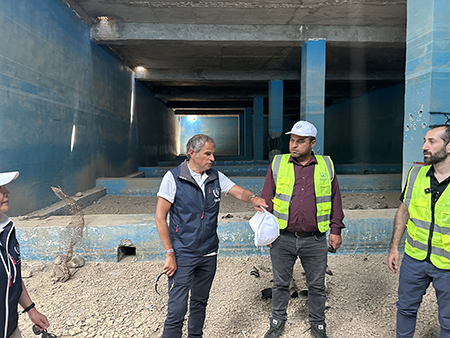
IAEA Director-General Rafael Mariano Grossi praised Syria’s “courageous decision” to notify the IAEA about the nuclear material in an Aug. 18 joint press conference with Syrian Foreign Minister Asaad al-Shibani in Damascus.
Grossi visited Syria Aug. 17-18 and went to the location where Syria discovered several tons of undeclared nuclear material, which Damascus described as a legacy of the former Assad government. Syria informed the agency that it discovered the material in a July 17 letter. The letter has not been made public but Shibani referenced it during the Aug. 18 press conference.
Grossi did not specify what type of material was found at the site, but Shibani, said that the nuclear “materials do not pose a risk.” Axios reported Aug. 10 that U.S. officials said that the nuclear material is uranium oxide, or yellowcake, a refined uranium ore that can be converted into gas for enrichment. The enriched uranium is then fabricated into fuel for a nuclear reactor.
Under deposed President Bashar al-Assad, Syria conducted undeclared nuclear activities, including the construction of a nuclear reactor at al-Kibar in the Deir el-Zour province. The reactor, which was never declared to the IAEA, was likely intended to produce plutonium for nuclear weapons. Israel destroyed the unfinished reactor in a September 2007 air strike. The U.S. intelligence community later assessed that North Korea assisted Syria in constructing the reactor. (See ACT, April 2018.)
After the Israeli strikes, the Assad government refused to allow the IAEA to inspect the bombed site when the agency first requested access in 2008 and denied conducting undeclared nuclear activities. Syria continued to obstruct the agency’s efforts to investigate its undeclared nuclear activities and later cleared the site. In 2011, the IAEA Board of Governors adopted a resolution finding Syria in noncompliance with its legally required safeguards obligations under the nuclear Nonproliferation Treaty. (See ACT, July/August 2011.)
Before being overthrown in 2024, Assad let an agency team visit the al-Kibar site. The IAEA took samples, which indicated that uranium had been present at the location. In June 2025, Grossi met Syria’s transitional President Ahmad al-Sharaa and announced that Syria’s new government agreed to give the agency unrestricted access. (See ACT, July/August 2025.)
During his Damascus visit, Grossi said the newly discovered nuclear materials will now be accounted for and “put within the international safeguards system.” He added: “In this way, we will be able to work towards the restoration of Syria as a country in full compliance with all its legal obligations in the area of nuclear nonproliferation.”
Shibani said the nuclear materials will “remain in Syria’s custody, while being subject to the agency’s supervision system.” He suggested during the press conference that Syria may seek to use the nuclear materials for a peaceful nuclear program.
Grossi also visited the al-Kibar site while in Syria. He confirmed that the IAEA’s inspection and excavation of the site was already underway and described the results of the cooperative effort as “really, really remarkable.” He said the agency’s work at al-Kibar “validates the long-standing evaluation” that the nuclear reactor at the site “was being built in secrecy.”
An Aug. 18 joint statement from Grossi and Shibani said that Grossi will report the agency’s conclusions to the IAEA Board of Governors “with the aim of a full resolution of the outstanding issues.”
The Syrian government is also cooperating with the Organisation on the Prohibition of Chemical Weapons to dispose of chemical weapons stockpiled by the Assad regime. (See ACT, July/August 2026.)