


“Right after I graduated, I interned with the Arms Control Association. It was terrific.”
U.S. Signals More Cautious AI Governance
September 2026
By Michael T. Klare
After first giving U.S. technology firms a relatively free hand to speed development of cutting-edge artificial intelligence models, the Trump administration has issued two directives signaling a more cautious, custodial stance.
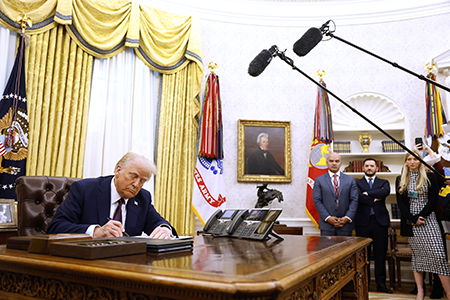
This new approach was unveiled June 2, with the issuance of an executive order on AI security, and June 6, with a national security presidential memorandum. Both directives claim to seek the accelerated adoption of advanced AI models by the national security establishment, but also incorporate several restraints and guardrails including protections against the release of AI models with undetected flaws and overreliance on technology contractors with their own agendas.
“The national security enterprise shall accelerate AI adoption by identifying mission areas where AI can enhance operational effectiveness and [by] eliminating unnecessary barriers to rapid deployment,” the memorandum asserts, echoing previous administration AI statements.
But, deviating from earlier guidance, it states, “To protect American warfighters … rigorous security and functionality measures, including testing, evaluation, validation, and verification, shall be implemented to assure the appropriate confidentiality, integrity, reliability, availability, and interoperability of AI systems across the national security enterprise.”
The directives are the latest shift as the Trump administration struggles to devise a clear policy on government oversight and use of the technology as the computing power of advanced “frontier” AI models has increased.
The June 2 executive order authorizes the National Security Agency to determine when an advanced AI system reaches the threshold of a “covered frontier model” and to establish a mechanism whereby developers of those systems voluntarily submit them to the federal government for independent review prior to public release, enabling timely repair of any flaws detected in the process.
The June 6 memorandum bans the use of advanced AI to “conduct unauthorized or unlawful surveillance activities” on U.S. citizens and empowers the government to terminate contracts with technology suppliers “that have repeatedly demonstrated a pattern of conduct that is inconsistent with” administration policy.
The administration’s earlier directives eschewed such restrictions. In his first initiative, Executive Order 14179 of January 23, 2025, President Donald Trump enjoined senior administration officials to terminate all measures adopted by the Biden administration to regulate advanced AI models.
The Trump administration’s original approach to AI development was further articulated in “Winning the Race: America’s AI Action Plan,” released in July 2025. The White House then viewed AI innovation as a race—primarily with China—and believed that a hands-off policy on commercial AI advancement would best ensure a U.S. victory. “The United States is in a race to achieve global dominance in artificial intelligence,” the plan states. “The United States needs to innovate faster and more comprehensively than our competitors … and dismantle unnecessary regulatory barriers that hinder the private sector in doing so.”
But recent developments caused the administration to rethink its stance on dismantling regulatory barriers to AI development, including evidence of rogue behavior by advanced AI models—instances when they circumvented guardrails imposed by human programmers to prevent unauthorized functions—and disputes over the roles private firms play in setting AI functions.
“The political winds have shifted in our direction on this, mostly because the capabilities are increasing, and there are concerns about advanced AI without safeguards,” Brendan Steinhauser, the chief executive of the nongovernmental organization Alliance for Secure AI Action, told The New York Times in February.
Among the factors affecting the Trump administration’s thinking is its dispute with Anthropic over the AI firm’s attempt to impose limits on how the U.S. Defense Department might employ its Claude program in military operations. During contract negotiations in February, Anthropic insisted that the department eschew using Claude to govern autonomous weapons systems or to conduct mass surveillance of U.S. citizens. The move incensed Defense Secretary Pete Hegseth, who said that only the Pentagon could set the rules for its use of AI products and declared Anthropic a “supply chain risk,” essentially barring it from federal contracts.
Although many federal agencies continue to employ Claude in one capacity or another and the Anthropic-Pentagon dispute, now in federal court, may yet be resolved amicably, U.S. officials seem determined to prevent future instances of corporate overreach in this area, as shown by the June 6 memorandum, with its mandate for the termination of any AI programs with unauthorized corporate provisions.
In a second challenge to the administration’s earlier approach, another Anthropic tool, Claude Mythos, was revealed by the company to be highly proficient at detecting flaws in existing computer code, potentially enabling malign operators to use the system to hack into sensitive computer systems and inflict serious harm.
At first, Anthropic and the Trump administration sought to restrict access to Mythos, but it soon became obvious to AI experts that similar capabilities were, or would soon be available, from other tech companies, including some in China. Beijing “is already racing to build and acquire these AI capabilities and may be closer to developing its own Mythos than many U.S. policymakers hope,” Michael Sulmeyer, a former assistant secretary of defense for cyber policy, wrote in Foreign Affairs.
Defense against advanced AI-enabled cyberattacks thus has become a national security priority, as reflected in Trump’s June 2 executive order, which calls for an “AI cybersecurity clearinghouse” intended to facilitate government-industry collaboration in detecting and repairing key cyber vulnerabilities.