

“For 50 years, the Arms Control Association has educated citizens around the world to help create broad support for U.S.-led arms control and nonproliferation achievements.”
German Military to Join French Nuclear Exercise for First Time
September 2026
By Libby Flatoff
German Chancellor Friedrich Merz announced that the German military will be participating in a French nuclear exercise for the first time as a part of France’s new deterrence strategy.
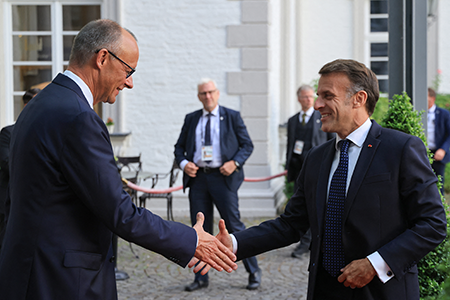
“We will have German conventional forces participate in a nuclear exercise conducted by the French armed forces before the end of this year,” Merz said at a July 17 news conference with French President Emmanuel Macron, according to the Associated Press.
The announcement came after Germany and France formed a nuclear steering group March 2, “to coordinate strategic doctrine and exercises.” (See ACT, March 2026.)
Politico reported July 16 that the drills would be part of France’s flagship nuclear exercise, “Poker,” and take place in September. The Federation of American Scientists reported in its 2025 overview of French nuclear weapons that France’s Strategic Air Forces Command conducts about 70 exercises per year, four of which are part of Poker.
The exercise involves “a majority of France’s nuclear-capable Rafale aircraft, which during flights carry unarmed air-sol moyenne portée-amélioré (ASMPA) air-launched cruise missiles,” according to the federation’s profile. The drill carries out a simulated nuclear aid raid and includes refueling operations by A330 MRTT tankers and “penetration of enemy airspace and firing of ASMPA missiles by Rafale fighters.”
On July 16, France and Germany took the first operational step and conducted a joint conventional air activity “in the context of the French concept of forward deterrence,” according to a press release from the French armed forces ministry. No nuclear forces were used, the release stated.
At the July 17 news conference, Merz emphasized that this new drill “complements our commitment to NATO’s nuclear sharing and deterrence arrangements, which we continue to uphold.” Macron noted that he viewed Germany as playing a “vanguard role” in European deterrence.
In April, Germany produced its first defense strategy that noted its goal is to become “the strongest conventional
army in Europe.” The strategy names Russia as Europe’s biggest threat and also asserts that “Germany must … become an even stronger military Ally to the United States.”
As of January 2026, Stockholm International Peace Research Institute estimated that a number of NATO member states, including Germany, together host 100 to 120 U.S. B61-12 nuclear bombs as a part of the alliance’s nuclear sharing agreement.
The Franco-German exercise will occur after the United States announced a new six-month force posture review in Europe as it pushes Europe to be primarily responsible for its own defense (See ACT, July/August 2026.) France also conducted two other nuclear steering group meetings, one with Sweden April 23 and the other with Poland July 10.