

August 2026
Last month, I and two members of ACA's Board of Directors, Maryann Cusimano Love and Matthew Bunn,were privileged to participate in a highly significant event held at the Vatican: "The Global Nobel Laureates Assembly on Artificial Intelligence (AI) and Nuclear War."
The July 14-16 gathering was a rare convocation of senior experts from key AI companies, Nobel laureates in physics and peace, faith leaders, including from the Vatican, and some of the world’s top nuclear weapons policy experts.
The Assembly, which was held shortly after Pope Leo issued his historic encyclical on “Disarming AI,” was also very timely.
The world’s nuclear-armed states are rapidly integrating AI into their nuclear weapons operations. This development complicates the dangerous array of nuclear weapons-related dangers the world is already facing.
As I explained in my presentation to the conference: "AI introduces new uncertainties to the already uncertain nuclear deterrence equation. Immediate and decisive action is required to counter these growing nuclear dangers before it is too late."
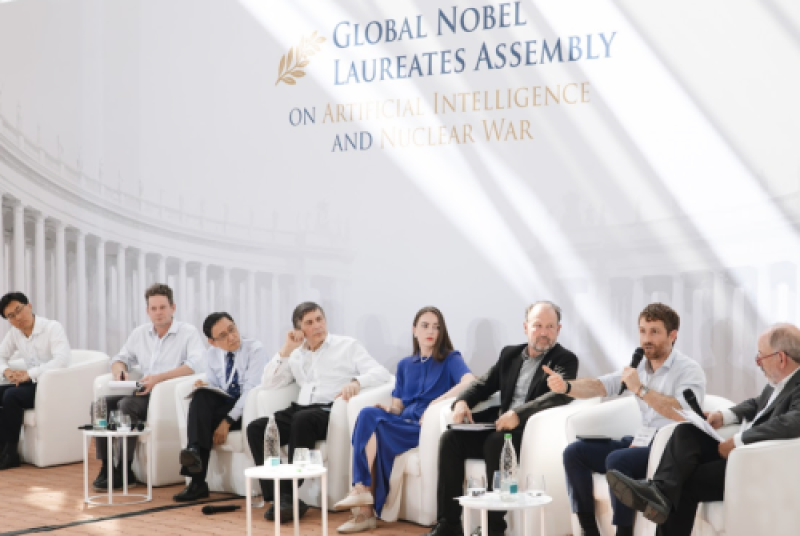
Panelists during a session on “The Use of AI in Nuclear Weapon Systems” on July 14, 2026. Left to right, Tong Zhao (Carnegie Endowment), Jason Pruet (OpenAI), Tatsujiro Suzuki (Nagasaki University), Andre Konstantin Geim (2010 Nobel Prize in Physics), Oleksandra Matviichuk (2022 Nobel Peace Prize), Daryl G. Kimball (Arms Control Association), Tristan Harris (Center for Humane Technology), and the moderator, John Mecklin (Bulletin of the Atomic Scientists).
Although there is a loose consensus that AI must never supplant human judgment in the authorization or execution of nuclear weapon launches, our research, and that of many others, indicate that this so-called "human in the loop" principle, while necessary, is woefully insufficient.
What’s more, the pace of "frontier" AI development is accelerating and may soon send us into new and unknown territory. Just last month, top CEOs and technical experts from the world's leading AI companies including Anthropic, OpenAI, Google, and Meta issued an important statement saying they "believe they could be close to automating AI research."
They warn that "there is a real risk that [this] development rapidly accelerates beyond our ability to understand or control the resulting systems."
The political, diplomatic, and legislative responses to regulate these technologies in the military realm are failing to keep pace with the rapid development of these AI large language models.
As ACA has been saying for some time, and was written in the "Rome Declaration" that emerged from the Assembly: "We call on governments, frontier AI developers, researchers and the international community to act now."
The situation requires that we redouble our efforts to press nuclear weapon states to engage in sustained nuclear arms and risk reduction talks, especially on responsible approaches to the use of AI in nuclear systems.
ACA is now working to fortify our existing capacity to raise awareness and advance actionable technically-sound solutions that can help mitigate the risks posed by AI in nuclear weapons operations.
We invite you to learn more and to support our efforts on this rapidly evolving challenge with a special financial gift.
Thanks for your engagement and support!

Daryl G. Kimball, Executive Director
The Rome Declaration on Artificial Intelligence and Nuclear Weapons
The text of the appeal from the participants from the “Nobel Laureates Assembly on AI and Nuclear War,” plus the program and participants list, can be accessed online here: globalnobelassembly.org
ACA Event: "Mitigating the Risks of AI in Nuclear Operations," Sept. 11
ACA will host a hybrid policy briefing on Friday September 11 at 9:30 a.m. to 11:00 a.m. Eastern Time at the National Press Club in Washington, D.C. featuring the inaugural director of the U.S. Department of Defense Joint Artificial Intelligence Center, Lt. Gen. John “Jack” N.T. Shanahan.
Shanahan warned in a 2025 article in Arms Control Today that the use of AI to integrate disparate data sources to build a cohesive picture of ongoing military operations “may create false confidence in the information that is shaping leaders’ situational awareness and influencing nuclear-related decisions."
You can register to attend the event in-person or watch the webcast here.
Countryman Visits Europe and China
ACA’s Board Chair, Thomas Countryman, officially retired after 35-year of public service at the State Department in 2017, but he hasn’t stopped working hard for global peace and security.
Last month alone, Tom was invited to speak at the OSCE Parliamentary Assembly at The Hague on the rising nuclear weapons threat and how to head it off organized by the Open Nuclear Network.
He then flew off to speak about nuclear materials security challenges in Beijing at an annual “U.S.-China Track 2 Dialogue on Nuclear Security” organized by the Nuclear Threat Initiative and the Chinese Arms Control and Disarmament Association.
Countryman then traveled to Armenia for another dialogue organized by the Pugwash Conferences on Science and Global Affairs to discuss security frameworks for Europe after a resolution of Russia’s war on Ukraine.

Countryman (second from left) and some of the organizers of the U.S.-China track 2 dialogue.
ACA Assails Flawed U.S.-Saudi Nuclear Cooperation Deal
The Trump administration and the Saudi government finally finalized their controversial agreement for nuclear cooperation on July 17. As expected:
- It provides a pathway for the Saudis to acquire enrichment technology.
- It does not require the Saudis to implement safeguards under the terms of the additional protocol to its safeguards agreement with the IAEA.
“The Saudis wish to keep open the option of pursuing nuclear weapons,” ACA Board Chair, Tom Countryman, told Politico. “The additional protocol restricts future options of Saudi Arabia with a nuclear program.”
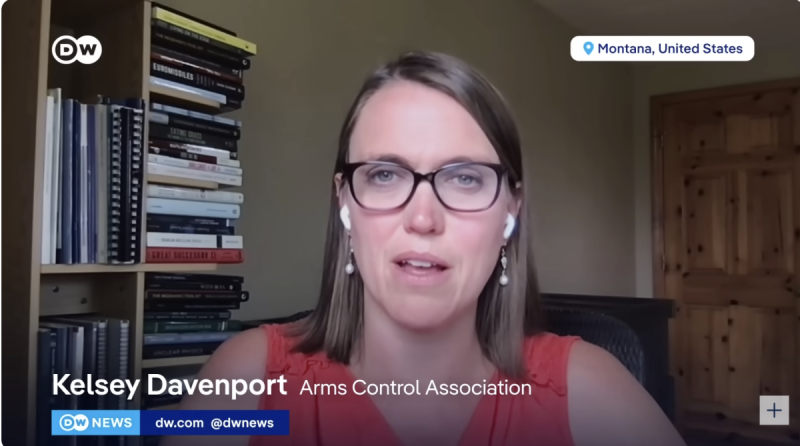
Watch ACA Director for Nonproliferation Policy Kelsey Davenport's interview on Deutsche Welle (7/22/2026).
“When I discussed this on three occasions with the Saudis … 10 years ago, I made clear that we have to have a Saudi additional protocol signed with the International Atomic Energy Agency,” Countryman continued. “That was the point that prevented them from moving forward into actual negotiations during the Obama administration.”
Within 24 hours of the announcement, our team issued a detailed informational memo to all Congressional offices and we issued a detailed press statement calling upon Congress to block or amend the agreement.
Congress will have 90 continuous session days to block or amend the agreement once it is sent to Capitol Hill. Stay tuned for further updates.
ACA Responds to Reported Shift in Pentagon Nuclear Strategy
As we reported in Arms Control Today in April, the Defense Department decided to conduct a “nuclear strategy review” rather than a formal Nuclear Posture Review (NPR).
According to an August 5 NBC News report, Undersecretary for Defense Policy Elbridge Colby, who is leading the review, wants to de-emphasize but not eliminate the long-standing requirement for “damage limitation” capabilities. This approach calls for a massive strategic nuclear attack against a U.S. nuclear adversary to try to destroy as many of their nuclear strike systems as possible. At the same time, Colby says the Pentagon wants to create more “credible” options for the president to threaten to or to wage a nuclear war at the regional level with “tactical” nuclear weapons.
ACA’s Daryl Kimball told NBC News that he would welcome a change in nuclear policy that discards the concept of a threatened massive strike against an enemy’s entire nuclear force, which has driven up the number of U.S. and Russian arsenals for decades and increased the risk of a catastrophic war.”
But he told NBC, “It would be dangerous to put forward a new strategy that doubles down on tactical nuclear weapons as a viable option. “Once nuclear weapons are used in a conflict involving another nuclear-armed state, there is no guarantee that any use of nuclear weapons, even on the smallest scale, could reliably be expected to remain limited,” he said.
Look for further updates in the news section of the September issue of Arms Control Today.
The War with Iran and the Nuclear File
ACA’s expertise and analysis about Iran’s nuclear program continues to be in high demand as Trump and Iranian leaders engage in on-again-off-again talks and hostilities in the Middle East.
If an arrangement can be struck to re-open safe passage for ships and cargo through the Strait of Hormuz, talks on how to limit Iran’s nuclear program in exchange for sanctions relief might resume.
ACA has spelled out in writing and in briefings and press interviews what the remaining Iran-related nuclear proliferation challenges actually are and how they might be resolved through more effective and sustained diplomacy. See our June 22 Issue Brief, "Assessing the Islamabad MOU and the U.S.-Iran Nuclear Negotiations,” and “Managing the Dangers of Iran’s Remaining Nuclear Capabilities,” an article by ACA Board member Matthew Bunn in the May issue of Arms Control Today.
ACA In the News
“The AI Ghost in the Nuclear War Machine,” Arms Control Today feature article contributor Lt. Gen. John N.T. Shanahan is quoted in New Republic, June 21.
“The Iran-US MOU: Why Experience Matters In Nuclear Diplomacy,” ACA nonproliferation policy director, Kelsey Davenport, is cited by Forbes, June 25.
“How Trump’s ‘original oil guy’ boosted US-Israel ties and played down risks of Iran war,” in The Guardian, July 16, quotes ACA Visiting Fellow Michael Klare.
“Nuclear deal that would permit uranium enrichment by Saudi Arabia in limbo awaiting Trump admin sign-off,” cites Davenport in CNN, July 18.
“What is Pickaxe Mountain? Trump says US will hit Iranian nuclear site 'pretty soon',” features comments from Davenport in ABC News, July 21.
“Why a Saudi nuclear deal is a perfect metaphor for Trump’s presidency,” by CNN, July 23, quotes Davenport.
“How Trump’s Saudi deal could spark a nuclear arms race in the Middle East,” the Arms Control Association is cited by The Independent, August 2.
“Fact-checking Trump's claims about how the Iran war is going,” features analysis from ACA Executive Director Daryl G. Kimball in PBS Newshour, August 2.
“The last thing we need is a nuclear pathway for Saudi Arabia,” written for The Hill by senior adviser to the Arms Control Association, Irwin Redlener, August 4.
“As AI complicates nuclear threats, religious groups are doubling down on calls for disarmament,” an article in Truthout cites Kimball’s description of the Nobel Laureates Assembly on AI and Nuclear War, August 5.
"How the American “Better” Became the Enemy of the Good" an August 5 Kommersant report on the situation six months after the expiration of New START, quotes analysis from Daryl Kimball (original in Russian).
“Pentagon drafting a new U.S. nuclear strategy in case of regional war with China or Russia, sources say,” Kimball is cited by NBC News, August 5.