


"I find hope in the work of long-established groups such as the Arms Control Association...[and] I find hope in younger anti-nuclear activists and the movement around the world to formally ban the bomb."
U.S., Saudi Arabia Announce Nuclear Cooperation
December 2025
By Kelsey Davenport
Saudi Arabia and the United States negotiated a joint declaration on civil nuclear cooperation, but key details about the terms of the final deal, including whether Saudi Arabia will be permitted to enrich uranium, remain unclear.
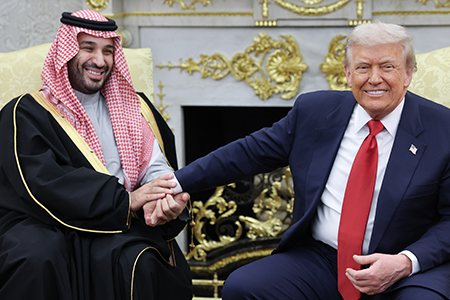
According to a Nov. 18 factsheet released by the White House, the two countries finalized a “Joint Declaration on the Completion of Negotiations on Civil Nuclear Energy Cooperation” during Saudi Arabian Crown Prince Mohammed bin Salman’s Nov. 18 meeting with U.S. President Donald Trump at the White House.
According to the statement, the declaration “builds the legal foundation for a decades-long, multi-billion-dollar nuclear energy partnership” and confirms that “the United States and American companies will be [Saudi Arabia’s] civil nuclear cooperation partners of choice.” The cooperation will be consistent with “strong nonproliferation standards,” the factsheet said.
Saudi Arabia is currently soliciting bids for two large nuclear power reactors and has expressed its intention to develop the entire nuclear fuel cycle, including enriching uranium and fabricating reactor fuel. (See ACT, March 2023.)
The United States has long sought to prevent the spread of enrichment and reprocessing because the technologies can be used to produce fissile materials for nuclear weapons. The issue of enrichment has stalled U.S.-Saudi nuclear negotiations for years, in part because Saudi Arabia has openly threatened to develop nuclear weapons.
In September 2023, bin Salman said that if Iran acquires a nuclear weapon, “we have to get one.” (See ACT, November 2023.) As a party to the nuclear Nonproliferation Treaty (NPT), Saudi Arabia is prohibited from developing or acquiring nuclear weapons.
U.S. Secretary of Energy Chris Wright said in a Nov. 19 interview on Fox News that the joint declaration is just for “American technology, American companies to build a very large nuclear power plant in Saudi Arabia.” He said there is “no enrichment” in the deal. It is unclear, however, if Wright was referring to the joint declaration or the final nuclear cooperation agreement, known as a “123 agreement,” that the Trump administration will need to share with Congress before certain technologies and materials can be transferred. The 123 agreements that meet certain criteria do not require congressional approval but can be subjected to a vote of disapproval. Agreements that do not meet certain criteria require a vote of approval. It is unclear yet what will happen in this case.
Section 123 of the Atomic Energy Act lays out the conditions for congressional approval. These include implementing safeguards, refraining from using transferred materials or technologies for developing a nuclear-explosive device, and obtaining advance U.S. consent before enriching or reprocessing nuclear materials transferred under the deal or producing nuclear materials using technology transferred under the terms of the agreement.
Following the announcement of the joint declaration, the chairman of the Senate Foreign Relations Committee, Senator Jim Risch (R-Idaho) and the ranking member, Senator Jeanne Shaheen (D-N.H.), said separately that any 123 agreement with Saudi Arabia should be a “gold standard” agreement, which includes a prohibition on uranium enrichment and plutonium reprocessing.
Under a gold standard agreement, a state is also required to implement an additional protocol to its legally required safeguards agreement. Saudi Arabia has not negotiated an additional protocol with the International Atomic Energy Agency (IAEA).
It is unclear if the Nov. 18 joint declaration includes a requirement that Saudi Arabia implement the additional protocol. In a Nov. 19 statement, Wright said there would be “bilateral safeguard agreements,” suggesting that the United States and Saudi Arabia might negotiate a separate monitoring agreement.
Saudi Arabia would still be required, however, to implement its comprehensive safeguard agreement with the IAEA under the NPT.