


“Right after I graduated, I interned with the Arms Control Association. It was terrific.”
North Korea Appears to Reject Trump’s Offer for Talks
December 2025
By Kelsey Davenport
U.S. President Donald Trump said he hoped to meet with North Korean leader Kim Jong Un in the “not-too-distant future,” but a senior North Korean official said the Trump administration should not expect its intensifying pressure on Pyongyang to yield results.
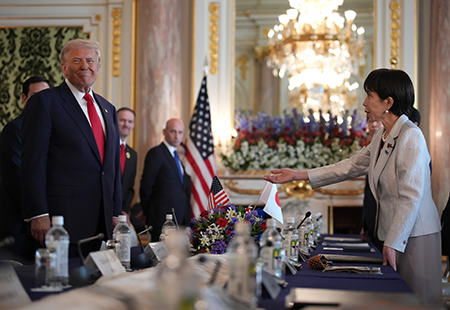
Speaking to reporters after an Oct. 29 meeting with South Korean President Lee Jae-Myung, Trump said he will do what he can to get the relationship between North and South Korea “straightened out” and downplayed North Korea’s recent missile tests. He suggested that he would use the lure of relief from U.S. sanctions to bring Kim to the negotiating table.
Trump said he was willing to meet with Kim during his trip to Asia in October, but it is unclear if his administration attempted to set up a meeting.
North Korea has not ruled out negotiating with the United States, but Kim has said multiple times that Washington must drop its demand for denuclearization before talks commence. (See ACT, October 2025.)
Trump and Lee, however, reaffirmed the U.S. and South Korean commitment to the denuclearization of North Korea, according to a Nov. 13 White House factsheet on the meeting. The factsheet also stated that South Korea and the United States pledged to “work together to implement” the Singapore Declaration from Trump’s meeting with Kim in 2018. (See ACT, July/August 2018.) In addition to the commitment to denuclearize the Korean peninsula, Kim and Trump pledged to build a lasting and stable peace regime in the region.
A Nov. 18 report by the North Korean news service KCNA criticized the Lee-Trump meeting and said the reference to denuclearization in the Nov. 13 factsheet proves “their only option is confrontation” with North Korea. It also said the 2018 agreement was “scrapped and nullified.”
The commentary accused South Korea and the United States of “anti-DPRK moves and escalation of tensions” and said these views “became more blatant since the emergence” of the second Trump administration.
In an earlier Nov. 6 KCNA statement, Vice Foreign Minister for U.S. Affairs Kim Un Chol criticized the U.S. pressure campaign in response to a U.S. announcement of new sanctions designations targeting North Korea’s illicit financing networks. He said the United States “should not expect or desire to see its own mode of dealing, which is full of pressure, appeasement, threat, and blackmail, working on [North Korea] someday.”
In a Nov. 4 press release, the U.S. Treasury Department announced the new sanctions, which target eight individuals and two entities for laundering money that North Korea acquired illicitly, primarily in cryptocurrency. The U.S. undersecretary of the Treasury for terrorism and financial intelligence, John K. Hurley, said that “North Korean state-sponsored hackers steal and launder money” to fund the country’s nuclear weapons program. The sanctioned entities and individuals “directly threaten U.S. and global security” by generating revenue for North Korea, he said.
“North Korea-affiliated cybercriminals have stolen over $3 billion” in the past three years, according to the department’s press release, which also noted that the illicit networks targeted by the new sanctions have ties to China and Russia.
Kim Un Chol said the “U.S. sanctions will have no effect on [North Korea’s] thinking” and that it is a “foolish move” to expect a “new result” from sanctions policy. The Trump administration has “clarified its stand to be hostile” toward North Korea, so Pyongyang will “take proper measures to counter” the United States, he said.
The Nov. 18 commentary also criticized U.S.-South Korea military drills. The frequent strategic drills prove that “the U.S. intention is to be hostile” toward North Korea and that sentiment “remains unchanged” with the new U.S. administration.
U.S. Secretary of Defense Pete Hegseth’s trip with South Korean Defense Minister Ahn Gyu-back to the demilitarized zone (DMZ) between North and South Korea also prompted backlash that suggested North Korea is not interested in diplomacy at this time.
In a Nov. 8 statement in KCNA, North Korean Defense Minister No Kwang Chol said that the visit was meant to “fan up war hysterics” and that Hegseth and Ahn “conspired” to strengthen deterrence against North Korea and rapidly promote “the process of integrating the nuclear forces with the conventional forces.”
No described the visit as “an unveiled intentional expression of [the U.S.-South Korea] hostile nature to stand against” North Korea, to which the state “will show more offensive action against the enemies’ threat.”
Ahn said the DMZ trip had a “declarative significance” and demonstrates the “strength of the South Korea-U.S. alliance and the strength of our combined defense posture.”