


“It will take all of us working together – government officials, and diplomats, academic experts, and scientists, activists, and organizers – to come up with new and innovative approaches to strengthen transparency and predictability, reduce risk, and forge the next generation of arms control agreements.”
U.S. Supports South Korean Enrichment, Reprocessing
December 2025
By Kelsey Davenport
U.S. President Donald Trump pledged support for South Korea to enrich uranium and separate plutonium, a move Seoul says is necessary to advance its civil nuclear program.
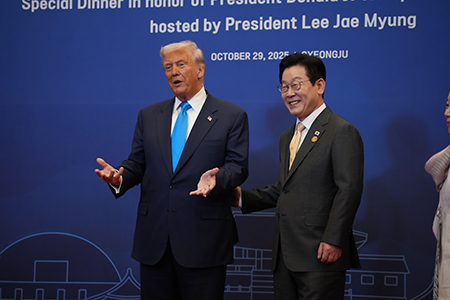
But South Korea’s acquisition of those capabilities would also give the country the ability to produce fissile material for nuclear weapons, raising the risk of proliferation at a time when there is an active debate in Seoul over the value of a national nuclear deterrent.
According to a Nov. 13 White House factsheet about Trump’s Oct. 29 meeting with South Korean President Lee Jae-Myung, the United States “supports the process that will lead to [South Korea’s] civil uranium enrichment and spent fuel reprocessing for peaceful uses.”
South Korea has long sought approval from the United States to develop enrichment and reprocessing capabilities. It argues that reprocessing spent fuel is necessary to manage nuclear waste produced by its energy reactors and that having the option to provide enriched uranium fuel for South Korean-built reactors, including those in foreign countries, also will benefit U.S. nuclear companies that partner with South Korea.
Until now, the United States has denied South Korea’s requests, consistent with Washington’s long-standing bipartisan policy to prevent the spread of enrichment and reprocessing technologies because of the risk that a state will use those capabilities to produce fissile materials for weapons.
The Nov. 13 factsheet does say that any enrichment and reprocessing must be consistent with the bilateral “123 agreement” between the two countries, suggesting the United States will press for limits on those capabilities.
Nuclear cooperation agreements are referred to as 123 agreements because Section 123 of the U.S. Atomic Energy Act lays out the conditions for cooperation and the congressional review process. Section 123 obligations include commitments that any state receiving certain U.S. nuclear technologies implement a comprehensive safeguards agreement with the International Atomic Energy Agency and obtain advance U.S. consent before enriching or reprocessing nuclear materials transferred under the deal or produced by technology transferred under the deal.
Seoul originally agreed to forgo enrichment and reprocessing when it signed a nuclear cooperation agreement with Washington in 1972, but it pushed to revisit the issue when the agreement was renewed in 2015. (See ACT, July/August 2015.)
The 2015 agreement did not give consent for enrichment and reprocessing, but it did create a pathway for Seoul to develop those technologies. The final 2015 agreement included the formation of a high-level bilateral commission to identify “appropriate options for uranium enrichment.” If the commission identifies a “mutually acceptable option” for enrichment, the agreement limits South Korea to enriching up to 20 percent uranium-235, a level below the 90 percent U-235 considered weapons grade.
The commission is also tasked with “identifying appropriate options for the management and disposition of spent fuel,” including the results of the joint fuel study on the feasibility of pyroprocessing and determining if South Korea can reprocess spent nuclear fuel.
Presumably, the commission would need to determine and define the contours of a mutually acceptable enrichment and reprocessing program in South Korea; the commission would likely do so now, given Trump’s public pledge of support. South Korean National Security Advisor Wi Sung-lac said in a Nov. 14 press briefing that “follow-up consultations are necessary to adjust our existing agreement.” Wi said the details will be negotiated.
In December 2024, the Biden administration’s Energy Department designated South Korea a “sensitive country,” a
term used for states that pose a proliferation risk. At the time, the since-removed South Korean President Yoon Suk Yeol was being impeached for declaring martial law. Yoon had suggested that South Korea may need to pursue nuclear weapons to deter North Korea.
Current President Lee is not calling for nuclear weapons development, but there is still an active debate in South Korea regarding the security value of nuclear weaponization. South Korea also has developed ballistic missiles powerful enough to deliver a nuclear warhead and built an advanced nuclear industry that it could leverage if the decision were made to develop nuclear weapons.
Under Section 123 of the Atomic Energy Act, the United States can demand the return of nuclear materials and equipment transferred under a nuclear cooperation agreement if the recipient state uses them for military purposes or an explosive device, but that would be challenging to enforce and could come too late.
North Korea responded to the announcement by accusing the United States of giving South Korea the “green light” to become a “quasi-nuclear weapons state” in a Nov. 18 commentary in the state-run Korean Central News Agency (KCNA).
Trump also announced U.S. support for South Korea’s plan to build nuclear-powered attack submarines in an Oct. 30 Truth Social post. Trump, who was in South Korea at the time, said that he gave South Korea “approval to build a Nuclear Powered Submarine” and suggested it would be better than the “old fashioned, and far less nimble diesel powered Submarines” that South Korea currently operates.
But the initial announcement stirred confusion when Trump suggested the submarines would be built in the United States, at a Korean-owned Pennsylvania shipyard that has no experience with nuclear-powered submarines. Lee, however, said the submarines will be built in South Korea. South Korean Defense Minister Ahn Gyu-back said the shipyard Trump referenced lacks the capabilities to build submarines. Ahn said South Korea has “accumulated technology” and research necessary to build the submarines domestically.
The Nov. 13 factsheet did not contain details on the location of construction. It said the “United States will work closely with [South Korea] to advance requirements for this shipbuilding project, including avenues to source fuel.”
During a Nov. 14 press briefing, Lee described the nuclear powered submarines as “a decades-long aspiration for South Korea and an essential strategic asset for peace and stability on the Korean peninsula.”
Ahn suggested in a Nov. 3 press briefing that “as long as fuel is available,” South Korea could construct its first nuclear-powered submarine in 10 years.
Ahn’s comment and the Nov. 13 factsheet suggest that South Korea will not enrich the fuel domestically for the reactor cores. South Korean Chief of Naval Operations Adm. Kang Dong-gil said the ships will be fueled with uranium enriched to less than 20 percent U-235, the upper limit allowed South Korea under the existing nuclear cooperation agreement. That agreement, however, prohibits South Korea from using any nuclear material transferred or produced under the deal “for any military purposes.”
U.S. naval nuclear-powered vessels, including U.S. nuclear-powered submarines, are fueled with above weapons-grade enriched uranium, or uranium enriched above 90 percent U-235.
North Korean leader Kim Jong Un probably will “not sleep well” given the stealth and speed of nuclear-powered submarines, Ahn said.
In the Nov. 18 KCNA commentary, North Korea said the U.S. decision to support South Korea’s development of nuclear-powered submarines is “disregarding the danger of the global nuclear arms race to be incurred by the nuclear proliferation to a non-nuclear state.”
North Korea first announced it was developing a nuclear-powered submarine in 2021.