


“It will take all of us working together – government officials, and diplomats, academic experts, and scientists, activists, and organizers – to come up with new and innovative approaches to strengthen transparency and predictability, reduce risk, and forge the next generation of arms control agreements.”
Drone Incursions in Belgium Spark Probes, NATO-EU Response
December 2025
By Shaghayegh Chris Rostampour
Belgium is conducting multiple criminal investigations after 17 recent, unexplained drone sightings over its nuclear power plants, military sites, and airports.
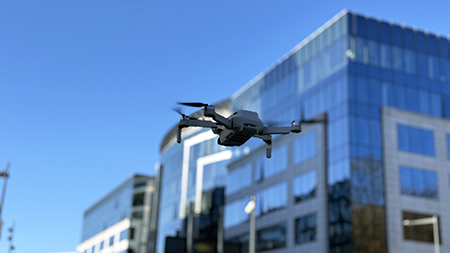
A spokesperson for Belgium’s federal prosecutors suggested that the problem escalated to the federal level due to signs of possible foreign interference. “Initially, we contact local police and prosecutors. If there are indications of espionage or interference, it will be federalized,” Yasmina Vanoverschelde told The Brussels Times Nov. 5.
Belgian Defense Minister Theo Francken confirmed Nov. 2 that a series of unidentified drone flights were observed near the Kleine-Brogel air base, which is believed to host U.S. nuclear weapons. He described the incidents as coordinated and resembling a spying operation. “By whom, I don’t know. I have a few ideas but I’m going to be careful about speculating,” he said.
But on Nov. 28, the Dutch newspaper Trouw reported that the drone alerts frequently were false alarms and revealed scant hard evidence of Russian involvement.
Additional drone sightings near the two main airports around Brussels led to temporary shutdowns Nov. 6 and Nov. 10. “At first, drones flying over our military bases were seen as our problem. Now it has become a serious threat affecting civilian infrastructure across multiple European countries,” Francken said in a Nov. 7 interview with the BBC.
NATO countries have expressed concern that such flights could be testing allied defenses. German Defense Minister Boris Pistorius linked the Belgian drone incursions to tensions over Russia’s war on Ukraine, its hybrid warfare tactics, and NATO’s consideration of using Russian frozen assets to further help defend Ukraine.
Reuters reported Nov. 10 that France, Germany, and the United Kingdom have sent experts and equipment to Belgium to help combat the drones. Addressing Belgium’s parliament, Francken announced Nov. 13 that the United States has offered “technical and operational assistance.”
Russia has denied any involvement with the drone incursions; the Russian embassy in Brussels said in a Nov. 5 statement on social media that it had “neither interest nor motive” in such activities.
Russia has been blamed for several recent airspace violations, notably in Poland and Estonia, prompting alliance security consultations under Article 4 of the North Atlantic Treaty. (See ACT, October 2025 and September 2025.) In response, NATO announced a multidomain operation Sept. 12 to “bolster NATO’s posture along the eastern flank.” At a press conference that day, NATO Secretary-General Mark Rutte said that although the operation followed Poland’s request under Article 4, “what happened on Wednesday was not an isolated incident. Russia’s recklessness in the air along our eastern flank is increasing in frequency.”
On Nov. 25, the Romanian Defense Ministry announced that NATO jets intercepted two Russian drones that had crossed into the country’s airspace from Ukraine, following missile and drone strikes between Russia and Ukraine. Moldova, a non-NATO European country, separately announced having detected six drones in its airspace, including one aerial vehicle that then traveled toward Romania.
Recent large-scale drone strikes, including Ukraine’s “Spiderweb” offensive against Russian strategic assets in June, have alarmed military planners worldwide. These events illustrate how emerging unmanned technologies are enabling new forms of asymmetric warfare, forcing a reevaluation of the security of high-value military assets, including the potential vulnerability of NATO allies’ own nuclear forces. (See ACT, July/August 2025.)
“Drones are already redefining warfare. Having drone defenses is no longer optional for anyone,” European Commission Vice President Kaja Kallas said at a press conference in Brussels Nov. 20.
She added that the European Union is developing a new anti-drone defense system “in close coordination” with NATO that is expected to be fully operational by the end of 2027.
Ukraine is also set to receive a French-made, first-of-its-kind “drone wall,” guided by artificial intelligence, that is designed to intercept incoming munitions from Russia. Speaking to Business Insider Nov. 12, the manufacturer described the new defense as a “flying drone minefield.” The system is expected to be deployed within the next few weeks.