


Volume 18, Issue 1,
February 12, 2026
With the expiration of the New Strategic Arms Reduction Treaty (START), the last bilateral treaty limiting the massive U.S. and Russian nuclear arsenals, civil society is speaking out – on behalf of an American and global public concerned about nuclear weapons – against the failure of U.S. and other global leaders to halt the dangerous slide into unconstrained global nuclear competition.
The erosion of arms control agreements and the deficit in U.S.-led nuclear disarmament diplomacy is, unfortunately, not new. Over the last several years, several very effective agreements have expired, been violated, or have been abandoned. For example, in 2018 the Trump administration unilaterally withdrew the United States from the Joint Comprehensive Plan of Action that verifiably blocked Iran’s pathways to nuclear weapons.
In 2019, the United States withdrew from the 1987 Intermediate-Range Nuclear Forces Treaty after Washington and Moscow failed to resolve a compliance dispute. In 2020, the United States also pulled out of the Open Skies Treaty, and Russia withdrew the following year over a different compliance dispute. And now, the 2010 New START Treaty has expired after the United States and Russia failed to even engage in talks to negotiate a new nuclear arms control framework agreement.
This isn’t the first time since New START entered into force that Moscow and Washington have misfired in their on-again, off-again discussions on further reductions to their massive nuclear arsenals.
In 2013, the Department of Defense said in a report on the U.S. Nuclear Weapons Employment Strategy that the United States could safely reduce its deployed strategic nuclear weapons by up to one-third below New START levels. Nevertheless, President Barack Obama chose to tie further U.S. nuclear reductions to Russian reciprocity. Later that year, Obama proposed, but Russian President Vladimir Putin refused, an offer to engage in talks designed to achieve a further one-third reduction in their strategic forces.
In 2020, as evidence of China’s strategic nuclear buildup began to emerge, U.S. and Russian negotiators resumed wide-ranging arms control talks on nuclear matters. Unfortunately, they failed to reach any agreement as President Donald Trump’s team refused to agree to extend New START (ahead of its original 2021 expiration date) and insisted that China must be part of a three-way negotiation.
In February 2021, Presidents Joe Biden and Vladimir Putin agreed to extend New START by five years (as allowed for under the treaty) and resumed “strategic stability” talks until Putin’s illegal invasion of Ukraine in 2022 derailed the dialogue.
In his second act as president, Trump has talked frequently about starting “denuclearization talks” with Russia and China. But again, Trump has failed to make any progress, and his team has, so far, not put forward any real plan on how to do so.
In remarks posted on Feb. 6, Secretary Rubio said: “No one understands that difficult deals are often the only ones worth having more than President Trump, who has repeatedly underscored the awesome power of nuclear weapons and his desire to reduce global nuclear threats. Today in Geneva, we are taking the first steps into a future where the global nuclear threat is reduced in reality, not merely on paper. We hope others will join us.”
But hope is not a strategy. In Geneva the next day, Undersecretary of State for International Security and Arms Control Thomas DiNanno did not outline a path forward or a timetable. He only said: “the United States is looking for meaningful progress based on concrete actions.”
As for “concrete actions,” however, he only said “we [will] pursue new dialogue and new formats .... [and] We cannot promise that this process will be quick or easy.”
Bipartisan Public Concern and Support for Action on Nuclear Arms Control
In response to the breakdown of arms control guardrails and the deficit in disarmament diplomacy, the U.S. public is broadly concerned about the threats posed by nuclear weapons. According to a 2024 YouGov survey, a majority of Americans (63%) said “nuclear weapons make the world more dangerous.”
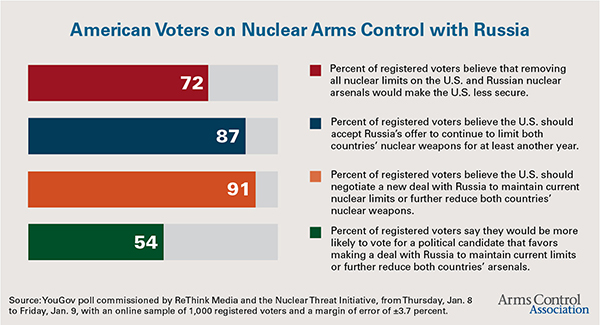
More recently, a 2026 YouGov public opinion survey showed there is broad, bipartisan support for capping and reducing the U.S. and Russian nuclear arsenals with 91 percent of registered voters “believing the U.S. should negotiate a new deal with Russia to maintain current nuclear limits or further reduce both countries’ nuclear weapons.”
There is a growing alliance of nongovernmental organizations and leaders calling for action from the U.S. president and Congress, as well as the leaders of the other nuclear armed states, to halt and reverse the arms race. In July 2025, a joint Call to Halt and Reverse the Arms Race was launched and has been endorsed by 50 organizations from several countries across the globe.
Their message calls upon “U.S. leaders to fulfill their disarmament obligations and engage immediately in good faith negotiations with Russia and other nuclear-armed states to cap and reduce their deadly nuclear arsenals, and to refrain from threats of nuclear use, which would move us closer to the peace and security of a world without nuclear weapons.”
Additionally, a joint 16-organization appeal generated over 70,000 letters to Congress, from about 16,000 advocates, urging Representatives “to publicly support U.S.-Russia negotiations to maintain New START limits and verification….”
Calls to Prevent a New Nuclear Arms Race
A wide array of nongovernmental organizations and experts are sounding the alarm about the growing dangers of nuclear weapons and the need for stronger and more effective leadership to reduce the dangers.
A Feb. 2 letter to Congress, “Support Efforts to Prevent a New Nuclear Arms Race and Renewed Nuclear Testing After New START,” signed by 50 prominent individuals and organizations, warned that “Without new nuclear restraints, Russia and the United States could increase the size of their deployed arsenals” for the first time “in more than 35 years.”
They suggest, “as a first step” that “Presidents Trump and Putin should pledge not to increase the sizes of their deployed strategic nuclear arsenals and agree to resume bilateral talks on a new framework agreement to achieve further nuclear reductions. At the same time, they should also press China (as well as France and the United Kingdom) to freeze the size of their nuclear forces and engage in bilateral or multilateral arms control and disarmament talks.”
Expert members of the U.S.-European-Russian Commission on Deeper Nuclear Cuts issued a joint appeal on February 4, warning that the expiration of New START without some form of new constraints “will reduce nuclear stability and predictability, threaten global security, and increase the risk of a new era of unconstrained nuclear competition.”
The signatories, which include former senior officials, also urgently call for the U.S. and Russia to “continue to respect the central limits of New START, which would create a more conducive environment… [to] restart bilateral talks on a new strategic stability and nuclear arms control framework at the earliest date.”
A Feb. 3 statement from The Elders, a group of independent global leaders working for peace, justice, human rights, and a sustainable planet, emphasizes that “It is in everyone’s interests to reduce nuclear risks. Any use of nuclear weapons, whether by accident or intentional, would be a catastrophic failure of leadership. The prize of a nuclear deal, on the other hand, is potentially huge.”
In July 2025, the Nobel Laureate Assembly for the Prevention of Nuclear War made the statement that “Russia and the United States [should] immediately enter into negotiations on a successor to the 2010 New Strategic Arms Reduction Treaty.” They went even further, calling for all nuclear weapon states to “engage in nuclear discussions without preconditions or preconceived notions of outcomes.”
Faith-Based Calls for Action
Faith-based communities have also been increasingly vocal about the dangers of nuclear weapons and arms racing.
In January 2025, 55 faith-based organizations and institutions emphasized that “Across many faiths—including Christian, Jewish, Muslim, Buddhist, Hindu, Sikh, Indigenous, and Humanist traditions—moral teachings converge on a shared conviction: nuclear weapons violate the dignity of life, the integrity of creation, and the foundations of peace.”
Congress, they wrote, should:
- “Publicly affirm the continued value of arms control, including limits and verification measures on U.S. and Russian nuclear arsenals;
- Encourage the Administration to begin immediate negotiations on a New START follow-on agreement that maintains or strengthens existing limits and;
- Support diplomatic engagement with Russia and other nuclear-armed states to reduce nuclear risks and build pathways toward a safer world.”
These organizations aren’t alone in their condemnation of nuclear weapons. Last year during the 80th anniversaries of the atomic bombings of Hiroshima and Nagasaki, Pope Leo stated that the bombings should serve “as a universal warning against the devastation caused ... by nuclear weapons.”
And in February, the president of the U.S. Conference of Catholic Bishops, declared: “The dangers posed by current conflicts around the world, including the devastating war in Ukraine, make the forthcoming expiration of New START simply unacceptable…I call on people of faith and all men and women of good will to ardently pray that we, as an international community, may develop the courage to pursue an authentic, transformative, and lasting peace.”
International Pressure
The appetite for renewed action on nuclear arms control and caps on nuclear weapons is high not only within the U.S. but across the globe. This responds, in large part, to the failure of the nuclear-armed states to make further progress on nuclear disarmament as required by Article VI of the Nuclear Nonproliferation Treaty (NPT), signed by 191 states.
The NPT Review Conferences (NPT RevCons), held every five years, have failed to agree on a consensus outcome document since 2010.
Last fall, at the United Nations General Assembly, a group of more than a dozen states issued a joint statement noting that: “Current high tensions underscore the need for urgent progress on nuclear disarmament, including by a return to arms control and their risk reduction, trust-building and stabilizing functions.”
They urged the United States and Russia to respect “the limits set by the Treaty until such time as a successor pact is concluded in order to secure the achievements of the New START Treaty ....”
We can expect that during this year’s 2026 NPT RevCon, many of the NPT’s non-nuclear weapon states, including U.S. allies, will continue to press Washington, Moscow, and Beijing to fulfill their NPT disarmament obligations.
What’s Next?
Even though New START expired without a follow-on agreement or even the announcement of negotiations for a follow-on agreement, the United States, Russia, and China will have opportunities to re-engage in talks on nuclear risk reduction, arms control, and disarmament.
The world has experienced periods of dangerous nuclear competition, nuclear testing, and nuclear arms racing before. But through sustained public pressure for more responsible nuclear risk reduction leadership, coupled with hard-nosed diplomacy and dialogue, we were able to move back from the brink.
It is more important than ever that the United States and Russia, owners of the largest nuclear arsenals, find a way forward and set examples for responsible and necessary nuclear arms control and disarmament. – LIBBY FLATOFF, Policy and Program Associate