


“We continue to count on the valuable contributions of the Arms Control Association.”
DOD Seeks Autonomous Warfare Command
November 2026
By Xiaodon Liang
The Pentagon plans to establish a new functional combatant command for the acquisition and integration of autonomous weapons across the U.S. military, U.S. Secretary of Defense Pete Hegseth announced Sept. 30, marking an organizational shift centralizing and prioritizing military autonomy.
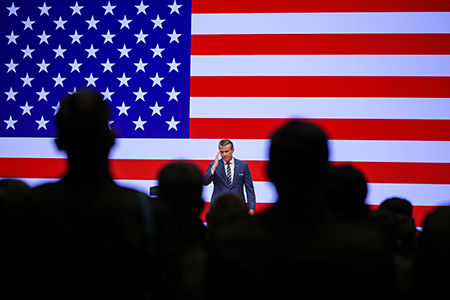
The new unified command will be called Autonomous Warfare Command and led by a four-star general officer, Hegseth said in a speech at Marine Corps Base Quantico, Virginia. The command will “institutionalize,” and “supercharge” Pentagon adoption of artificial intelligence, autonomous weapons, and robotics, Hegseth said, describing the shift as “the biggest battlefield revolution in generations.”
The new organization must first be authorized by Congress, but the Senate Armed Services Committee, in its June 15 draft of the fiscal 2027 National Defense Authorization Act, has already recommended that Congress authorize the Pentagon to set up such a command, although under a different name.
Autonomous Warfare Command will be assigned “directed manpower, budget, acquisition authorities,” Hegseth wrote in a Sept. 30 memorandum. The Senate committee language authorizing the new command would grant authority for “force generation, joint training, interoperability, doctrine development, and operational employment through other combatant commands.”
The Senate has yet to take up the annual authorization bill on the chamber floor. The House of Representatives passed its bill, which does not include language creating a new command, July 22.
U.S. Space Command, which was created in 2019, was the last combatant command created by Congress. The Pentagon currently has seven geographical commands, including Space Command, and four functional commands for transportation, cyber operations, special operations, and strategic deterrence.
Responsibility for working with Congress and within the Pentagon to set up the new command will fall on Project Agincourt, a new effort announced by Hegseth in the Sept. 30 memorandum. Agincourt will be led by Owen West, the former director of the Defense Innovation Unit and assistant secretary of defense for special operations during the first Trump administration.
West will simultaneously also lead the office of the direct reporting portfolio manager for unmanned systems, a new entity that the Pentagon created in June, implementing acquisition reforms passed by Congress in last year’s defense policy act. The portfolio manager concept is designed to grant a single office the authority to oversee multiple related acquisition projects and make trade-offs across them. (See ACT, December 2025.)
Besides setting up the Autonomous Warfare Command, Project Agincourt will also implement “a new construct called war-fighting acquisition,” Hegseth said in his speech. The approach “fuses operators with entrepreneurs in rapid adaptation cycles, while distributing decisions and dollars closer to front-line units,” he said.
West provided an insight into what that approach might look like in practice during remarks Oct. 14 at the Association of the United States Army (AUSA) annual meeting, at which he pointed to “what’s happening in Ukraine, where a small portion of … the average [brigade’s] budget, 5 to 15 percent, is … gamified in the form of points where people can purchase directly” from a drone marketplace.
West and acting Army Secretary Adam Telle, who also appeared on the panel, noted that the U.S. Army has created a similar internal marketplace for drones. Telle announced that the army component of the new unified command would be called Futures and Autonomous Systems Command. “We are going to keep it distributed to our units. We are pushing autonomy down into our units,” the acting secretary said, while indicating that the new army command would primarily focus on coordination.
Speaking on the same Oct. 14 panel, Hegseth voiced optimism that the Pentagon could convince Congress to pass a $350 billion additional defense appropriation as part of a partisan reconciliation bill, regardless of whether Republicans lose control of one or both chambers of Congress in November’s midterm elections. “We’re running fast immediately with the committees to ensure that that reconciliation bill at a minimum of [$350 billion], potentially more, ultimately fills up what this department needs,” he said.
That additional funding request includes $53.6 billion for “multi-year investment in autonomous systems procurement, domestic production capacity, and advanced capabilities,” according to budget request documents. Legislators in both parties have expressed skepticism that Congress will take up an additional reconciliation bill this year.
The Defense Autonomous Warfare Group, successor to the Biden-era Project Replicator, was to administer that investment in autonomous systems. Derek Anderson, the assistant secretary for special operations and low intensity-conflict, said on the Oct. 14 AUSA panel that the group, which focuses on low-cost attritable drones, had now been folded into a task force under Special Operations Command.