


"I find hope in the work of long-established groups such as the Arms Control Association...[and] I find hope in younger anti-nuclear activists and the movement around the world to formally ban the bomb."
Nobel Laureates Call for Slowing AI, Nuclear Arms Races
September 2026
By Mia Clarke, with additional reporting from Daryl Kimball in Rome
Motivated by the accelerating development of artificial intelligence and multiplying nuclear weapons dangers, Nobel laureates and other experts have called for an international treaty prohibiting “reckless integration” of AI in nuclear weapons operations.
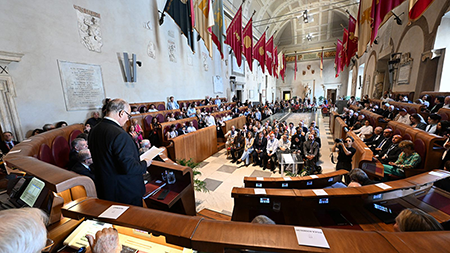
The declaration emerged from a conference July 14-16 at the Vatican. The conference followed the publication of Pope Leo XIV’s path-breaking May 15 encyclical, Magnifica Humanitas, which calls for a global effort to shape and regulate AI in ways that protect human dignity and promote just peace and urges civil society, AI builders, and governments not to leave pivotal decisions in AI policy solely to the technology elites.
In preparatory materials for the conference at the Pontifical Villas in Castel Gandolfo, the Pope’s traditional summer retreat, the organizers asserted that “In the midst of a worsening nuclear arms race, we are embarking on an equally dangerous AI race” and these “great challenges of the twenty-first century can no longer be understood or governed in isolation.”
Called the “global Nobel laureates assembly on artificial intelligence and nuclear war,” the conference brought together a diverse array of more than 200 participants, including Nobel Prize winners in peace, medicine, economics, and physics; AI experts from Anthropic, Open AI, and Google DeepMind; founders and leaders of international peace organizations; nuclear weapons researchers and experts from more than 30 institutions; and religious leaders from several faiths.
The conferees heard expert presentations on key themes including the rapid development of increasingly powerful frontier AI models, the risks posed by the integration of AI in conventional military systems as well as nuclear command and control; the moral and ethical implications of AI adoption on a societal scale; and potential pathways to nuclear conflict.
At the conclusion of the assembly July 16, the participants issued the “Rome Declaration,” which recommends measures that would: ensure the responsible development and governance of AI models so they align with “humanity’s interests, including international law and respect for human rights” and prevent “fully-automated recursive self-improvement in artificial intelligence systems without the means to monitor, and if needed, to halt such systems.”
They called for “an international treaty prohibiting the reckless integration of artificial intelligence into nuclear command, control, and launch systems so that meaningful human control is maintained.” The declaration also urged measures that would “halt renewed arms racing and the expansion of [nuclear] arsenals, resume bilateral and multilateral negotiations on arms control and disarmament” to “diminish the role of nuclear weapons, and reduce the likelihood of first use and catastrophic war.”
The gathering occurred a year after another Nobel Laureates assembly in Chicago on the prevention of nuclear war, which also included a “call on all states to engage in increased cooperative dialogue on the scientific, legal, and military implications of [AI] technologies.”
Reflecting on the importance of these assemblies, 2011 Nobel physics laureate Brian Schmidt said, “It’s a very complicated new space. I think by bringing the groups together, it has clarified the risk.”
But the organizers and participants also recognized that the assembly’s call to action requires urgent follow-up and action. At the July 16 press conference announcing the Rome Declaration, Daniel Holz, a University of Chicago astrophysicist and chair of the Bulletin of the Atomic Scientists’ Science and Security Board cautioned, that “AI is a technology we do not understand, and it’s developing faster than humans can comprehend.”
Shortly after the assembly concluded, more than 1,300 frontier AI developers and corporate leaders issued their own appeal, warning that they “could be close to automating AI research.”
Their July 29 statement, entitled “Pacing the Frontier,” said this achievement could “risk that capability development rapidly accelerates beyond our ability to understand or control the resulting systems.” They end their statement with a vague “request that the U.S. government support an international effort to develop the technical and governance tools needed to deliberately pace the frontier of automated AI development.”
Nikita Gryazin, a fellow at the European Leadership Network, wrote in a July 27 commentary about the conference’s outcome document: “The Rome Declaration is a useful starting point, but its practical value will depend on what follows. Governments and international organisations must turn its principles into rules and risk reduction mechanisms, while technology developers must make relevant systems transparent.”