


“It will take all of us working together – government officials, and diplomats, academic experts, and scientists, activists, and organizers – to come up with new and innovative approaches to strengthen transparency and predictability, reduce risk, and forge the next generation of arms control agreements.”
DOD Officials Preview U.S. Tactical Weapons Push
September 2026
By Xiaodon Liang
An ongoing review of U.S. nuclear forces will recommend additional limited options for nuclear warfighting below the strategic level, according to senior Pentagon officials.
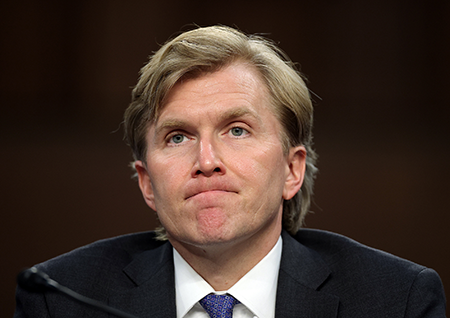
Undersecretary of Defense for Policy Elbridge Colby and the commander of Strategic Command, Adm. Richard Correll, previewed Aug. 5 the results of the review, first announced in March, to attendees of an annual conference hosted by Correll’s command near its Omaha headquarters. (See ACT, April 2026.)
The review will examine “rationally employable, limited options that advantage us and stand the chance of favorably managing escalation and not getting us into an inexorable spiral,” Colby said during a conference event.
The limited options referred to by the officials likely imply acquisition of more types of tactical nuclear weapons—weapons with a shorter range and smaller yield, and intended for tactical missions on the battlefield.
But neither official directly addressed whether the administration of President Donald Trump would increase the size of the deployed U.S. strategic nuclear force to match growth in the combined number of potential targets in Russia and China, a key policy decision deferred by the Biden administration. (See ACT, December 2024.)
Advocates for a strategic buildup argue that a larger U.S. force may be needed to deter Russia or China if the United States were to be involved in conflicts with both simultaneously or sequentially. Opponents argue it would trigger an acceleration of the arms race as Russia and China respond in kind.
An Aug. 5 story by NBC News reported that the review would de-emphasize strategic nuclear forces and traditional damage limitation requirements, which task U.S. troops with effectively preventing enemy nuclear forces from retaliating against a U.S. strategic first strike.
Colby spoke only obliquely regarding strategic forces and missions in Omaha. “We need to have a plausible plan that doesn’t [depend on] ‘Well, if we get to that point, we blow up the world,’ or … ‘We take them out, you know, problem solved,’” he said.
Although the United States has traditionally rejected Chinese requests to recognize mutual vulnerability between the two sides’ nuclear forces, Colby came close, noting that “We and China both have nuclear weapons, so nobody’s going to be in a position where they can absolutely dominate.”
He sought to contrast “credible,” “rational” tactical options that are currently lacking against strategic options that, if used, could “result in a catastrophe whose costs are way out of proportion to whatever we’re fighting about, or more plausibly cause the political leadership to say ‘No, I don’t want do that.’”
The move to downplay strategic superiority will meet skepticism in some corners of the Republican-controlled Congress. “It’s hard to imagine a study that is more out of line with President Trump’s stated position of making our nuclear deterrent great again,” an unidentified staffer told the authors of the NBC report.
Congress has already appropriated funding to open tubes on Ohio-class ballistic missile submarines and ordered the Pentagon to study and plan for uploading additional warheads to the Minuteman III intercontinental ballistic missile.
The legislature will likely greet the nuclear strategy review’s emphasis on tactical nuclear weapons with greater enthusiasm. The Senate Armed Services Committee’s draft of this year’s key policy bill recommends authorization of new air-launched and ground-launched tactical nuclear weapons. (See ACT, July/August 2026.)
These would supplement weapons already in the arsenal, such as the B61-12 gravity bomb and the W76-2 lower-yield warhead for the Trident II submarine-launched ballistic missile. The Navy is also planning to field a nuclear-capable sea-launched cruise missile by 2032, and the Air Force’s long-range standoff weapon—a new air-launched cruise missile presently entering full-scale production—and its selectable-yield warhead may also be relevant to tactical nuclear missions.
Colby and Correll confirmed that U.S. declaratory policy would remain unchanged, while providing little clue as to whether additional tactical nuclear weapons would be intended for initiating or responding to a nuclear conflict.
Both the 2018 and 2022 nuclear posture reviews declared that the United States might use nuclear weapons first in extreme circumstances in response to non-nuclear strategic attacks against itself or allies and partners.
Some U.S. analysts have called for a more explicit focus on the tactical use of nuclear weapons to blunt a potential Chinese invasion of Taiwan.
A 2022 report by Colby and a co-author recommended planning to target not only People’s Liberation Army troops, but also China’s defense industrial base with limited use of nuclear weapons.
In contrast, Correll told reporters on an Aug. 5 media call that the review contemplates “deterrence, first and foremost.”
A larger number of tactical launchers and platforms would “raise the threshold for consideration of theater nuclear employment by any potential adversary,” Correll said.
The strategy review will inform an update to the president’s nuclear weapons employment guidance. By law, the executive branch is required to provide a summary of the changes to Congress 60 days before they are implemented.