


"I find hope in the work of long-established groups such as the Arms Control Association...[and] I find hope in younger anti-nuclear activists and the movement around the world to formally ban the bomb."
Australia Clears Path to Export Uranium to India
September 2026
By Kelsey Davenport
Twelve years after Australia and India reached a nuclear cooperation agreement, the two countries finalized the necessary technical arrangements to allow Australia to begin exporting uranium to India.
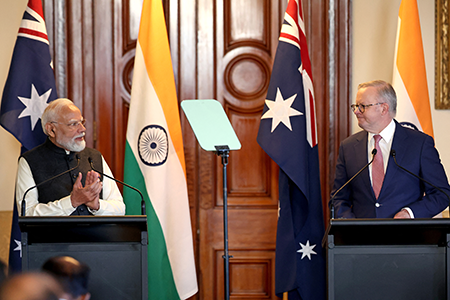
Australian Prime Minister Anthony Albanese and Indian Prime Minister Narendra Modi announced the deal during the third annual India-Australia summit in Melbourne July 9.
The agreement, which took two years to negotiate, provides a framework for implementing the 2014 nuclear cooperation agreement. According to the Australian government, it addresses long-standing conditions that any exported uranium must be used solely for India’s civil nuclear program and not for nuclear weapons by establishing tracking and accountancy procedures. Neither Australia nor India has provided details about how the accountancy arrangement will function.
In a joint press conference July 9, Albanese emphasized that Australian uranium would be used only for “peaceful purposes” in India and “help increase the share of non-fossil fuel power capacity.” Modi said the deal “will pave the way for uranium supplies from Australia to India and give our clean energy objectives fresh momentum.”
India operates 24 nuclear reactors and is building 10 more, but it relies on imports to fuel its expanding nuclear energy program. Modi initially sought a nuclear cooperation agreement with Australia to secure necessary uranium for fuel purposes. Australia is the fourth-largest producer of uranium and it leads the world in uranium reserves, at about 28 percent.
When the two countries reached a nuclear cooperation agreement in 2014, Modi described the deal as a “historic milestone” and said it would provide his country with “long-term reliable supplies of uranium.” (See ACT, October 2014.)
But after the nuclear cooperation agreement was finalized, Australia’s Joint Standing Committee on Treaties recommended that the country delay any uranium export contracts until certain conditions were met, including on safeguards and inspections, to ensure that Australian uranium did not end up in India’s nuclear weapons program.
As a member of the Treaty of Rarotonga, which established a nuclear-weapon-free zone in the South Pacific, Australia cannot sell nuclear materials to any country that does not have a safeguards agreement with the International Atomic Energy Agency (IAEA). The treaty specifically states that the recipient state must have a safeguards agreement as required by the nuclear Nonproliferation Treaty (NPT). India, which developed nuclear weapons outside of the NPT, does have an IAEA safeguards agreement, but it only applies to certain civil facilities.
When the Australian Parliament voted to lift its ban on selling uranium to India in 2011, critics of the deal argued that the facility-specific safeguards are not the same as the comprehensive safeguards agreement required by the NPT. India signed a facility-specific additional protocol with the IAEA in 2014, which helped facilitate its nuclear cooperation agreement with Australia. The additional protocol is designed to provide the IAEA with expanded access to information and sites, but India’s additional protocol omits some of the key transparency provisions included in the IAEA’s model agreement. (See ACT, March 2009.)