


"I find hope in the work of long-established groups such as the Arms Control Association...[and] I find hope in younger anti-nuclear activists and the movement around the world to formally ban the bomb."
Honoring 25 Years on the Arms Control Front Lines
September 2026
By Thomas Countryman
A couple of years ago, the Arms Control Association celebrated its 50th anniversary as one of the leading nongovernmental organizations dedicated to confronting the risk of planetary suicide by nuclear weapons. We marked last month with an equally significant milestone: Daryl G. Kimball has now led our association as executive director through 25 years of setbacks and breakthroughs, gloom and hope in the arms control field.
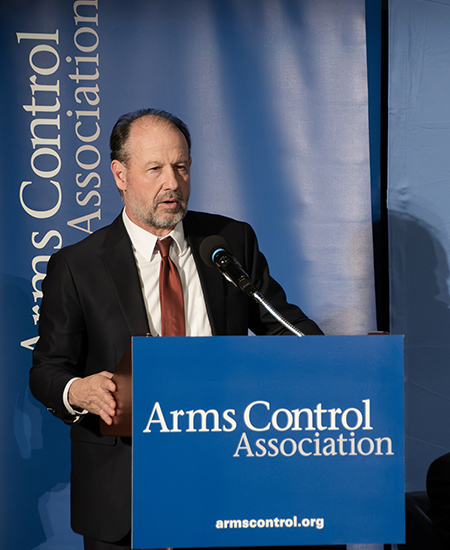
Daryl came to this work inspired partly by his family. His mother organized and campaigned tirelessly to demand a cleanup of the consequences of the government’s uranium enrichment program near their home in Ohio. His father was a noted scholar of U.S. nuclear policy.
Daryl first came to Washington in the Scoville Fellowship, the innovative program that—to this day—gives so many scholars and activists their first experience with arms control and nonproliferation issues, and from which the ACA team has drawn several of its top experts.
Daryl started not just in research, but in media and public education efforts that still inspire the association’s efforts to be not just a think tank, but a “think and do” tank. At Physicians for Social Responsibility, his leadership and partnership helped achieve a U.S. Congress resolution endorsing a nuclear testing moratorium in 1992 and engendered administration and congressional support for negotiation of the Comprehensive Test Ban Treaty (CTBT).
Following the dissolution of the Soviet Union, the 1990s were a time when many of us believed that still more significant progress could be made toward a world free of nuclear weapons. In 1997, Daryl became the executive director of the Coalition to Reduce Nuclear Dangers, which brought together 17 of the largest nongovernmental organizations to push for ratification of the CTBT and demand additional reductions in the world’s nuclear arsenals.
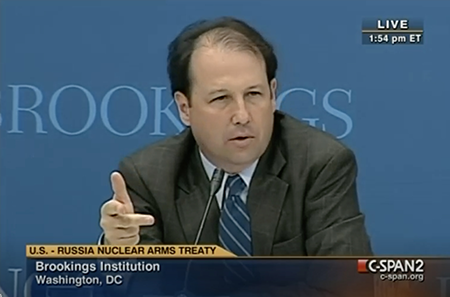 Asked by the ACA Board of Directors to become the association’s executive director in 2001, Daryl brought the same focus and drive to an organization already prominent not just for its longevity, but for its credibility and objectivity in analyzing the national security choices facing the United States and the world. The ACA has become a prime forum for senior officials in successive U.S. administrations, and even future presidents, to outline their vision of managing nuclear risk. When we had administrations whose officials were open to dialogue, ACA’s voice was not just heard, but respected, and—yes—influential. In 2011, the association received the MacArthur Award for Creative & Effective Institutions for its ability to address “pressing national and international security challenges with an impact that is disproportionate to its small size.”
All of us who have worked with or for Daryl—and the list of senior officials and creative thinkers who began their careers at ACA is long and impressive—appreciate the asset that best marks a successful leader: genuine appreciation for his coworkers and an active concern for their professional advancement. It matters no less in a small organization than in a lumbering bureaucracy, and it shines through in Daryl’s daily work.

Our challenges today are aggravating: an economic environment that puts the financial squeeze on nongovernmental organizations in national security and other spaces; an ever more crowded public marketplace of ideas, where an even-tempered voice strains to be heard; an erosion of the arms control agreements that have provided a small measure of peaceful breathing to the world; a government disinclined either to listen, or to explain, to the experts whose experience has contributed so much to decades of complex national security issues.
But we do not have the luxury of being discouraged, the time to indulge despair, nor the option to admit defeat. For a quarter-century, we have relied on Daryl Kimball’s judgment, focus, and energy to confront challenges great and small. This would be a good moment for all of our readers to express our thanks to him and honor his significant contributions.
Thomas Countryman, chairman of the board of the Arms Control Association, is a retired U.S. foreign service officer who served as acting undersecretary of state for arms control and international security, among other senior positions.