


"I find hope in the work of long-established groups such as the Arms Control Association...[and] I find hope in younger anti-nuclear activists and the movement around the world to formally ban the bomb."
Outages Rising at Zaporizhzhia Power Plant
September 2026
By Shaghayegh Chris Rostampour
Attacks and disruptions on Ukraine’s Zaporizhzhia Nuclear Power Plant are rising, heightening concerns about the facility’s ability to maintain essential safety functions.
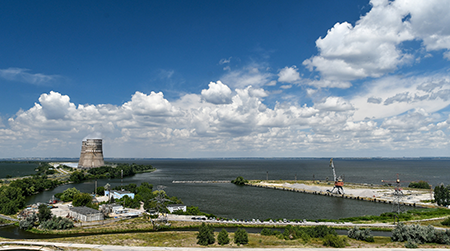
The International Atomic Energy Agency (IAEA) reported Aug. 14 that the plant experienced three losses of off-site power in the first eight days of August, requiring emergency diesel generators to power vital safety systems. This brings the total number of times the plant lost all off-site power since the beginning of the conflict to 25. Thirteen of those outages have occurred in the last four months.
The incidents come amid continuing uncertainty over the plant’s future, which has been illegally occupied by Russia since its invasion of Ukraine in 2022. The United States and Russia have proposed different arrangements for the future control and operations of the complex, but Ukraine opposes both proposals. (See ACT, May 2026.)
Meanwhile, a more immediate concern remains the deterioration of plant infrastructure, which increases the risk of meltdown and radiation release. According to the IAEA, the nuclear power complex requires reliable external electricity for reactor and spent-fuel cooling and other essential safety systems. Before Russia invaded Ukraine, the plant had access to 10 off-site power lines. It now has only one operational connection, the 330-kilovolt Ferosplavna-1 line, after damage left the 750-kilovolt Dniprovska line unavailable. When that line is disconnected, as it was on Aug. 8, the plant experiences a complete loss of off-site power and must rely on emergency diesel generators.
A drone struck a turbine May 30, causing localized damage. The IAEA described the incident as the first military activity to directly affect the plant site since April 2024. The plant subsequently suffered repeated power disruptions.
In a June 26 statement, IAEA Director-General Rafael Mariano Grossi stressed the challenging nature of making repairs during temporary ceasefires, especially as military action continued in the area.
The IAEA reported July 15 that more than two-thirds of the complex’s off-site radiation monitoring stations appeared not to be transmitting data because of power losses or damage. Attacks on local electrical infrastructure disrupted water supplies to parts of the complex and nearby Enerhodar, although groundwater wells remained available for reactor cooling.
On August 1 and 4, the plant lost off-site power, automatically activating emergency diesel generators. The IAEA has described the increasing frequency of outages as “deeply concerning” and reported that the plant raised water levels in its six spent-fuel pools as a precaution against prolonged loss of power and diesel supplies.
No radiological release or loss of reactor cooling has occurred. Although the power plant reactors are currently shut down and therefore in a cold state, continued damage to supporting infrastructure could leave the complex increasingly vulnerable to a prolonged power loss or other emergency.