


“We continue to count on the valuable contributions of the Arms Control Association.”
Preserving Normative Restraint in Outer Space
October 2026
By Wu Riqiang
Normative restraint in outer space is steadily eroding. Although great powers continue to reaffirm their commitment to the peaceful use of outer space and refrain from deploying space weapons, they have developed counterspace capabilities, and some have placed dual-use systems in orbit. The United States is now going a step further by openly embracing the weaponization of outer space and explicitly adopting an offensive counterspace posture.1 If deployed, the proposed “Golden Dome” system would further erode the longstanding space weapons taboo.

One week after U.S. President Donald Trump began his second term in 2025, he issued an executive order announcing the development of a next-generation missile defense system that includes a space-based layer, called the Golden Dome. Breaking with previous policy, the Trump administration explicitly presented the proposed Golden Dome as protection against attacks from “peer, near-peer, and rogue adversaries,”2 rather than limiting homeland missile defense to rogue-state threats.
Space-based interceptors (SBIs) have inherent anti-satellite (ASAT) capabilities. Ironically, although the Golden Dome is likely to face significant technical and economic challenges as a missile defense architecture, its SBIs could prove far more effective as ASAT weapons. Accordingly, the Golden Dome’s most consequential impact on international security may lie not in undermining strategic stability among the great powers, but in eroding the norm of restraint in outer space.
Missile Defense and ASAT Capabilities
The use of SBIs against ballistic missiles in their boost phase is constrained by fundamental physical limitations. The boost phase of a typical intercontinental ballistic missile (ICBM) lasts only three to four minutes and may not be detected until one minute after launch. This leaves interceptors little time to reach their targets, limiting the coverage of each SBI. As a result, it is estimated that approximately 1,600 interceptors would be required to ensure that at least one of them is in position to engage a single solid-propellant ICBM launched from anywhere on the earth. A peer or near-peer adversary could easily overwhelm the system with a coordinated missile salvo.
As a potential alternative, employing SBIs for midcourse interception of ballistic missiles also encounters major difficulties. The midcourse phase can last more than 20 minutes—significantly longer than the boost phase—allowing each SBI to cover a much larger area and thereby reducing the number of interceptors required. Nevertheless, after booster burnout, ICBMs are designed to deploy nuclear warheads along with decoys and other countermeasures that follow similar trajectories outside the atmosphere, making discrimination by defense systems very difficult.
Although their effectiveness in missile defense is limited, SBIs could be highly effective as kinetic ASAT weapons. Deployed in low Earth orbit at an altitude of roughly 300-400 kilometers, each interceptor would have a delta-V (signifying a change in velocity) of 4-5 kilometers per second, thus enabling significant orbital maneuvering and attacks on satellites across different orbital regimes, including geostationary orbit at an altitude of approximately 35,786 kilometers.
The use of kinetic ASAT weapons would generate large amounts of space debris, threatening the long-term sustainability of the outer space environment. If debris density exceeds a critical threshold, it may trigger a collision cascade—known as the Kessler syndrome—by which each collision generates additional fragments that, in turn, collide with other objects, producing yet more debris and potentially rendering entire orbital regions unusable.
Eroding Normative Restraint
For decades, great powers have exercised strategic restraint in outer space, helping establish a de facto taboo against space weapons. During the 1960s and early 1970s, the United States and the Soviet Union generally regarded space as a sanctuary, recognizing both the fragility of the space environment and the importance of satellite reconnaissance for strategic stability and treaty verification. Only limited ASAT capabilities were developed, largely as a hedge against a potential technical breakout.
Since the mid-1970s, concerns that Soviet satellites could enable the targeting of U.S. warships prompted Washington to develop ASAT capabilities against satellites supporting tactical military operations. The Jimmy Carter administration continued U.S. ASAT research and development while simultaneously seeking a verifiable ban on ASAT capabilities with the Soviet Union. U.S. President Ronald Reagan’s Strategic Defense Initiative further intensified debates over missile defense and the weaponization of outer space. In 1985, the United States successfully tested a kinetic ASAT missile launched from an F-15 against the U.S. Air Force Solwind (P78-1) satellite. However, Congress subsequently prohibited further destructive ASAT testing.
The 1991 Gulf War demonstrated the decisive role of space systems in supporting terrestrial military operations. After the Cold War, the United States enjoyed unrivaled military and technological superiority, and its military space activities primarily focused on enabling joint force operations rather than pursuing space control.
This relatively benign environment began to change in the early 21st century as outer space became an increasingly contested domain. Beyond the 1985 U.S. ASAT test, China, India and Russia also have conducted ground-launched kinetic ASAT tests. The 2008 U.S. test using a Standard Missile-3 interceptor validated earlier concerns that exoatmospheric missile defense systems could be adapted for anti-satellite purposes. Russia is reportedly developing a nuclear ASAT satellite. If deployed, such a system would violate the Outer Space Treaty. To mitigate the vulnerability of its space assets, the United States has sought to enhance the resilience of its space architecture by shifting away from large, expensive satellites that could become “big, fat, juicy targets” toward proliferated constellations.3
All major space powers are developing and deploying dual-use technologies that could potentially be repurposed for counterspace operations. China, for example, has developed and demonstrated satellites with robotic arms, debris-removal satellites, on-orbit refueling technologies, and a reusable spaceplane similar to the U.S. X-37B. China, Russia and the United States have also deployed inspector satellites capable of conducting rendezvous and proximity operations.
 Meanwhile, the United States shifted toward a more offensive counterspace posture as China increasingly relied on space capabilities to support terrestrial military operations. The 2014 U.S. Space Strategic Portfolio Review concluded that resilience measures alone were insufficient and called for capabilities to counter adversary space systems. U.S. military leaders subsequently spoke more openly about offensive space control and preparing for war in space, a shift sometimes described as a “counterspace awakening.”4
An increasing number of countries have begun to incorporate counterspace elements into their space strategies and conduct military exercises involving counterspace operations. For example, France has adopted an “active defense” approach, exploring concepts such as bodyguard satellites and potential on-orbit laser capabilities. Germany’s space strategy identifies restricting adversaries’ use of space as one of the purposes of space operations. The United Kingdom has designated space control as one of the three priority areas for investment in its space capabilities. In 2025, France and the UK conducted joint rendezvous and proximity exercises with the United States under the Multinational Force Operation Olympic Defender framework. It was reported that five Chinese satellites had conducted what were described as on-orbit “dogfighting” exercises in 2024.5 The Pentagon accused Russia of deploying a satellite in 2022 into nearly the same orbit as a classified U.S. reconnaissance satellite.6
Although most space powers continue to refrain from openly declaring an intention to deploy space weapons and reaffirm their commitment to the peaceful use of outer space, their actions reveal a widening gap between rhetorical commitments and actual practices.
Dropping the Pretense of Restraint
The establishment of the U.S. Space Force in 2019 marked a decisive shift in U.S. space policy as Washington openly designated space as a war-fighting domain and explicitly embraced an offensive counterspace doctrine. The Space Force leadership has emphasized that space is a war-fighting domain alongside land, sea, air, and cyberspace and that its personnel—known as guardians—are war-fighters in space rather than merely supporting forces. The new military service’s primary mission is to achieve space superiority, which entails not only defending U.S. space capabilities but also denying adversaries access to and use of space.
The U.S. military has also sought to normalize the deployment of weapons in space. Chief of Space Operations Gen. Chance Saltzman has called for investment in “six categories of counter-space weapons,” including three types of capabilities—jamming, directed-energy, and kinetic capabilities—in both space-based and ground-based configurations.7 Gen. Stephen Whiting, commander of U.S. Space Command, was equally explicit: “It’s time that we can clearly say that we need space fires and we need weapon systems. We need orbital interceptors. And what do we call these? We call these weapons.”8
In September 2026, U.S. Air Force Secretary Troy Meink publicly acknowledged that the United States has deployed “space control weapons” in orbit, without specifying their type, making the United States the first country to publicly confirm having weapons deployed in orbit.9 Meink’s disclosure represented a symbolic breach of the space weapons taboo. If deployed as planned, Golden Dome’s space-based interceptors would represent a more consequential erosion of that taboo, as the United States would openly field a specifically identified class of space-based weapons.
The U.S. military has further sought to legitimize space war-fighting. The Space Force’s theory of success—competitive endurance—advocates “responsible counterspace campaigning,” and stresses that efforts to achieve space superiority must not compromise the long-term sustainability of outer space. John Shaw, the first commander of the U.S. Space Force’s Space Operations Command, argued that achieving space superiority would require a paradigm shift from traditional positional space operations to space maneuver warfare, which in turn would require new designs for future military space platforms as well as new logistics architectures.10
Some may argue that space is already weaponized; that the space weapons taboo never existed or was already broken; that opposing space weapons while pursuing dual-use capabilities is inherently hypocritical; and that the U.S. doctrinal shift merely acknowledges this reality. There is some validity to the charge of hypocrisy, as aligning words with actions is certainly preferable. Yet even rhetorical commitments to a norm matter: They create expectations, generate reputational costs, constrain state behavior, and can help sustain the norm over time. By contrast, dropping the pretense of restraint may appear honest, but it would fundamentally erode the norm itself.
Contested Domain, Contested Norms
The traditional restraint governing outer space is eroding but not yet dead, as competing normative visions seek to shape the future rules governing the use of space. These visions can be situated along a spectrum ranging from restraint to war-fighting, as illustrated in the table below.
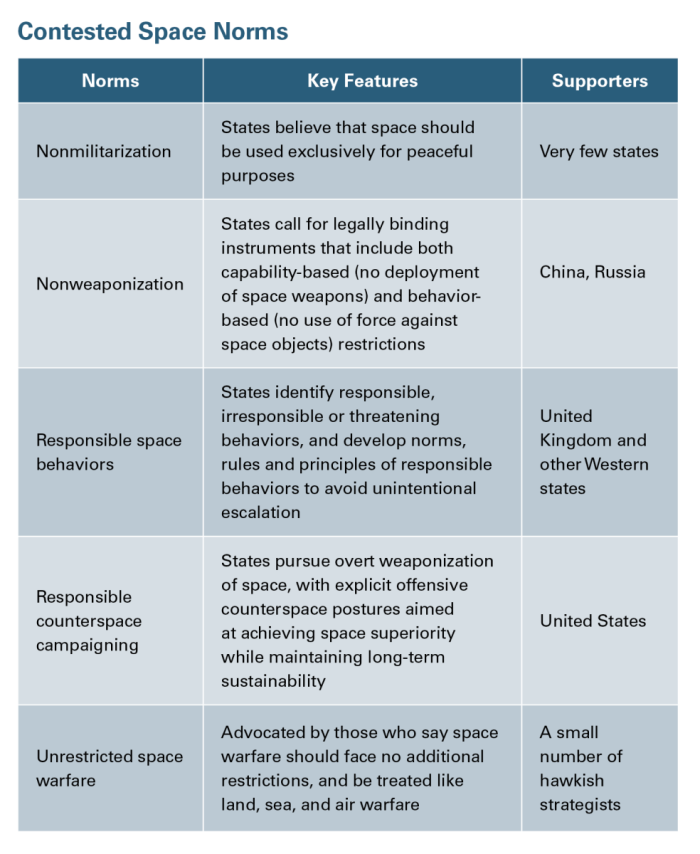
At one end, nonmilitarization reflects the most restrictive normative vision, asserting that outer space should be used exclusively for peaceful purposes and rejecting the legitimacy of all military activities, including support functions such as communications, positioning, and reconnaissance. Only a small number of states endorse this view.
Moving along the spectrum, China and Russia advocate nonweaponization, which accepts the legitimacy of military support activities in space while opposing the deployment of space weapons and the use of force against space objects through legally binding instruments. Western states oppose this approach, arguing that the proposed treaty is unverifiable and fails to ban ground-based ASAT weapons, while accusing China and Russia of hypocrisy for developing and deploying dual-use technologies in space.
Further toward the war-fighting end lies the framework of responsible space behaviors, promoted by the UK and other Western states. It aims to identify and characterize responsible, irresponsible, or threatening behaviors in outer space and to develop norms, rules, and principles of responsible space behaviors to avoid miscalculation and reduce the risks of unintentional escalation. Critics argue, however, that this approach cannot restrain space weaponization, just make space warfare safer.11 They also contend that, by promoting a highly politicized dichotomy between “responsible” and “irresponsible” behaviors, this approach serves to preserve U.S. advantages in potential space weaponry.12
Officially, Washington supports responsible space behaviors. In practice, however, it has moved further along the war-fighting end of the spectrum by endorsing the norm of responsible counterspace campaigning. This approach accepts overt weaponization and explicit offensive counterspace postures to achieve space superiority while claiming to preserve long-term sustainability.
At the far end of the spectrum, a small number of hawkish strategists advocate unrestricted space warfare, calling for loosening policy restrictions over the fielding of weapons in space and normalizing counterspace operations “like warfighting operations in all other domains performed by the Air Force, Army, Navy, and Marine Corps.” At the same time, they warn that responsible counterspace campaigning “may undermine a warfighting mentality and the core of the Guardian identity.”13 No state has openly embraced such an unrestricted vision of space warfare as official policy.
The prospects for the current contest over space norms appear bleak. Given the unparalleled U.S. influence in space, the emerging normative order may tilt toward accepting space as a war-fighting domain rather than preserving traditional restraint. Whether this trajectory can be reversed will depend on whether the remaining taboo against space weapons can be preserved.
Preserve the Taboo
The continuing erosion of normative restraint could have a profound impact on the future of outer space. The fragile nature of the space environment makes the consequences of a great-power conflict in space potentially catastrophic. More fundamentally, disruption is far easier than dominance in space—and once achieved, hard to reverse.14 The U.S. concept of “responsible counterspace campaigning” seeks to win a space war without triggering large-scale, destructive ASAT exchanges. In practice, however, a state that loses access to space is unlikely to prioritize the sustainability of the space environment; once a conflict in space begins, escalation to kinetic attacks may be difficult to prevent.

Moreover, crossing the threshold of deploying dedicated weapons in space could encourage other states to pursue similar capabilities, fueling a new cycle of space arms racing. If Washington’s international lawyers build the legal case for deploying Golden Dome’s space-based interceptors, this could pave the way for other states to pursue similar systems, potentially leading to multiple rival constellations of SBIs that possess inherent ASAT capabilities. This could create incentives for preemptive attacks against adversary space assets during a crisis or conflict.
The priority now should be to preserve the taboo against space weapons, halt the ongoing erosion of space restraint, prevent the normalization of space war-fighting, and, if possible, reverse this trend altogether.
As a first step, states that support space arms control, together with civil society, need to speak out and draw clear red lines. In ongoing debates on space norms, the deployment of any dedicated weapons in outer space should be explicitly framed as irresponsible, regardless of whether such systems are labeled as missile defense interceptors, space weapons, or weapons in space. Given its vulnerability, space should not be treated as a war-fighting domain and certainly should not be transformed into a battlefield. Offensive counterspace activities and doctrines should be considered inherently unacceptable.
Second, all states should commit not to conduct kinetic ASAT operations, regardless of whether they are carried out using dedicated ASAT weapons, dual-use space systems, or missile defense interceptors. More than 30 states have committed unilaterally not to conduct destructive ASAT tests. These commitments, while welcome, impose no substantive constraints on the development of counterspace capabilities or their operational use. Extending this logic from nontesting to non-use would therefore represent a natural next step. Although such voluntary non-use commitments are not legally binding and can be withdrawn at any time, they can nevertheless raise the bar for destructive ASAT operations and, in doing so, help reinforce the taboo against space weapons and strengthen broader norms of restraint in outer space.
Traditionally, China and Russia have opposed restrictions on particular categories of ASAT weapons, arguing that selectively banning certain capabilities would disproportionately favor the United States, given its comparative advantage in other forms of ASAT capability. Instead, they have advocated a comprehensive ban on all ASAT weapons. These concerns are well-founded. Yet the uniquely destructive consequences of debris-generating ASAT weapons suggest that they are better understood as weapons of last resort than as practical war-fighting capabilities. Beijing and Moscow could therefore view a commitment to forgo such weapons not merely as a practical restraint, but also as a means of reinforcing normative restraint in outer space and, over the longer term, supporting the broader goal of nonweaponization.
For the United States, such a commitment would come at relatively little cost. Although Golden Dome’s SBIs possess inherent ASAT capabilities, they are unlikely to become the U.S. military’s preferred counterspace option. As a result, pledging not to employ SBIs for anti-satellite operations would impose minimal operational constraints while generating significant symbolic and normative benefits.
Finally, all major space powers should engage in sustained dialogue on space security and strategic stability across Track 1, Track 1.5, and Track 2 channels. Current discussions on space security have largely focused on the impact of space operations on the risk of nuclear escalation—so-called space in strategic stability. Although this perspective is undoubtedly important, it also risks implying that space warfare is acceptable so long as it does not trigger nuclear escalation. Instead, greater attention should be devoted to the “strategic stability in space” framework aimed at preventing war in outer space.
The world is approaching a point of no return. The long-standing taboo against space weapons is on the brink of collapse, and an arms race in outer space is looming. Space has become an indispensable infrastructure for human society and economic development. Its continued viability hinges on preventing weaponization, which would otherwise transform space into a battlefield and jeopardize humanity’s access to and use of it.
ENDNOTES
1. Sandra Erwin, “Space Command identifies capabilities it needs for the next space war,” Space News, August 12, 2026.
2. Donald J. Trump, “Executive Order 14186: The Iron Dome for America,” January 27, 2025.
3. Sandra Erwin, “STRATCOM chief Hyten: ‘I will not support buying big satellites that make juicy targets,’” Space News, November 19, 2017.
4. Maximilian Betmann, “A counterspace awakening?” The Space Review, May 22, 2017.
5. Mikayla Easley, “China practicing on-orbit ‘dogfighting’ tactics with space assets, Gen. Guetlein says,” Defense Scoop, March 18, 2025.
6. Brett Tingley, “Pentagon space chief condemns ‘irresponsible’ launch of Russian inspector satellite,” Space.com, August 18, 2022.
7. Theresa Hitchens, “Saltzman: Space Force in ‘pretty good spot’ regarding DoD funding shift,” Breaking Defense, March 20, 2025.
8. Audrey Decker, “The US needs ‘weapons in space,’ SPACECOM head says,” Defense One, April 8, 2025.
9. Courtney Albon, “Meink Reveals Space Force Has ‘On-Orbit Space Control Weapons,’” Air & Space Forces, September 14, 2026.
10. John Shaw, “The Age of Space Maneuver Warfare Is Imminent,” Forbes, April 6, 2026.
11. Jessica West, “Arms Control and the Myth of Peaceful Uses in Outer Space,” in Saadia M. Pekkanen and P. J. Blount, eds., The Oxford Handbook of Space Security (Oxford University Press, 2024), pp. 223-247.
12. Zhou Bo and Wang Guoyu, “The Future of Cooperation in Space: Irreconcilable Differences?” in Saadia M. Pekkanen and P. J. Blount, eds., The Oxford Handbook of Space Security (Oxford University Press, 2024), pp. 839–852.
13. Charles S. Galbreath and Jennifer K. Reeves, “Ensuring a Spacepower Advantage in Prolonged Competition: Findings and Recommendations from the Space Endurance Workshop,” Mitchell Institute for Aerospace Studies, 2025, p. 2.
14. Clayton Swope, “Can Space Be Disrupted Like the Strait of Hormuz?” Center for Strategic and International Studies, May 1, 2026.
Wu Riqiang, a professor of international relations at Tsinghua University in China and former People’s Republic of China missile engineer, has held visiting fellowships at Harvard University, Dartmouth College, Stanford University, and Massachusetts Institute of Technology. His research is supported by the National Social Science Fund of China.