


“We continue to count on the valuable contributions of the Arms Control Association.”
Emerging Technologies and the NPT: Assessing AI in the 2026 Review Cycle
October 2026
By Julia Elizabeth Rodríguez Acosta
By the time states-parties to the nuclear Nonproliferation Treaty gathered in New York for the 2026 NPT Review Conference in April and May, artificial intelligence and other emerging technologies had become increasingly prominent in discussions about the future of the nuclear order. States raised concerns about AI in the areas of nuclear command, control, and communications (NC3); nuclear decision-making; strategic stability; and human control, as well as possible applications in risk reduction, verification, safeguards, and peaceful uses.1
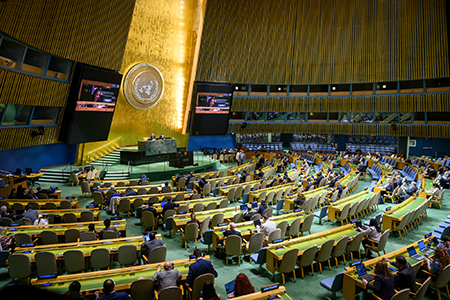
Yet the draft final document that came closest to consensus did not explicitly address the nexus between AI and nuclear weapons.2 This contrasted with the growing attention devoted to AI throughout the eleventh review cycle, which covered 2022 to 2026, that led up to the conference. This progression in the debate illustrates a broader challenge: Technologies such as AI, cyber capabilities, quantum technologies, autonomous systems, and developments in the space domain increasingly intersect with the NPT’s three pillars of nonproliferation, disarmament, and peaceful use of nuclear energy. Yet, states-parties do not necessarily agree on their risks and opportunities, the concepts that should guide their governance, or the extent to which the NPT should address them.
This article traces the treatment of AI and other emerging technologies from the 2022 review conference through the three preparatory committee processes and the 2026 review conference. It examines how AI entered the NPT debate, why growing attention did not translate into explicit AI language in the final 2026 draft document, and the options and necessity for creating a more structured discussion of technological change within future review cycles.
The Road to a More Structured Debate
At the 2022 NPT Review Conference, AI was not yet a prominent issue, although some states and working papers produced for the conference began drawing attention to AI, machine learning, and other technological developments in connection with nuclear risks.3 These references were limited but they anticipated a discussion that became progressively more visible in 2024.
At the first NPT preparatory committee meeting in Vienna in 2023, Bangladesh and Kazakhstan explicitly raised AI and emerging technologies as topics of interest. Working papers also addressed technological change through nuclear risk and strategic stability, while France, the United Kingdom, and the United States emphasized maintaining human control and involvement in decisions concerning the employment of nuclear weapons. The conference chair’s reflection referred to the potential impact of emerging and disruptive technologies on the risk of nuclear weapon use.4 Emerging technologies had entered the NPT conversation, but not yet as a prominent or structured area of discussion.
A clearer shift occurred at the second preparatory committee in Geneva in 2024. States from different regions, groups of states, and observers raised the issues of AI, cyberspace, space technologies, and other technological developments. The predominant framing remained one of risk, particularly the potential consequences of integrating AI into the nuclear domain and NC3 systems. The New Agenda Coalition (involving Brazil, Egypt, Ireland, Mexico, New Zealand, and South Africa) identified developments in AI, cyberspace, and outer space among the factors that could increase nuclear risk, while the chair encouraged consideration of developments in science and technology and later reflected calls to mitigate risks associated with AI and offensive cyber capabilities.5 Discussions also began to connect technological change with peaceful nuclear applications, suggesting a broader risk and opportunity debate.
By the third preparatory committee meeting in New York in 2025, the discussion had become substantially more developed. The Non-Aligned Movement (NAM), the African Group, states-parties to the Treaty on the Prohibition of Nuclear Weapons (TPNW), and individual states addressed AI integration into nuclear weapons, NC3, and the importance of human control. The debate also expanded beyond AI, as the Organisation for the Prohibition of Chemical Weapons highlighted dual-use technologies including AI, synthetic biology, and three-dimensional printing.6
At the same time, states increasingly considered the possible benefits of emerging technologies for risk reduction, arms control, verification, and the peaceful uses of nuclear energy. A Stockholm Initiative working paper offered one of the most comprehensive treatments of this dual character of positive and negative aspects and recommended further NPT dialogue on the issue.7 Negotiations over preparatory committee recommendations nevertheless revealed differences over terminology, including formulations such as “meaningful human control” and whether AI should be framed primarily as a source of risk or also as an opportunity. The chair’s final working paper recognized risks as well as opportunities and reaffirmed the importance of human control but did not mention AI by name.8 By the end of the preparatory process, the question was no longer whether emerging technologies were relevant to the NPT, but how they should be characterized and addressed.
A Broader Multilateral Debate
The NPT discussion did not evolve in isolation. Elsewhere in the UN disarmament machinery, AI and nuclear weapons were receiving increasingly specific attention. In 2024, the UN Disarmament Commission began a three-year cycle with a working group mandated to consider common understandings related to emerging technologies in international security. Its discussions addressed a broad range of technological developments, whereas a secretary-general report, which was considered by the commission, examined AI and its potential implications for nuclear command and control and early-warning systems. The 2025 chair’s summary of the working group also reflected discussions on human control, AI, autonomy, and machine learning. In 2026, however, the commission was unable to achieve consensus on its agenda, thus preventing the working group from completing its work or producing agreed recommendations.9
The UN General Assembly also expanded its consideration of AI in the military domain. Resolution 79/239 led to a secretary-general report compiling member state and stakeholder views, several of which addressed human control and AI in nuclear command and control.10 The 2025 political declaration of the TPNW’s third meeting of states-parties likewise raised concerns about AI in nuclear decision-making and emphasized maintaining human control.11 This language was particularly relevant to the NPT because all TPNW states-parties are also NPT states-parties, and similar positions would subsequently be advanced at the 2026 NPT Review Conference.
Most directly, General Assembly Resolution 80/23 focused on the possible risks of integrating AI into NC3. It identified limitations that could contribute to accidental, unintended, or unauthorized nuclear weapon use; emphasized human control and oversight; and encouraged consideration of the issue across relevant disarmament machinery, treaties, and regional and multilateral forums.12 The 2026 review conference therefore began against a backdrop of intensified and specific multilateral discussion about AI, nuclear risk, and human decision-making.
AI at the 2026 NPT Review Conference
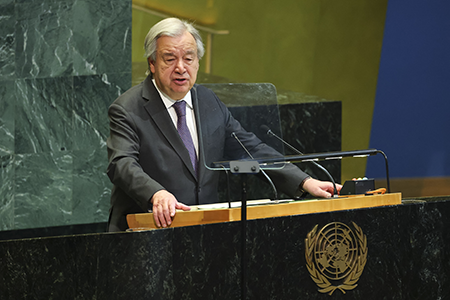
At the 2026 review conference, emerging technologies were considerably more prominent than earlier in the cycle. UN Secretary-General António Guterres warned at the opening of the meeting that nuclear threats were being compounded by rapidly evolving technologies, including AI and quantum computing.13 In the general debate, some 26 national delegations referred in their official statements to emerging technologies and AI. Major groups, including NAM, the Association of Southeast Asian Nations, the African Group, the Group of Arab States, and TPNW states-parties also raised these issues. Most interventions emphasized nuclear risk, NC3, and human control; references to potential benefits were less frequent.
The discussion was even more pronounced in Main Committee I. Of more than 70 national and group statements delivered during the general exchange of views, approximately 30 referred to emerging technologies, AI, nuclear command and control, or human control. Some delegations also highlighted possible applications for risk reduction and disarmament verification. Emerging technologies appeared in Main Committees II and III as well, particularly in relation to safeguards and peaceful nuclear applications.14
The evolution of the negotiated text, however, demonstrates the continuing difficulty of converting this attention into agreed language. The opening draft established that human control should be maintained at all times pending the elimination of nuclear weapons and called for further discussion of emerging technologies and potential risks, including interference with NC3 systems. The first revision went further and explicitly referred to AI, but that reference did not survive. Subsequent revisions progressively narrowed the treatment of emerging technologies, and the final revision retained a reference to emerging technologies, but no longer explicitly referred to AI or the preservation of human control over nuclear weapons.15
This omission cannot be attributed to a lack of attention during the conference. AI was raised by numerous states and major groups, and several delegations expressed concern, including in closed consultations, that the issue was not adequately reflected in successive drafts. Conversations with delegates during the conference similarly revealed disappointment over the removal of the explicit AI reference. These exchanges suggest that the principal obstacle was political: Although there was growing interest in addressing AI and emerging technologies, some states-parties remained reluctant to address these issues explicitly within the NPT framework. Differences also persisted over terminology, the balance between risks and opportunities, and formulations concerning human control.
The narrowing of the text therefore illustrates a broader NPT challenge: Growing interest in the AI issue—and a growing sense of urgency about its implications for the nuclear order—does not necessarily produce agreement on how it should be characterized, much less dealt with, in a consensus outcome.
Adapting the NPT to Technological Change
The eleventh review cycle demonstrates that emerging technologies have become part of the NPT debate. The challenge for the next review cycle is to move beyond recurring references toward a more structured approach that can help states-parties develop common understandings and where possible, translate them into concrete recommendation and action. One option would be to establish a dedicated working group on emerging technologies. Such a mechanism could provide space to develop common understandings without requiring immediate agreement on negotiated recommendations. Under current geopolitical tensions, establishing a new group may be difficult. A more achievable approach might therefore be to integrate structured discussions into existing NPT preparatory committee and review conference processes. Dedicated sessions or focused exchanges could examine developments across three pillars, drawing on expertise from international organizations, scientific advisory bodies, academia, and other relevant stakeholders.
This broader approach matters because emerging technologies present both risks and opportunities. AI may affect nuclear decision-making and strategic stability, but emerging technologies may also contribute to solutions advancing such challenges as verification, safeguards, transparency, risk reduction, and peaceful nuclear applications. Sustained dialogue is necessary to understand these dimensions and their implications for the NPT. AI does not operate independently of cyber capabilities, quantum technologies, autonomous systems, and space and aerospace technologies. A technologically informed NPT discussion should consider the relationship among these interactions rather than treating each technology in isolation.
Any structured discussion should also be inclusive. Interest in emerging technologies is not limited to nuclear-weapon states or technologically advanced countries; groups representing developing and non-nuclear-weapon states contributed substantively throughout the cycle. Yet increasingly technical discussions require expertise and institutional capacity. Future NPT processes should therefore encourage broad regional representation, access to scientific and technical expertise, and capacity-building that enables all states-parties to participate effectively.
States-parties do not need to resolve every conceptual disagreement before beginning such a dialogue. A structured process could clarify differences over terminology, human control, and the balance between risks and benefits while identifying areas of possible convergence. The technological environment surrounding nuclear disarmament, nonproliferation, and peaceful uses of nuclear energy will continue to change. Ensuring that the NPT remains responsive will require creating sufficient space not to only understand technological developments, but also, where possible, to translate emerging areas of common understandings into recommendations and action before their implications for the nuclear order become more difficult to address.
ENDNOTES
1. Author’s analysis of national and group statements, working papers, and committee records of the 2026 NPT Review Conference.
2. 2026 NPT Review Conference, draft final document, NPT/CONF.2026/CRP.2/Rev.4, May 2026.
3. 2020 NPT Review Conference, NPT/CONF.2020/SR.1; NPT/CONF.2020/WP.6; NPT/CONF.2020/WP.9/Rev.1.
4. 2026 NPT Review Conference Preparatory Committee, NPT/CONF.2026/PC.I/SR.3; SR.4; WP.24; WP.30; WP.38 (2023); see also NPT/CONF.2020/WP.70.
5. 2026 NPT Review Conference Preparatory Committee, NPT/CONF.2026/PC.II/SR.1-SR.6; New Agenda Coalition, NPT/CONF.2026/PC.II/WP.2; Chair’s summary, NPT/CONF.2026/PC.II/WP.44 (2024).
6. 2026 NPT Review Conference Preparatory Committee, NPT/CONF.2026/PC.III/SR.1-SR.7 (2025); Julia Elizabeth Rodríguez Acosta, “Impacto de las tecnologías emergentes en las armas nucleares: una aproximación desde América Latina y el Caribe,” in A 80 años de la era nuclear, ¿dónde estamos y a dónde vamos? (AMEI, 2025), p. 291.
7. Stockholm Initiative for Nuclear Disarmament, NPT/CONF.2026/PC.III/WP.35 (2025).
8. 2026 NPT Review Conference Preparatory Committee, NPT/CONF.2026/PC.III/SR.17-SR.18; Chair’s working paper, NPT/CONF.2026/PC.III/WP.45 (2025).
9. UN Disarmament Commission, Reports for 2024 to 2026; Chair of Working Group II, “Chair’s Summary,” April 23, 2025; UN Secretary-General, A/79/224.
10. UN General Assembly Resolution 79/239 (2024); UN Secretary-General, A/80/78 (2025).
11. Third Meeting of States Parties to the Treaty on the Prohibition of Nuclear Weapons, “Political Declaration,” 2025.
12. UN General Assembly Resolution 80/23, “Possible risks of the integration of artificial intelligence into command, control and communications systems of nuclear weapons,” 2025.
13. António Guterres, remarks at the opening of the 2026 NPT Review Conference, New York, April 2026.
14. Author’s analysis of 2026 NPT Review Conference summary records, NPT/CONF.2026/SR.1-SR.7; MC.I/SR.1-SR.7; MC.II/SR.1-SR.4; MC.III/SR.1-SR.4.
15. 2026 NPT Review Conference draft final document and revisions, NPT/CONF.2026/CRP.2 through NPT/CONF.2026/CRP.2/Rev.4, May 2026.
Julia Elizabeth Rodríguez Acosta is a minister-counsellor at El Salvador’s UN mission in New York, where she works on disarmament, international security, cybersecurity, and emerging technologies. She chaired Working Group II of the UN Disarmament Commission in 2024 and 2025. This article reflects the author’s personal views.