


“For 50 years, the Arms Control Association has educated citizens around the world to help create broad support for U.S.-led arms control and nonproliferation achievements.”
U.S. Energy Department Deregulation Prompts Pushback
November 2026
By Xiaodon Liang
The U.S. Department of Energy amended dozens of regulations as part of its drive to accelerate programs across the department, including within the nuclear weapons enterprise, while repealing several directives on environment, workplace safety, and health considerations.
“By removing unnecessary barriers, we are giving our scientists, engineers, and technicians, more freedom to focus on the critical missions that matter most,” Energy Secretary Chris Wright said in an Aug. 13 press release announcing the changes.
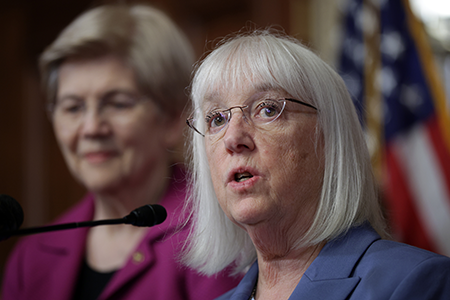
The mass changes to 46 directives and the elimination of four, which took effect Aug. 5, triggered pushback from Sen. Patty Murray (D-Ore.) and Rep. Marcy Kaptur (D-Ohio), the ranking members of the two congressional appropriations subcommittees responsible for funding the Energy Department.
“The department cannot execute such sweeping systemic changes across multibillion-dollar facilities without providing the empirical baselines, safety analyses, and governance frameworks that justify them,” they wrote in a Sept. 16 letter to Wright.
The letter requested the department to provide a detailed, 20-point breakdown of the regulatory overhaul, including an explanation for which requirements had been merged or eliminated, within 30 days.
A staffer in the office of Rep. Kaptur told Arms Control Today Oct. 30 that the department had not yet provided a response.
The regulatory changes come shortly after the Defense Nuclear Facilities Safety Board, an independent organization created by Congress in 1988 to oversee health and safety at defense nuclear weapons facilities, reported deliberate moves by Energy Department officials to impede the board’s mission. (See ACT, December 2025.)
The dispute over the trade-off between speed and safety at defense nuclear facilities has become increasingly important as the National Nuclear Security Administration (NNSA) proceeds with major construction and warhead production efforts, including a plan to reconstitute a plutonium pit production capability at Los Alamos, New Mexico, and Savannah River, South Carolina. (See ACT, April 2026.)
Board member Patricia Lee wrote in July that since the beginning of the year, safety board staff have “experienced increasing access challenges, the most significant in its history, including verbal and written denials from DOE and a lack of responsiveness to access requested.” Lee issued the warning as part of a congressionally mandated twice-yearly report on board requests for access. As a result, the board “has been unable to conduct some safety reviews” and has “not been provided access to large numbers of draft DOE safety directives and regulations that are currently being revised,” Lee wrote.
Lee is currently the board’s only Senate-confirmed member. President Joe Biden nominated William White to serve on the board in May 2024, but the Senate did not vote on his appointment during that Congress. The Trump administration has made no additional nominations.
In March, department officials instructed staff to escalate to their superiors access requests by the board that are perceived to be “activities or requests outside those authorized by its statute” and to recognize, assert, and protect “the Executive privileges of the President and the Secretary” in interactions with the board.
The instructions were issued in a March 10 memorandum, co-authored by James McConnell, the NNSA’s associate principal deputy administrator for operations, and Greg Sosson, the associate principal deputy assistant secretary for field operations at the Energy Department’s Office of Environmental Management, that listed what the department considered to be inside and outside the safety board’s purview.
The March 10 instructions risks “impairing the [safety board’s] ability to carry out its independent safety oversight mission,” Lee responded in an April 29 letter, posted on the board’s website, that highlighted points of disagreement with the memorandum.
A bipartisan oversight committee of the New Mexico state legislature highlighted similar concerns in two Sept. 16 letters. Writing for the Radioactive and Hazardous Materials Committee, chair Jeff Steinborn accused the Energy Department of making regulatory changes without “sufficient transparency or critical review” and voiced “escalating concern regarding the collapse in communication and cooperation” between the department and the safety board.
The NNSA greenlit Oct. 15 construction of the main processing building of the future Savannah River Plutonium Processing Facility, where the agency intends to produce at least 50 plutonium pits per year. (See ACT, June 2026.)
The decision included approval of a performance baseline for the project, but the agency did not release a new estimate of the building’s cost. In its fiscal year 2027 budget request, the NNSA assigned a “placeholder” estimate of $23.5 billion for the main processing building, which should be complete by 2035.